Punjab Police hits Day 497 of Yudh Nashian Virudh, arrests top 73,302
Synopsis
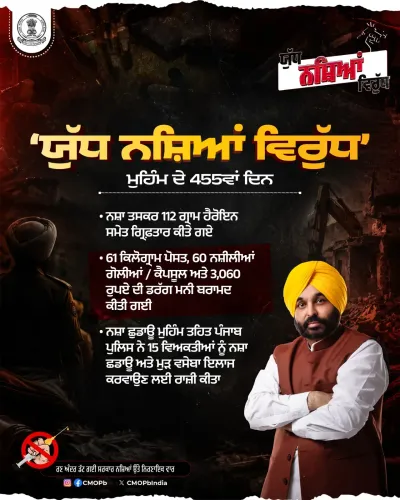
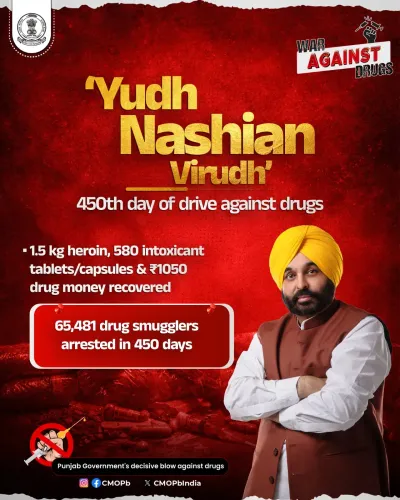
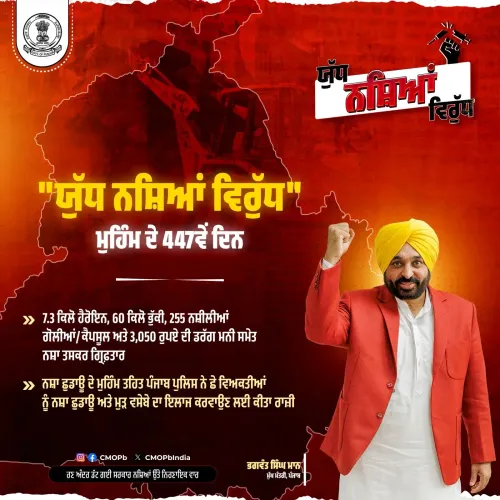
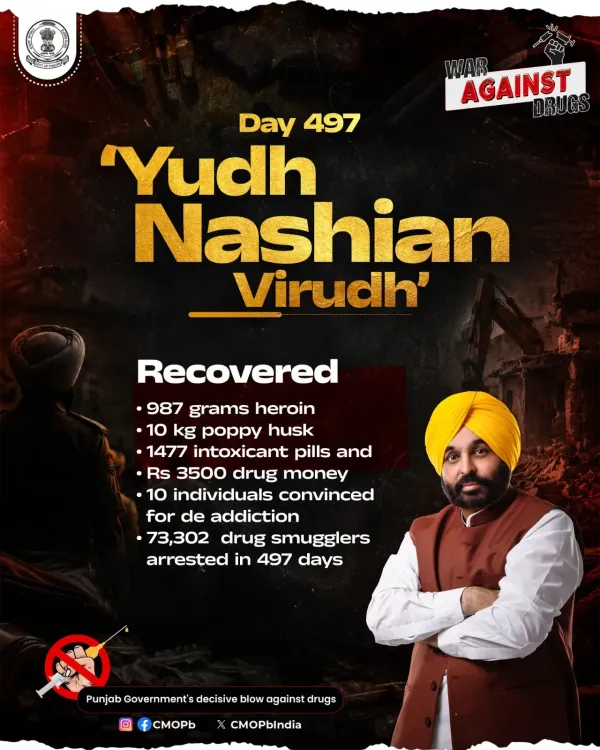
Punjab's 'Yudh Nashian Virudh' anti-narcotics campaign reached Day 497 on 12 July 2026, with cumulative arrests hitting 73,302. The latest enforcement round recovered 987g of heroin, 10 kg of poppy husk and 1,477 intoxicant pills. Police also convinced 10 persons to enter de-addiction treatment.
Key Takeaways
The Yudh Nashian Virudh drive completed its 497th consecutive day on 12 July 2026 .
Cumulative drug smuggler arrests under the campaign have reached 73,302 .
The latest seizures include 987 grams of heroin , 10 kg of poppy husk , and 1,477 intoxicant pills .
Rs 3,500 in drug money was recovered from arrested individuals.
10 persons were convinced to voluntarily undergo de-addiction and rehabilitation treatment in the latest round.
The campaign runs parallel enforcement and rehabilitation tracks under Chief Minister Bhagwant Mann's government.
The Chief Minister's Office of Punjab announced on Sunday, 12 July 2026 that the state police's anti-narcotics drive 'Yudh Nashian Virudh' has entered its 497th consecutive day, with cumulative arrests of drug smugglers now reaching 73,302 since the campaign began.
What the latest round-up recovered
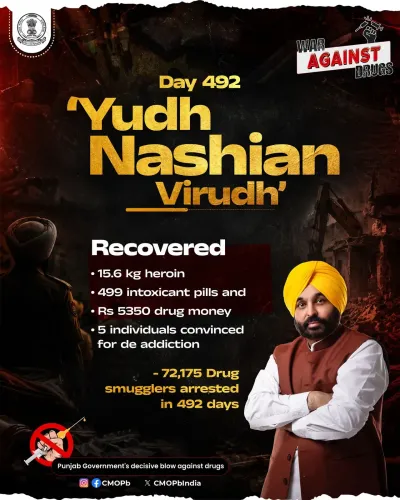
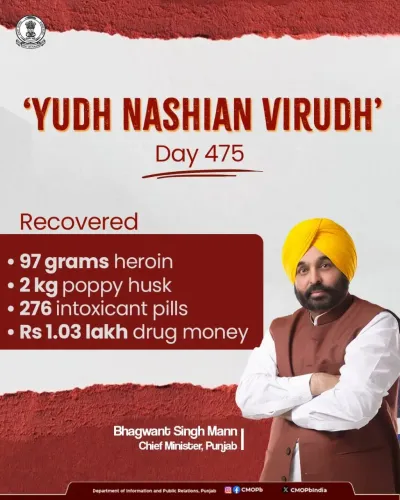
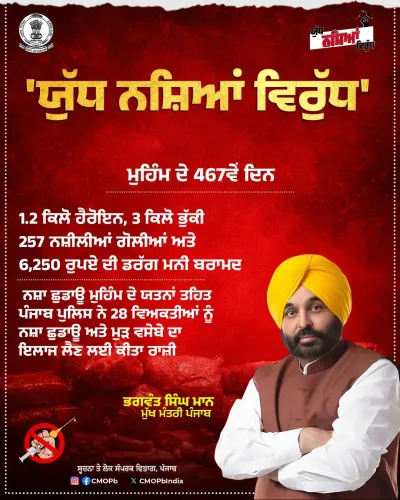
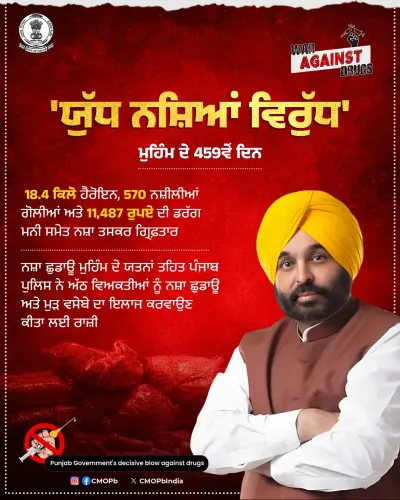
In the most recent enforcement push, police teams seized 987 grams of heroin, 10 kg of poppy husk, and 1,477 intoxicant pills, along with Rs 3,500 in drug money recovered from arrested smugglers. The CMO's post stated that these recoveries were made directly from the possession of individuals taken into custody during the day's operations.
The seizure profile — combining heroin, poppy derivatives and synthetic pills — reflects the layered nature of Punjab's drug supply chain, which draws on both cross-border trafficking and locally circulating pharmaceutical narcotics.
Context: A campaign built on daily accountability
Yudh Nashian Virudh (War Against Drugs) was launched by the Aam Aadmi Party government under Chief Minister Bhagwant Mann after the party's 2022 election victory, with drug eradication positioned as a signature governance commitment. The daily public reporting of arrest and seizure figures is itself a deliberate transparency mechanism, designed to sustain political and public pressure on enforcement agencies.
Punjab's geographic position along trafficking corridors linked to the Golden Crescent — comprising Afghanistan, Iran and Pakistan — has made it a persistent transit and consumption zone for heroin and opium-based narcotics. Successive state governments have cycled between enforcement-heavy crackdowns and rehabilitation-focused interventions; the current administration has sought to run both tracks simultaneously.
Policy backdrop: Rehabilitation alongside enforcement
Alongside arrests, the Punjab Police reported convincing 10 persons to voluntarily undergo de-addiction and rehabilitation treatment as part of the campaign's demand-reduction component. While the number is modest on a single-day basis, the cumulative rehabilitation outreach figures represent a parallel metric the government tracks alongside arrest tallies.
The integration of de-addiction referrals into a police-led operation marks a shift from purely punitive approaches. State-level campaigns of this kind have periodically coordinated with central bodies such as the Narcotics Control Bureau, though the daily operational reporting remains anchored within the state machinery.
Stakeholders and impact
The campaign's primary stakeholders are Punjab's youth, who have historically borne the heaviest burden of addiction-related harm, and families in border districts where trafficking networks have long operated. The 73,302 cumulative arrests over 497 days represent a significant volume of enforcement action, though analysts and civil society groups have consistently noted that arrest numbers alone do not capture shifts in street-level drug availability or addiction prevalence.
De-addiction infrastructure — the number of functional rehabilitation beds, trained counsellors and follow-up mechanisms — remains a key variable in determining whether the rehabilitation arm of the campaign translates into durable recovery outcomes.
What's next
With the campaign now approaching the 500-day mark, attention will likely turn to whether the government releases a consolidated review of cumulative rehabilitation outcomes alongside enforcement data. Any expansion of de-addiction centre capacity or fresh budgetary allocation in upcoming assembly sessions would signal whether the policy is evolving beyond daily arrest reporting toward a longer-term public-health framework for tackling Punjab's drug crisis.
Point of View
302 arrests over 497 days is a volume that no previous state administration matched in comparable periods, lending the drive a record-setting narrative the AAP government is keen to sustain. However, the rehabilitation figure — 10 persons counselled on a single day — underscores the persistent gap between the scale of enforcement and the depth of demand-side intervention, a tension that will define whether this campaign is remembered as a policing exercise or a genuine public-health turning point. As the drive nears its 500-day milestone, the government faces growing pressure to publish outcome data — relapse rates, treatment completion numbers — that go beyond arrest tallies.
NationPress
12 Jul 2026
Frequently Asked Questions
What is Yudh Nashian Virudh in Punjab?
'Yudh Nashian Virudh' (War Against Drugs) is the Punjab government's ongoing anti-narcotics campaign launched after the Aam Aadmi Party came to power in 2022. It combines daily police enforcement — arrests and seizures — with de-addiction and rehabilitation outreach, and the Chief Minister's Office publishes daily updates on its progress.
How many drug smugglers have been arrested in Punjab's anti-drug drive?
As of Day 497 of the campaign on 12 July 2026, a cumulative total of 73,302 drug smugglers have been arrested under the Yudh Nashian Virudh drive by the Punjab Police.
What drugs were seized in the latest Punjab Police drug raid?
In the most recent enforcement action reported on 12 July 2026, Punjab Police recovered 987 grams of heroin, 10 kg of poppy husk, 1,477 intoxicant pills, and Rs 3,500 in drug money from arrested smugglers.
Is Punjab Police doing de-addiction work as part of the drug drive?
Yes. Alongside arrests, Punjab Police teams are actively referring individuals to de-addiction and rehabilitation centres. In the latest update, 10 persons were convinced to voluntarily undergo treatment as part of the campaign's demand-reduction component.
Why does Punjab have a major drug problem?
Punjab's location along trafficking corridors linked to the Golden Crescent region — Afghanistan, Iran and Pakistan — has made it a long-standing transit and consumption zone for heroin and opium-based narcotics. Synthetic drugs and pharmaceutical opioids have compounded the problem in recent decades, particularly affecting the state's youth.