Petroleum Minister Puri clarifies E85 launch won't affect E20 vehicles
Synopsis
Union Petroleum Minister Hardeep Singh Puri clarified on 6 June 2026 that E85 fuel is exclusively for flex-fuel vehicles and poses no threat to E20 or petrol cars, citing Brazil's decades-long experience and linking the move to farmer income, energy security, and Atmanirbhar Bharat.
Key Takeaways
E85 and E20 are fuels for two distinct vehicle categories — E85 is exclusively for flex-fuel vehicles, not standard E20-compatible or petrol cars.
Flex-fuel vehicle engines can run on any ethanol-petrol blend from E20 to E100 , as demonstrated by Brazil since its 1975 Proálcool programme .
India's E20 target was advanced from 2030 to 2025 under a 2021 government decision rooted in the National Policy on Biofuels, 2018 .
Higher ethanol blending is projected to increase farmers' incomes , cut crude oil imports — currently over 80 per cent of domestic demand — and strengthen energy security.
The government frames E85 as part of the Atmanirbhar Bharat self-reliance agenda and a move toward a cleaner fuel future.
Key next steps include automaker flex-fuel vehicle launches and Petroleum Ministry notifications on E85 pricing and pump availability.
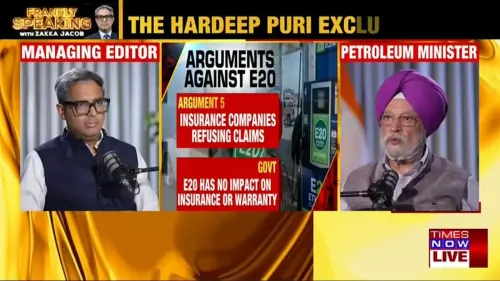
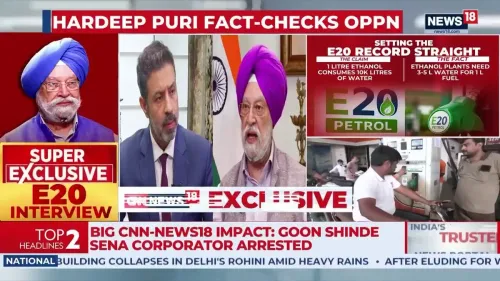
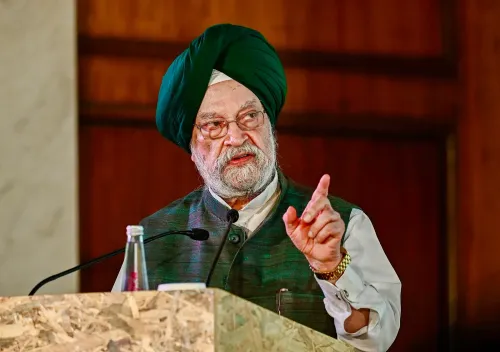
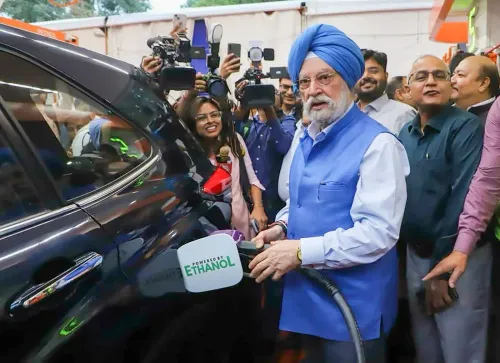
Union Petroleum Minister Hardeep Singh Puri on Saturday, 6 June 2026, took to X to address public confusion around the introduction of E85 fuel in India, clarifying that its availability does not threaten or replace existing E20-compatible vehicles or conventional petrol cars.
Context
Responding to widespread questions circulating online, Minister Puri posted a detailed clarification in Hindi, stating: 'E20 aur E85 do alag-alag shreniyon ke indhan hain' ('E20 and E85 are fuels belonging to two entirely different categories'). He emphasised that E85 is designed exclusively for flex-fuel vehicles and is not meant for standard E20-compatible or petrol-powered cars. The minister's post carried the hashtag #E85, signalling a deliberate effort to shape public understanding at a critical juncture in India's ethanol transition.
Policy Backdrop
India's push toward higher ethanol blending is rooted in the National Policy on Biofuels, 2018, which laid out a roadmap to progressively raise the share of domestically produced ethanol in petrol. A 2021 government decision advanced the E20 target — a blend of 20 per cent ethanol with petrol — from 2030 to 2025, reflecting accelerated ambition. The arrival of E85, which contains up to 85 per cent ethanol, marks the next frontier of this programme.
Brazil serves as the primary global reference point for this transition. Since its landmark Proálcool programme of 1975, Brazil has maintained a thriving ecosystem of flex-fuel vehicles capable of running on any ethanol-petrol blend from E20 to E100. Minister Puri explicitly cited Brazil's decades-long experience to reassure Indian consumers that a multi-blend fuel market is both viable and proven. Flex-fuel engines are engineered to detect the ethanol concentration in the tank and adjust combustion parameters accordingly, making them compatible across the entire blend spectrum.
Stakeholders and Impact
The minister outlined three direct benefits of expanding to E85: boosting farmers' incomes through greater demand for ethanol feedstocks such as sugarcane and grain; reducing India's dependence on crude oil imports, which currently exceed 80 per cent of domestic demand; and strengthening the country's overall energy security. He framed the development as a step toward a 'clean and self-reliant future' — language that directly echoes the Atmanirbhar Bharat framework championed by the government.
For Indian farmers, assured ethanol offtake at government-determined prices provides an additional revenue stream beyond conventional crop sales. Oil marketing companies and vehicle manufacturers are the other key actors: automakers will need to expand their flex-fuel vehicle portfolios, while fuel retailers must invest in dedicated E85 dispensing infrastructure at pumps nationwide.
What's Next
The immediate watch points are announcements from Indian automakers on flex-fuel vehicle launches and any formal Petroleum Ministry notifications covering E85 retail pricing, pump availability, and compatibility standards. The minister's clarification signals that the government is aware of consumer anxiety and intends to manage the communication of this transition proactively. As India moves from an E20 baseline toward a multi-blend market, the pace at which flex-fuel vehicles enter the mainstream will determine how quickly E85 shifts from a policy milestone to an everyday fuel option for Indian motorists.
Point of View
He lends credibility that a purely domestic policy argument would lack. The post also quietly advances a political triple-play: energy security, farmer welfare, and Atmanirbhar Bharat — three pillars the BJP government consistently uses to build a coherent economic-nationalism story. The timing, as E85 enters the market, suggests the ministry is treating consumer communication as integral to the rollout, not an afterthought.
NationPress
21 Oct 2026
Frequently Asked Questions
What is E85 fuel and which vehicles can use it in India?
E85 is a high-ethanol fuel blend containing up to 85 per cent ethanol and is designed exclusively for flex-fuel vehicles whose engines can handle ethanol-petrol mixtures ranging from E20 to E100. Standard petrol or E20-compatible cars cannot run on E85.
Will E85 fuel replace E20 petrol in India?
No. Union Petroleum Minister Hardeep Singh Puri explicitly stated on 6 June 2026 that E85 and E20 belong to different fuel categories for different vehicle types, and the introduction of E85 does not mean E20 or petrol vehicles will be discontinued.
What is a flex-fuel vehicle and how does it work?
A flex-fuel vehicle is equipped with an engine that can automatically detect the ethanol concentration in its fuel tank and adjust combustion settings accordingly, allowing it to run on any blend from E20 to E100 without modification.
How does India's E85 policy benefit farmers?
E85 requires significantly more ethanol per litre of fuel than lower blends, driving higher demand for ethanol feedstocks such as sugarcane and grain. This creates additional assured offtake for farmers at government-determined prices, supplementing their conventional crop income.
Which country does India look to as a model for high-ethanol fuel blends?
Brazil is the primary reference. Since its Proálcool programme launched in 1975, Brazil has operated a large-scale flex-fuel vehicle ecosystem with E85 and higher blends widely available, providing decades of operational proof that a multi-blend fuel market is viable.