Puri at FICCI AGM: India's Energy Leap from 27 to 41 Crude Sources
Synopsis
At FICCI's Centenary AGM at Bharat Mandapam, Petroleum Minister Hardeep Singh Puri detailed India's energy resilience strategy: crude sourcing expanded to 41 countries, Samudra Manthan unlocking offshore exploration, and petrochemical demand projected to hit 120 MMTPA by 2047.
Key Takeaways
India expanded crude oil sourcing from 27 to 41 countries , insulating consumers from Middle East conflict-driven price shocks.
Domestic LPG production rose from roughly 34,000 to 55,000 tonnes per day ; peak refining capacity reached around 267 MMTPA .
Samudra Manthan opens nearly 1 million sq. km of previously restricted offshore areas for hydrocarbon exploration.
Petrochemical demand is projected to grow from 36.4 MMTPA today to 55 MMTPA by 2030 and 120 MMTPA by 2047 .
The USD 3 billion GOBARdhan programme converts organic waste into compressed biogas, supporting rural incomes and clean energy transition.
India's strategy runs two parallel tracks: securing near-term supply through diversification and capacity, and building a long-term clean energy stack.
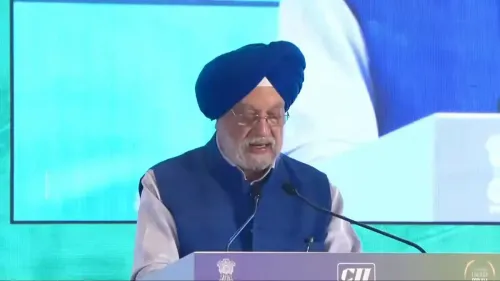
When global energy markets buckled under the weight of Middle East conflict and supply chain chaos, India did not flinch — and Union Petroleum Minister Hardeep Singh Puri used a high-profile fireside chat at FICCI's Centenary AGM and Annual Convention on Thursday, 19 November 2026 to explain exactly why.
Speaking on the theme 'Securing India's Energy Future: Growth, Resilience and Transition' at Bharat Mandapam, New Delhi, alongside Vijay Sankar, President-Elect of FICCI, Minister Puri laid out a data-rich case: India's energy resilience is not luck — it is the product of decisions made well before the crises hit.
From 27 to 41: India's Crude Diversification Sprint
The centrepiece of Puri's argument was supply-side diversification. India expanded its crude oil sourcing from 27 countries to 41 countries, ensuring no single disruption — whether in the Strait of Hormuz or the Red Sea — could hold domestic consumers hostage to a price spike. That strategic spread, he argued, is the direct output of Prime Minister Narendra Modi's energy diplomacy.
Alongside crude diversification, domestic LPG production climbed from roughly 34,000 tonnes per day to 55,000 tonnes per day, while India's refining capacity reached a peak of around 267 million tonnes per annum. These are not marginal gains — they represent a systematic effort to build buffer before the buffer was needed.
Samudra Manthan: Unlocking India's Offshore Frontier
Puri unveiled the ambition behind Samudra Manthan, a major government push to open nearly 1 million square kilometres of previously designated 'No-Go' areas for offshore hydrocarbon exploration. The initiative is designed to strengthen domestic exploration and production, chipping away at India's dependence on imported crude over the long term.
The logic is straightforward: every barrel extracted at home is one fewer barrel bought abroad at the mercy of geopolitical weather. Samudra Manthan is as much a sovereignty play as an energy one.
Petrochemicals: The Next Chapter of India's Refining Story
Minister Puri framed petrochemicals as the defining frontier of India's refining evolution. Current capacity stands at around 36.4 million metric tonnes per annum (MMTPA). Demand is projected to rise to approximately 55 MMTPA by 2030 and an extraordinary 120 MMTPA by 2047 — the year India marks its centenary of independence.
The implication is sharp: the future of Indian refining is not merely about pumping out more fuel. It is about extracting maximum value from every barrel of crude, turning petrochemical complexity into an economic multiplier.
GOBARdhan, Green Hydrogen and the Clean Energy Stack
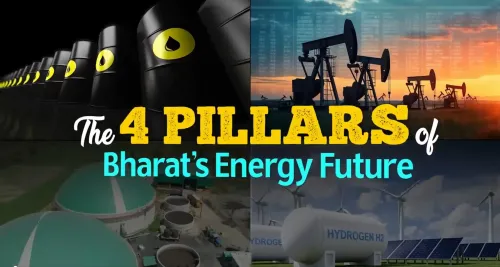
Puri also highlighted the USD 3 billion GOBARdhan programme, which converts cattle dung and organic waste into compressed biogas, linking rural livelihoods to the clean energy transition. The minister pointed to a broader renewables stack — biofuels, green hydrogen, compressed biogas (CBG) and natural gas — as the complementary architecture being built alongside the conventional hydrocarbon base.
Taken together, the picture Puri painted at FICCI is of a country running two tracks simultaneously: securing the present through supply diversification and capacity expansion, while engineering the future through clean fuels and offshore frontiers.
India's energy ambition is now a conversation the world cannot afford to miss — and the country, it seems, intends to keep it that way.
Point of View
Offshore expansion and petrochemical scaling under a single 'resilience' umbrella signals that the BJP intends to make energy security a core governance credential. Samudra Manthan, in particular, carries both economic weight and symbolic resonance — opening 'No-Go' zones reads as a reversal of regulatory timidity. The 2047 petrochemical demand figure plants a long flag in India's centenary story, tying present-day industrial policy to a civilisational ambition that is very difficult for any opposition to argue against.
NationPress
19 Nov 2026
Frequently Asked Questions
What is Samudra Manthan and how does it affect India's energy security?
Samudra Manthan is a government initiative to open nearly 1 million square kilometres of previously restricted offshore areas for hydrocarbon exploration, aiming to boost domestic production and reduce India's dependence on crude oil imports.
How many countries does India now source crude oil from?
According to Union Petroleum Minister Hardeep Singh Puri, India has expanded crude oil sourcing from 27 countries to 41 countries, significantly diversifying its supply base.
What is the GOBARdhan programme?
GOBARdhan is a central government scheme backed by USD 3 billion that converts cattle dung and organic waste into compressed biogas, supporting rural incomes while accelerating India's clean energy transition.
What is India's projected petrochemical demand by 2047?
Minister Puri stated that India's petrochemical demand is projected to rise from the current capacity of around 36.4 MMTPA to approximately 55 MMTPA by 2030 and 120 MMTPA by 2047.
What was the FICCI Centenary AGM about and where was it held?
The FICCI Centenary Annual General Meeting and Annual Convention was held at Bharat Mandapam in New Delhi, bringing together industry leaders to discuss issues including India's energy future, growth, resilience and clean energy transition.