As Women's Reservation Bill Nears Approval, Advocates Push for Disability Quota
Synopsis
As the women's quota bill gains momentum, advocates urge for the inclusion of political representation for persons with disabilities. Experts emphasize the importance of inclusivity in democracy, highlighting the underrepresentation of disabled individuals in decision-making roles.
Key Takeaways
Women's Reservation Bill is moving towards approval, highlighting the need for political equality.
Advocates are calling for inclusion of persons with disabilities in political representation.
The NCPEDP emphasizes the importance of addressing disability issues in policymaking.
Census 2027 presents a significant opportunity for improved data on disabilities.
Political representation is essential for a truly inclusive democracy .
New Delhi, April 14 (NationPress) As the women's reservation bill approaches potential approval, experts are calling on Prime Minister Narendra Modi and Minister of State for Social Justice and Empowerment, Ramdas Athawale, to advocate for the political representation of individuals with disabilities, an official stated on Tuesday.
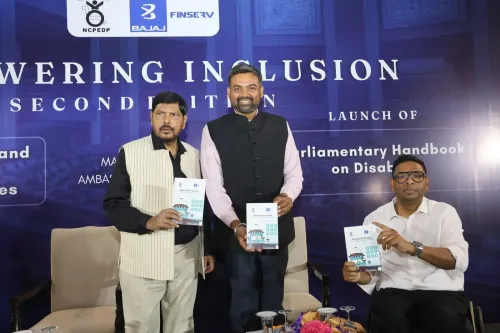
Arman Ali, Executive Director of NCPEDP and author of India's inaugural handbook on disability for Parliamentarians, titled 'Beyond the Visible: A Handbook on Disability Inclusion for Parliamentarians', remarked, “The Women’s Reservation Bill is a significant advancement; however, it should also pave the way for wider inclusivity. Individuals with disabilities are notably underrepresented in decision-making roles. Their involvement is crucial for a genuinely inclusive democracy.”
During the release of the handbook last month, Athawale endorsed the proposal from the National Centre for Promotion of Employment for Disabled People (NCPEDP) to initiate a national dialogue on securing political representation for persons with disabilities.
Athawale further noted that the upcoming Census 2027 presents a major opportunity to acknowledge all 21 categories of disabilities through skilled enumeration and enhanced data collection.
The NCPEDP has sent a letter to President Droupadi Murmu, Vice President C.P. Radhakrishnan, PM Modi, and Lok Sabha Speaker Om Birla, along with leaders from various political parties, urging that reservation for persons with disabilities be included in the broader electoral reform framework.
The correspondence emphasized that “political barriers” are explicitly recognized under the Rights of Persons with Disabilities Act, 2016, and the lack of representation often leads to disability-related issues being neglected in policy formulation.
With the proposed increase in legislative seats, the NCPEDP highlighted a timely opportunity to facilitate inclusive representation without impacting existing categories.
“India hosts one of the largest populations of individuals with disabilities. According to the 2011 Census, over 2.68 crore individuals were classified as persons with disabilities, a figure many consider to be an undercount. As new data is anticipated in the upcoming Census, the urgency for direct political representation is becoming more pronounced,” Ali added.
The NCPEDP has also called upon Members of Parliament to prioritize this matter during the current session and advocate for the integration of reservations for persons with disabilities into the broader electoral reforms.
Point of View
Experts are advocating for the inclusion of persons with disabilities in the political landscape, especially with the impending approval of the women's reservation bill. The call for broader representation underscores the essential need for an inclusive democracy that acknowledges and addresses the needs of all citizens.
NationPress
6 Oct 2026
Frequently Asked Questions
What is the Women's Reservation Bill?
The Women's Reservation Bill aims to reserve a certain percentage of seats for women in legislative bodies to enhance their representation in politics.
Why is political representation for persons with disabilities important?
Political representation for persons with disabilities ensures their concerns and needs are included in policymaking, promoting a more inclusive democracy.
How does the Rights of Persons with Disabilities Act, 2016 relate to this issue?
The Rights of Persons with Disabilities Act, 2016 recognizes political barriers faced by disabled individuals and emphasizes the need for their representation in political spaces.
What opportunity does the upcoming Census 2027 present?
The Census 2027 offers a chance to accurately recognize and collect data on various disabilities, which is crucial for informed policymaking and representation.