Rahul Gandhi calls BJP, RSS 'casteist' and spiritually ignorant
Synopsis
Leader of the Opposition Rahul Gandhi launched a blistering ideological attack on the BJP and RSS on 22 November 2026, calling them 'uncouth, greedy, casteist male chauvinists' with no genuine understanding of India's spiritual and religious traditions — escalating a long-running contest over who legitimately speaks for India's civilisational heritage.
Key Takeaways
Rahul Gandhi posted a direct personal attack on the BJP and RSS on 22 November 2026 , calling them 'uncouth, greedy, casteist male chauvinists.' Gandhi framed the criticism as arising from his own deepening engagement with Indian spiritual and religious traditions .
The RSS , founded in 1925 , and the BJP , in power at the centre since 2014 , both claim custodianship of India's Hindu civilisational heritage.
Gandhi's earlier Bharat Jodo Yatra (2022-23) laid similar ideological groundwork, arguing RSS-BJP ideology distorts India's inclusive spiritual legacy.
The statement pairs spiritual ignorance explicitly with caste and gender chauvinism , embedding the attack in a social-justice frame.
BJP counter-statements and parliamentary responses are anticipated as the winter session of Parliament approaches.
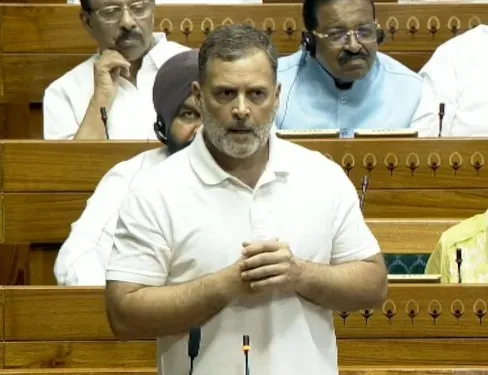
A sharp ideological broadside landed on Sunday afternoon as Congress leader Rahul Gandhi, Leader of the Opposition in the Lok Sabha, accused the BJP and the RSS of being fundamentally disconnected from India's spiritual and religious traditions — framing the attack not as politics, but as a matter of cultural literacy.
Posting on 22 November 2026, Gandhi wrote: 'The deeper I go into Indian spiritual and religious traditions, the clearer it becomes. The BJP and RSS are uncouth, greedy, casteist male chauvinists with absolutely no understanding of our spiritual and religious traditions.' The statement is unambiguous in both its target and its register — this is not a policy critique but an indictment of character and comprehension.
A battle over who owns India's spiritual legacy
The charge is not new, but the framing is pointed. Gandhi has spent years positioning himself as a student of India's philosophical and devotional traditions — visiting temples, engaging with religious teachers, and threading references to Vedantic and Upanishadic thought through his public speeches. During the landmark Bharat Jodo Yatra of 2022-23, he repeatedly argued that the RSS-BJP's brand of cultural nationalism is a distortion — not a defence — of India's inclusive spiritual heritage. The Rashtriya Swayamsevak Sangh, founded in 1925, has long claimed custodianship of Hindu civilisation as the ideological parent of the Bharatiya Janata Party, which has governed at the centre since 2014. The contest over that custodianship — who reads the texts, who understands the traditions, who can legitimately speak for India's religiosity — has become one of the defining fault lines of contemporary Indian politics.Caste and gender as the sharper edge
What distinguishes Sunday's post from routine opposition rhetoric is the explicit pairing of spiritual ignorance with caste chauvinism and male chauvinism. By using the word 'casteist' alongside 'male chauvinists,' Gandhi is embedding his spiritual argument inside a social-justice frame — suggesting that the BJP-RSS's misreading of Indian tradition is not merely intellectual but structural, producing hierarchies of caste and gender that he argues are antithetical to the egalitarian core of India's deeper philosophical inheritance. Congress leaders have long contrasted a secular, pluralistic reading of Indian traditions with the Hindutva cultural-nationalist project. Gandhi's post sharpens that contrast into a direct personal accusation, delivered in language designed to cut through.Winter session timing and what comes next
The statement arrives as Parliament's winter session approaches — a period when ideological temperatures typically rise and the floor of the Lok Sabha becomes an extension of the broader cultural debate. BJP leaders are likely to respond, and their counter-framing — that Gandhi's critique of the RSS amounts to an attack on Hindu sentiment itself — is a playbook that has proved electorally effective before. Watch for parliamentary statements and social-media rebuttals from ruling-party spokespersons in the coming days. The question Gandhi is really asking is an old one, but no less live for its age: who speaks for India's soul?Point of View
Gandhi attempts to shift the debate from electoral arithmetic to cultural authority, a space where the BJP has historically dominated. The explicit inclusion of 'casteist' and 'male chauvinists' signals an attempt to split the BJP's broad Hindu coalition along social-justice lines, particularly targeting Dalit, OBC, and women voters. Whether the gambit expands Congress's appeal or allows the BJP to consolidate its base by portraying the critique as an attack on Hindu identity will be the central dynamic to watch.
NationPress
22 Nov 2026
Frequently Asked Questions
What did Rahul Gandhi say about BJP and RSS on 22 November 2026?
Rahul Gandhi posted on X that the BJP and RSS are 'uncouth, greedy, casteist male chauvinists with absolutely no understanding of our spiritual and religious traditions,' framing the charge as a conclusion drawn from his personal engagement with Indian spirituality.
Why does Rahul Gandhi keep visiting temples and religious sites?
Gandhi has consistently used temple visits and engagement with religious teachers to position himself as a genuine student of Indian traditions, contrasting what he describes as a sincere spiritual interest with what he calls the BJP-RSS's politicised and distorted use of religion.
What is the RSS and why is it significant in Indian politics?
The Rashtriya Swayamsevak Sangh (RSS) is a Hindu nationalist volunteer organisation founded in 1925 . It is the ideological parent of the BJP and plays a central role in shaping the ruling party's cultural and political agenda, making it a frequent target for opposition critique.
What was the Bharat Jodo Yatra and what did Rahul Gandhi say about RSS during it?
The Bharat Jodo Yatra was a mass contact march undertaken by Rahul Gandhi from 2022 to 2023 . During the march, he repeatedly argued that RSS-BJP ideology is divisive and contradicts India's historically inclusive and pluralistic spiritual heritage.
How is BJP likely to respond to Rahul Gandhi's remarks on spirituality?
The BJP has historically responded to such critiques by arguing that Congress's criticism of the RSS amounts to an attack on Hindu sentiment broadly, a counter-frame that has proved electorally potent in past cycles. Formal parliamentary responses are expected as the winter session approaches.