Rajasthan Cabinet approves Industrial Relations Rules 2026

Synopsis
The Rajasthan State Cabinet, chaired by Chief Minister Bhajanlal Sharma, approved the Rajasthan Industrial Relations Rules, 2026 on 7 August 2026, aiming to simplify and modernise the state's labour framework in line with the central Industrial Relations Code, 2020.
Key Takeaways
The Rajasthan State Cabinet approved the Rajasthan Industrial Relations Rules, 2026 on 7 August 2026 .
The meeting was chaired by Chief Minister Bhajanlal Sharma at the Chief Minister's Office, Jaipur .
The rules are designed to simplify and modernise Rajasthan's labour and industrial relations framework.
The move aligns Rajasthan's state-level rules with the central Industrial Relations Code, 2020 , which consolidated older labour statutes.
Key stakeholders include industrial workers, employers, and manufacturing firms operating in Rajasthan.
The next step is formal gazette notification and a phased implementation timeline from the state Labour Department .
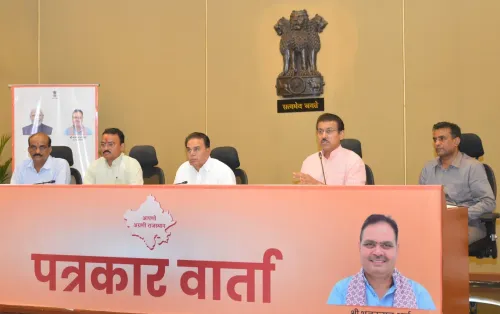
A sweeping push to modernise Rajasthan's labour architecture cleared a decisive hurdle on Friday, 7 August 2026, as the Rajasthan State Cabinet approved the Rajasthan Industrial Relations Rules, 2026 — a framework designed to simplify and contemporise the state's industrial relations regime. The meeting was chaired by Chief Minister Bhajanlal Sharma at the Chief Minister's Office in Jaipur.
The Chief Minister's Office announced the development on X, stating that the cabinet meeting held under CM Bhajanlal Sharma's chairmanship approved the new rules 'राज्य के श्रम ढाँचे को सरल और आधुनिक बनाने के लिए' — 'to simplify and modernise the state's labour framework' — under the hashtag #आपणो_अग्रणी_राजस्थान ('Our Leading Rajasthan').
From central code to state rules: the reform lineage
The approval does not emerge in a vacuum. At the national level, Parliament enacted the Industrial Relations Code, 2020, consolidating multiple older central labour statutes into a single, compliance-friendly architecture. That central code, however, requires states to frame their own subordinate rules before it can take operational effect on the ground. Rajasthan's new 2026 rules represent precisely that step — translating the spirit of the central consolidation into a workable state-level rulebook. Rajasthan has historically maintained its own industrial relations and labour welfare rules alongside central legislation, a legacy of the state's large informal workforce and its significant manufacturing and mining sectors. The new rules signal an intent to bring that legacy framework into alignment with contemporary ease-of-doing-business expectations.Who stands to gain — and what comes next
The immediate beneficiaries span both sides of the factory gate: industrial workers stand to gain from clearer, more accessible grievance and dispute-resolution mechanisms, while employers and manufacturing firms operating in the state can expect reduced procedural complexity in compliance. For a state that has been actively courting industrial investment — including through large investor summits — streamlined labour rules are a tangible signal to prospective investors. The next milestone to watch is the publication of the formally notified rules in the Rajasthan Gazette and any phased implementation timeline that the state's Labour Department announces. The devil, as always in labour reform, will be in the operational detail. Rajasthan has staked its industrial ambitions on becoming a leading investment destination — and a modernised labour rulebook is the unglamorous but essential scaffolding that makes that promise credible.Point of View
2026 is a concrete, if incremental, step in the BJP-led state government's broader push to position Rajasthan as an investor-friendly destination. It fits a national pattern of state governments operationalising the central Industrial Relations Code, 2020 — a process that has moved unevenly across India. For Chief Minister Bhajanlal Sharma, who took office in December 2023, the cabinet nod translates an inherited policy mandate into administrative action. The real test will be whether the notified rules genuinely reduce compliance friction or simply repackage existing obligations in new language.
NationPress
8 Aug 2026
Frequently Asked Questions
What are the Rajasthan Industrial Relations Rules 2026?
The Rajasthan Industrial Relations Rules, 2026 are a new set of state-level labour regulations approved by the Rajasthan Cabinet on 7 August 2026 to simplify and modernise the state's industrial relations framework, broadly in line with the central Industrial Relations Code, 2020.
Who approved the Rajasthan Industrial Relations Rules 2026?
The rules were approved by the Rajasthan State Cabinet in a meeting chaired by Chief Minister Bhajanlal Sharma at the Chief Minister's Office in Jaipur on 7 August 2026.
How do the new rules relate to the central Industrial Relations Code 2020?
The central Industrial Relations Code, 2020 consolidated older central labour laws but requires states to frame their own subordinate rules for implementation. Rajasthan's 2026 rules are the state's step toward operationalising that central framework at the ground level.
Who benefits from the Rajasthan Industrial Relations Rules 2026?
Both industrial workers — who may see clearer dispute-resolution mechanisms — and employers and manufacturing firms — who stand to gain from reduced compliance complexity — are the primary beneficiaries.
When will the Rajasthan Industrial Relations Rules 2026 come into effect?
The rules have been approved by the cabinet; they will come into effect after formal notification in the Rajasthan Gazette. The Labour Department is expected to announce an implementation timeline.