Rajasthan CMO directs Excise Dept to act on illegal liquor
Synopsis
The Chief Minister's Office of Rajasthan on 10 July 2026 publicly directed the Excise Department to take concrete action against illegal liquor, tagging CM Bhajan Lal Sharma under the hashtag 'Our Leading Rajasthan'. The move continues a pattern of public administrative directives from the BJP government since December 2023.
Key Takeaways
The Chief Minister's Office of Rajasthan issued a public directive on 10 July 2026 ordering the Excise Department to act firmly against illegal liquor.
The post directly tagged Chief Minister Bhajan Lal Sharma (@BhajanlalBjp) , placing accountability at the top of the administration.
The Rajasthan Excise Department is responsible for regulating liquor trade, collecting excise revenue, and raiding illicit supply networks.
The BJP government has directed departments to intensify anti-illegal-liquor enforcement since CM Sharma took office in December 2023 .
The directive carries the hashtag #आपणो_अग्रणी_राजस्थान ('Our Leading Rajasthan'), framing enforcement as part of the government's broader governance agenda.
Monthly excise raid statistics and potential amendments to the Rajasthan Excise Act are the key indicators to watch going forward.
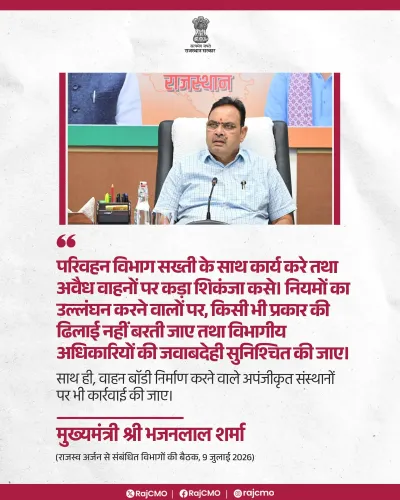
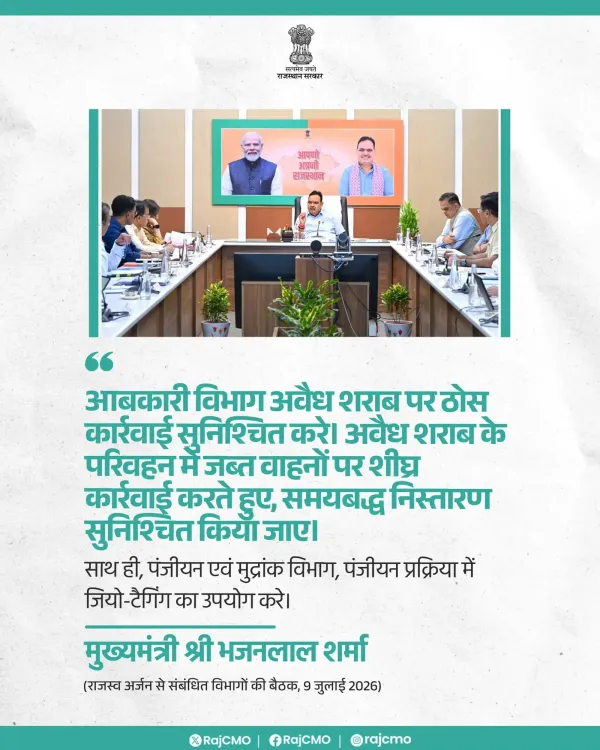
The Chief Minister's Office of Rajasthan on Friday, 10 July 2026, issued a public directive to the state's Excise Department, calling for firm action against illegal liquor. The post, addressed directly to Chief Minister Bhajan Lal Sharma, carried the hashtag #आपणो_अग्रणी_राजस्थान ('Our Leading Rajasthan'), signalling the instruction as part of a broader governance push.
Context
The CMO's post read: 'आबकारी विभाग अवैध शराब पर ठोस कार्रवाई सुनिश्चित करे' — 'The Excise Department must ensure concrete action against illegal liquor.' By tagging @BhajanlalBjp, the office placed the directive squarely within the Chief Minister's accountability framework, making it a public administrative instruction rather than an internal memo.
The Rajasthan Excise Department is the state body responsible for regulating the liquor trade, collecting excise revenue, and enforcing prohibition on illicit sales. Its mandate covers licensing, inspection of distilleries, and raids on bootlegging networks.
Policy Backdrop
Since Chief Minister Bhajan Lal Sharma assumed office in December 2023 after the BJP's assembly election victory, the government has periodically directed departments to intensify enforcement against illegal liquor networks. Rajasthan has seen recurring enforcement drives against bootlegging syndicates under successive administrations, reflecting a long-standing challenge for excise authorities in the state.
Across Indian states, such directives serve a dual purpose: protecting fiscal revenue from excise duty — a significant source of state income — and reducing public health risks associated with adulterated or spurious alcohol, which has caused fatalities in several states in recent years.
Stakeholders and Impact
The directive directly concerns Rajasthan Excise Department officials at the district and divisional levels, who are expected to translate the instruction into on-ground raids, seizures, and prosecutions. Illegal liquor traders and bootlegging networks operating across the state are the primary targets of any intensified enforcement action.
For ordinary citizens, particularly in rural and semi-urban areas where illicit liquor is more accessible, stricter enforcement can reduce exposure to adulterated alcohol. Simultaneously, licensed liquor vendors stand to benefit from a more level playing field if illegal supply chains are disrupted.
What's Next
Observers will watch for the publication of monthly excise raid statistics and any proposed amendments to the Rajasthan Excise Act in the next legislative session. The CMO's public tagging of the Chief Minister signals that accountability for results will rest at the top of the administration. Whether the directive translates into sustained enforcement — rather than a short-term spike in raids — will determine its long-term impact on the state's illegal liquor trade.
Point of View
Designed to create visible accountability in a domain where enforcement has historically been inconsistent. It fits a broader pattern of the Rajasthan BJP administration using social media as an instrument of administrative pressure, compressing the distance between political leadership and departmental action. The invocation of the 'Our Leading Rajasthan' hashtag ties routine enforcement to the government's larger brand-building exercise ahead of future electoral cycles. Whether the public directive produces measurable results will depend on follow-through at the district level, where political will and administrative capacity must align.
NationPress
10 Jul 2026
Frequently Asked Questions
Why did the Rajasthan CMO direct action against illegal liquor?
The Chief Minister's Office issued the directive to ensure the Excise Department takes concrete steps against illegal liquor, protecting both state excise revenue and public health from adulterated alcohol.
Who is Bhajan Lal Sharma and why was he tagged in the post?
Bhajan Lal Sharma is the Chief Minister of Rajasthan, in office since December 2023. He was tagged to signal that the directive carries the Chief Minister's authority and that accountability rests with his office.
What does the Rajasthan Excise Department do?
The Rajasthan Excise Department regulates the liquor trade, issues licences, collects excise duty, and enforces prohibition on illegal liquor sales and bootlegging across the state.
What is the hashtag #आपणो_अग्रणी_राजस्थान used for?
The hashtag translates to 'Our Leading Rajasthan' and is used by the Rajasthan BJP government to frame its governance initiatives as part of a vision of a progressive and well-administered state.
What should we watch for after this Rajasthan excise directive?
Key indicators include monthly excise raid and seizure statistics released by the department, and any proposed changes to the Rajasthan Excise Act in the next state legislative session.