Rajasthan CMO drives groundwater recharge under 'Karmabhoomi Se Matrubhoomi'
Synopsis
Rajasthan's CMO has announced construction of groundwater recharge structures under the 'Karmabhoomi Se Matrubhoomi' campaign, pooling Bhamashah donors, diaspora Rajasthanis, and CSR funds to combat the state's chronic aquifer depletion — echoing the 2016 Jal Swavalamban Abhiyan model.
Key Takeaways
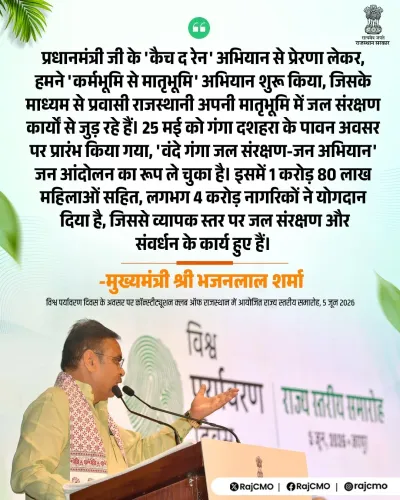
The Chief Minister's Office of Rajasthan announced on 20 June 2026 that groundwater recharge structures are being built under the 'Karmabhoomi Se Matrubhoomi' campaign.
The campaign pools three funding sources: Bhamashah philanthropists , diaspora Rajasthanis , and corporate CSR funds .
The initiative targets Rajasthan's chronic groundwater depletion, which directly affects farmers and rural communities across the arid state.
The campaign echoes the Mukhya Mantri Jal Swavalamban Abhiyan launched in 2016 , which similarly leveraged community and private capital for water conservation.
Chief Minister Bhajanlal Sharma is associated with the initiative, which carries the state government's #AapnoAgraniRajasthan branding.
District-level progress reports and post-monsoon groundwater data will be key indicators of the campaign's on-ground impact.
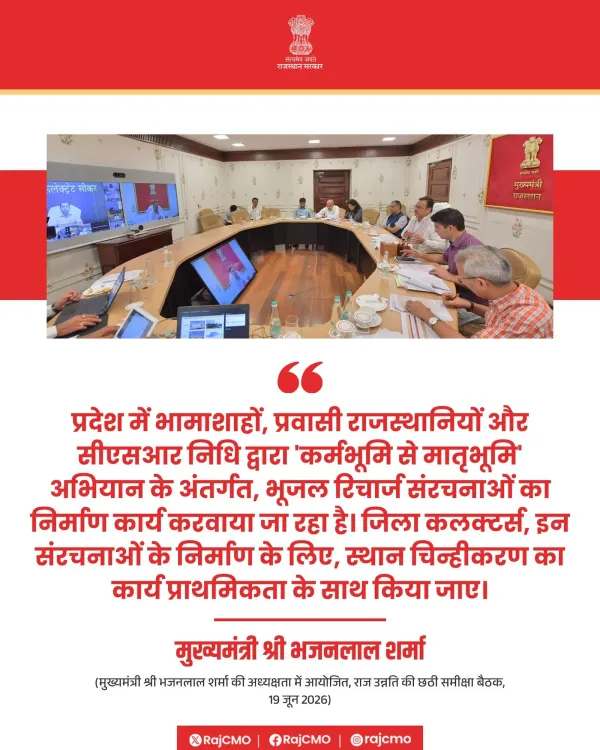
The Chief Minister's Office of Rajasthan announced on Saturday, 20 June 2026 that groundwater recharge structures are being constructed across the state under the 'Karmabhoomi Se Matrubhoomi' campaign, mobilising Bhamashah philanthropists, diaspora Rajasthanis, and corporate social responsibility funds.
Context
The post, shared from the official CMO handle and tagging Chief Minister Bhajanlal Sharma, states: 'Pradesh mein Bhamashaahon, pravasi Rajasthanion aur CSR nidhi dwara Karmabhoomi Se Matrubhoomi abhiyan ke antargat, bhoojal recharge sanrachnaon ka nirman karya karvaya ja raha hai' — meaning, 'In the state, groundwater recharge structures are being constructed by Bhamashahs, diaspora Rajasthanis, and CSR funds under the Karmabhoomi Se Matrubhoomi campaign.' The announcement carries the hashtag #AapnoAgraniRajasthan ('Our Pioneering Rajasthan'), a branding phrase associated with the current state government's development agenda.
Rajasthan is one of India's most water-stressed states, characterised by arid terrain, erratic monsoons, and chronic depletion of aquifers that millions of farmers and rural households depend on.
Policy Backdrop
The 'Karmabhoomi Se Matrubhoomi' campaign channels three distinct funding streams — individual Bhamashah donors, non-resident Rajasthanis, and corporate CSR contributions — into on-ground water infrastructure. The Bhamashah tradition of community philanthropy has deep historical roots in Rajasthan, and successive governments have sought to formalise and revive it within modern regulatory frameworks.
A significant precedent is the Mukhya Mantri Jal Swavalamban Abhiyan, launched in 2016, which promoted rainwater harvesting and recharge structures through community and private participation. The current campaign follows a similar philosophy of supplementing state budgets with non-governmental capital to address aquifer stress in drought-prone districts.
Stakeholders and Impact
The primary beneficiaries of groundwater recharge infrastructure are farmers and rural communities in Rajasthan's arid and semi-arid districts, where falling water tables directly threaten irrigation and drinking water security. By drawing on diaspora remittances and CSR funds, the campaign aims to expand the geographic and financial reach of water conservation beyond what state allocations alone can cover.
Corporate entities contributing CSR funds gain a structured channel to direct mandated social spending toward measurable environmental outcomes, while non-resident Rajasthanis are offered a direct link to development in their home districts — a model that has gained traction in several Indian states seeking to leverage their diaspora networks.
What's Next
The effectiveness of the campaign will be assessed through district-level progress reports on the number and capacity of recharge structures completed, as well as any measurable changes in local groundwater tables over coming monsoon seasons. With the 2026 southwest monsoon underway, the timing of the announcement signals an effort to accelerate construction activity ahead of peak rainfall, when recharge structures yield the greatest benefit.
Sustained groundwater recovery in Rajasthan will require not just infrastructure construction but long-term monitoring and community stewardship — factors that will determine whether this campaign delivers durable results beyond a single season.
Point of View
Philanthropy, and CSR mandates — to fill gaps in water infrastructure spending that the state budget cannot fully address. By publicly tagging Chief Minister Bhajanlal Sharma and deploying the #AapnoAgraniRajasthan hashtag, the CMO is also weaving environmental governance into a broader political brand-building exercise. The approach carries genuine policy logic, given Rajasthan's acute groundwater stress, but its long-term credibility will hinge on transparent district-level reporting of structures built and aquifer levels measured. If the campaign delivers verifiable outcomes before the next election cycle, it could set a replicable template for other water-stressed states seeking supplementary conservation funding.
NationPress
20 Jun 2026
Frequently Asked Questions
What is the 'Karmabhoomi Se Matrubhoomi' campaign in Rajasthan?
'Karmabhoomi Se Matrubhoomi' is a Rajasthan government campaign that mobilises Bhamashah philanthropists, non-resident Rajasthanis, and corporate CSR funds to finance public infrastructure works — including groundwater recharge structures — in the state.
Who are Bhamashahs and what role do they play in Rajasthan?
Bhamashahs are wealthy individual donors in the Rajasthani tradition of community philanthropy, historically associated with funding public welfare and infrastructure. The current campaign formalises this tradition within a modern fundraising framework alongside CSR and diaspora contributions.
What is groundwater recharge and why does Rajasthan need it?
Groundwater recharge refers to the process of replenishing underground aquifers, typically through structures that channel rainwater into the ground. Rajasthan is one of India's most arid states and faces chronic aquifer depletion, making recharge infrastructure critical for farmers and rural communities.
What was the Mukhya Mantri Jal Swavalamban Abhiyan?
The Mukhya Mantri Jal Swavalamban Abhiyan was a Rajasthan government scheme launched in 2016 to promote rainwater harvesting and groundwater recharge through community and private participation — a predecessor model to the current campaign.
Who is Bhajanlal Sharma and what is his role in this campaign?
Bhajanlal Sharma has been the Chief Minister of Rajasthan since December 2023. The CMO's post on this campaign tags his official account, indicating the initiative is being driven under his administration's development agenda.