Rajasthan CM Bhajanlal Launches Water Body Revival Drive
Synopsis
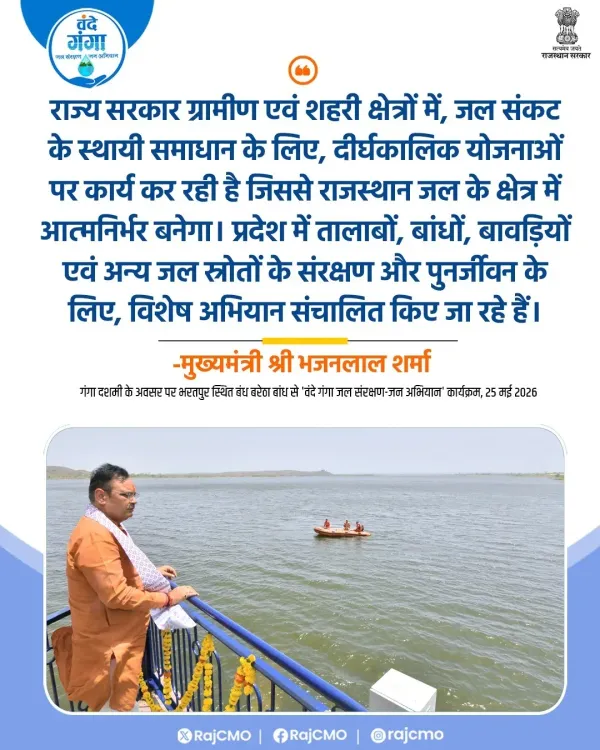
The Chief Minister's Office of Rajasthan announced on 26 May 2026 that special campaigns are underway to conserve and rejuvenate ponds, dams, stepwells, and other water sources statewide. The drive, attributed to CM Bhajanlal Sharma, builds on the state's established water self-reliance programmes and aligns with central conservation schemes.
Key Takeaways
The Chief Minister's Office of Rajasthan announced on 26 May 2026 that special campaigns are being run for conservation and rejuvenation of water bodies across the state.
CM Bhajanlal Sharma was directly tagged in the announcement, indicating personal ownership of the initiative.
The campaign covers ponds (talabs), dams, stepwells (bawdis), and other water sources across Rajasthan.
The drive builds on the Mukhya Mantri Jal Swavalamban Abhiyan launched in 2016 and aligns with the central government's Jal Shakti Abhiyan of 2019 .
Primary beneficiaries are rural communities and farmers dependent on local water infrastructure for irrigation and drinking water.
District-level outcomes are expected to become measurable after the 2026 monsoon season .
The Chief Minister's Office of Rajasthan announced on Tuesday, 26 May 2026 that special campaigns are being conducted across the state for the conservation and rejuvenation of ponds, dams, stepwells (bawdis), and other water sources. The announcement, attributed to Chief Minister Bhajanlal Sharma, signals a renewed state-level push to address Rajasthan's chronic water scarcity through revival of traditional and modern water infrastructure.
Context
The post, shared under the hashtag #आपणो_अग्रणी_राजस्थान ('Our Leading Rajasthan'), states that 'प्रदेश में तालाबों, बांधों, बावड़ियों एवं अन्य जल स्रोतों के संरक्षण और पुनर्जीवन के लिए, विशेष अभियान संचालित किए जा रहे हैं' — meaning 'special campaigns are being run for the conservation and rejuvenation of ponds, dams, stepwells and other water sources in the state.' The statement is a direct communication from the Chief Minister's Office, tagging CM Bhajanlal Sharma personally.
Rajasthan, the largest state by area in India, encompasses the Thar Desert and faces some of the country's most severe water stress. Recurrent drought cycles and falling groundwater tables have made water conservation a perennial governance priority across administrations.
Policy Backdrop
The current drive builds on a well-established policy lineage in the state. The Mukhya Mantri Jal Swavalamban Abhiyan, first launched in 2016, aimed to make villages water self-reliant by mobilising community-driven conservation of talabs (ponds), bawdis (stepwells), and other local water bodies. The scheme became a flagship model for decentralised water governance in Rajasthan.
At the national level, the Jal Shakti Abhiyan, rolled out by the central government in 2019, identified Rajasthan as a key participating state for source rejuvenation and groundwater recharge. The current state campaigns appear to align with this broader federal thrust, integrating traditional water harvesting structures into a contemporary conservation framework.
Bawdis — the ornate stepwells that dot Rajasthan's landscape — have historically served as community reservoirs for rainwater harvesting and daily water access. Their revival carries both functional and cultural significance for rural populations.
Stakeholders and Impact
The primary beneficiaries of these campaigns are rural communities and farmers, who depend most directly on local water bodies for irrigation, livestock, and drinking water. In an arid state where monsoon rains are irregular and groundwater depletion is acute, even modest improvements in water body capacity can have outsized effects on agricultural livelihoods.
The BJP-led government under CM Bhajanlal Sharma, in office since December 2023, has positioned water conservation as a core pillar of its rural development agenda. Campaigns of this nature also serve to activate local governance bodies — gram panchayats and district administrations — as frontline implementers of conservation work.
What's Next
The measurable impact of the current special campaigns will likely become clearer after the 2026 monsoon season, when district-level data on revived water bodies and groundwater levels can be assessed. Progress reports from individual districts will be a key indicator of whether the campaigns translate into durable improvements in water availability.
With Rajasthan heading into the monsoon months, the timing of this announcement also signals the government's intent to prepare water infrastructure ahead of the rains — maximising catchment and storage capacity before seasonal inflows arrive.
Point of View
Particularly ahead of the monsoon. By tagging CM Bhajanlal Sharma directly, the communication personalises credit for an ongoing administrative exercise, reinforcing his government's rural development credentials less than three years into its term. The alignment with both a state legacy scheme from 2016 and the central Jal Shakti Abhiyan of 2019 suggests a deliberate effort to present continuity and federal partnership simultaneously. The real test will be whether post-monsoon data on groundwater and water body restoration validates the campaign's scale.
NationPress
20 Sept 2026
Frequently Asked Questions
What is the Rajasthan government's water conservation campaign about?
The Rajasthan government is running special campaigns to conserve and rejuvenate ponds, dams, stepwells (bawdis), and other water sources across the state, as announced by the Chief Minister's Office on 26 May 2026.
What is the Mukhya Mantri Jal Swavalamban Abhiyan?
The Mukhya Mantri Jal Swavalamban Abhiyan is a Rajasthan state scheme launched in 2016 to make villages water self-reliant through community-driven conservation of local water bodies including ponds and stepwells.
What are bawdis and why are they important in Rajasthan?
Bawdis are traditional stepwells historically used in Rajasthan for rainwater harvesting and community water access. Their revival is significant both functionally for rural water supply and culturally as part of Rajasthan's heritage.
Who is CM Bhajanlal Sharma?
Bhajanlal Sharma is a BJP leader who has served as Chief Minister of Rajasthan since December 2023. He has positioned water conservation as a key plank of his government's rural development agenda.
How does the Jal Shakti Abhiyan relate to Rajasthan's water campaigns?
The Jal Shakti Abhiyan is a central government campaign launched in 2019 for water conservation and source rejuvenation. Rajasthan was identified as a key participating state, and the current state campaigns align with this national framework.