Rajasthan CMO launches water conservation people's campaign
Synopsis
The Chief Minister's Office of Rajasthan announced the Karmabhoomi se Matrubhoomi campaign on 25 July 2026, aiming to convert water conservation into a grassroots public movement across the water-stressed state under CM Bhajanlal Sharma's leadership.
Key Takeaways
The Chief Minister's Office of Rajasthan announced the Karmabhoomi se Matrubhoomi Abhiyan on 25 July 2026 to make water conservation a people's movement.
Chief Minister Bhajanlal Sharma of the BJP is the face of the campaign, which falls under the Aapno Agrani Rajasthan vision.
Rajasthan is one of India's most water-stressed states, with arid and semi-arid zones covering a large portion of its territory.
The campaign builds on the legacy of the Mukhya Mantri Jal Swavalamban Abhiyan launched in 2016 for rainwater harvesting and community water management.
Primary beneficiaries are farmers and rural communities dependent on groundwater for agriculture and domestic use.
District-level metrics and changes in groundwater levels during the 2026 monsoon season will be key indicators of the campaign's success.
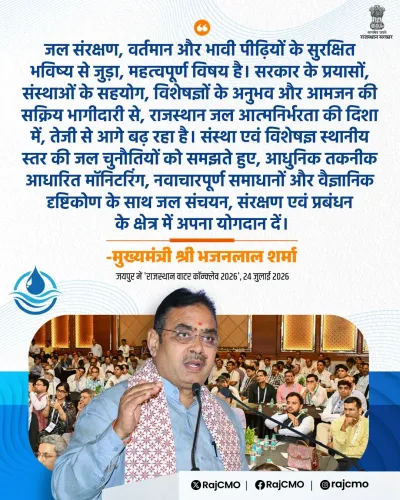
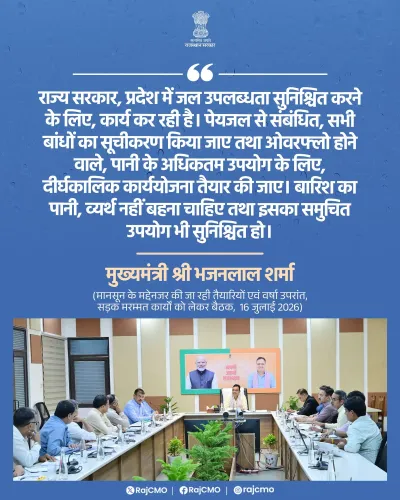
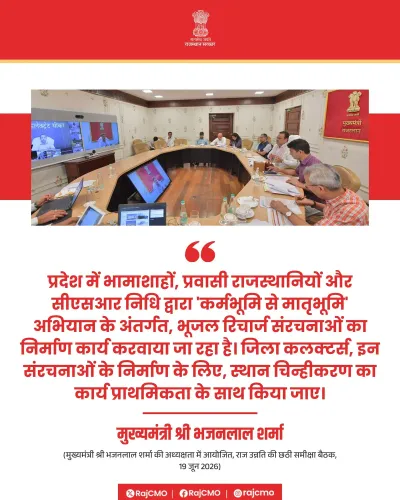
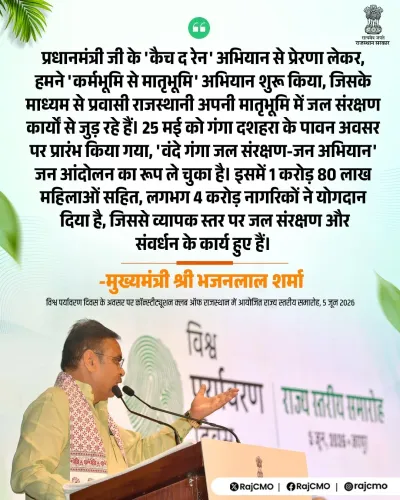
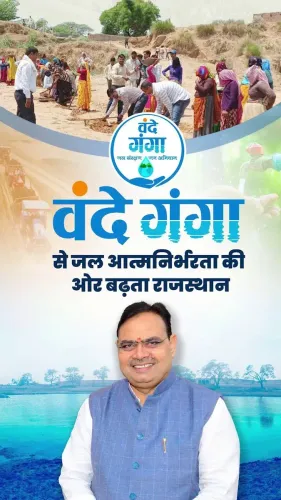
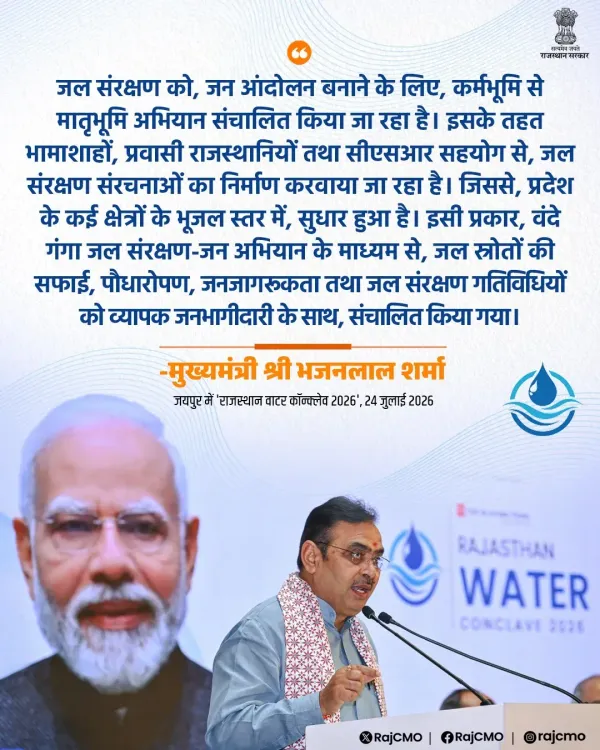
The Chief Minister's Office of Rajasthan announced on Saturday, 25 July 2026 that a new campaign is being run to transform water conservation into a mass public movement, tagging Chief Minister Bhajanlal Sharma and invoking the state's flagship Aapno Agrani Rajasthan (Our Leading Rajasthan) vision.
The post states: 'Jal sanrakshan ko, jan andolan banane ke liye, Karmabhoomi se Matrubhoomi Abhiyan sanchaalit kiya ja raha hai' — 'To make water conservation a people's movement, the Karmabhoomi se Matrubhoomi (From Land of Work to Motherland) campaign is being run.'
Context
Rajasthan is one of India's most water-stressed states, with large swathes of its 342,239 sq km area falling in arid and semi-arid zones. Groundwater depletion and erratic monsoon patterns have made water security a perennial governance priority. The state's desert ecology makes community-level conservation efforts critical to long-term agricultural and domestic water supply.
The Karmabhoomi se Matrubhoomi campaign frames water stewardship as a civic duty — linking citizens' everyday work (karmabhoomi) to their obligation toward the land that sustains them (matrubhoomi). The framing is designed to build grassroots ownership rather than relying solely on state infrastructure.
Policy Backdrop
Rajasthan has a documented history of state-led water campaigns. The Mukhya Mantri Jal Swavalamban Abhiyan, launched in 2016, sought to promote rainwater harvesting and community-managed water bodies across the state. That programme demonstrated that structured campaigns with measurable targets could improve local water storage and reduce dependence on groundwater in participating villages.
The current initiative under Chief Minister Bhajanlal Sharma's government sits within a broader national architecture that includes the Jal Jeevan Mission, aimed at piped water supply to every rural household, and the Atal Bhujal Yojana, which targets groundwater management in water-stressed blocks. Rajasthan is a key beneficiary state under both programmes.
Stakeholders and Impact
Farmers and rural communities are the primary stakeholders of this campaign. Agriculture in Rajasthan is heavily dependent on groundwater, and any sustained decline in the water table directly threatens crop yields and livelihoods. Community-driven conservation campaigns have historically helped in recharging local aquifers and reviving traditional water bodies such as baoris (stepwells) and talavs (ponds).
Urban residents, local self-government bodies, and school and college students are also typically mobilised in such state-wide movements, creating awareness around water-use efficiency and reducing wastage in domestic settings.
What's Next
The effectiveness of the Karmabhoomi se Matrubhoomi campaign will be measured by district-level rollout metrics, including the number of water structures created or restored and verifiable changes in groundwater levels during and after the 2026 monsoon season. Rajasthan's annual monsoon window, typically July to September, is the most critical period for rainwater harvesting and aquifer recharge.
If the campaign achieves meaningful community participation, it could serve as a replicable model for other arid states grappling with similar water security challenges — and strengthen the state government's credentials on environmental governance ahead of future electoral cycles.
Point of View
Differentiating itself through a campaign identity rather than purely technocratic announcements. The timing — mid-monsoon, when water harvesting potential is highest — is strategically sound and aligns with national programmes like Jal Jeevan Mission and Atal Bhujal Yojana. Whether the campaign translates into measurable aquifer recharge or remains a communications exercise will depend on district-level accountability mechanisms that have historically been the weak link in such state-wide drives.
NationPress
25 Jul 2026
Frequently Asked Questions
What is the Karmabhoomi se Matrubhoomi Abhiyan in Rajasthan?
The Karmabhoomi se Matrubhoomi Abhiyan is a water conservation campaign launched by the Rajasthan government under Chief Minister Bhajanlal Sharma to turn water-saving into a grassroots public movement, particularly targeting farmers and rural communities across the state.
Who announced the Karmabhoomi se Matrubhoomi campaign?
The campaign was announced by the Chief Minister's Office of Rajasthan on 25 July 2026, tagging Chief Minister Bhajanlal Sharma and linking it to the state's Aapno Agrani Rajasthan vision.
Why does Rajasthan need a water conservation campaign?
Rajasthan is one of India's most water-stressed states, with large arid and semi-arid zones, declining groundwater tables, and agriculture heavily dependent on wells and borewells, making sustained conservation efforts critical.
What was Rajasthan's previous water conservation campaign?
The Mukhya Mantri Jal Swavalamban Abhiyan, launched in 2016, was Rajasthan's earlier flagship water campaign focused on rainwater harvesting and community-managed water bodies, and is seen as a policy predecessor to the current initiative.
How will the success of this Rajasthan water campaign be measured?
Success will be tracked through district-level rollout metrics such as the number of water structures built or restored and measurable changes in groundwater levels, especially during the July-to-September 2026 monsoon season.