Rajasthan CM Bhajan Lal Calls Water Conservation Vital for Future Generations
Synopsis
Chief Minister Bhajan Lal Sharma's office on 24 July 2026 called water conservation a critical issue tied to the secure future of present and future generations, reaffirming Rajasthan's long-standing policy focus on water harvesting, aquifer recharge, and rural water security.
Key Takeaways
The Chief Minister's Office of Rajasthan on 24 July 2026 shared a statement from CM Bhajan Lal Sharma emphasising water conservation as vital for present and future generations.
Rajasthan is one of India's most water-stressed states, with large arid and semi-arid zones and declining groundwater tables.
The state's Mukhya Mantri Jal Swavalamban Abhiyan , launched in 2016 , promotes village-level water self-reliance through community tanks and recharge structures.
The central Jal Jeevan Mission (announced 2019 ) and Jal Shakti Abhiyan complement Rajasthan's state-level conservation efforts.
Key stakeholders include farmers , rural households , and urban local bodies across the state.
Budget allocations for 2026-27 and the upcoming monsoon session of the Rajasthan Legislative Assembly will be watched for concrete policy follow-through.
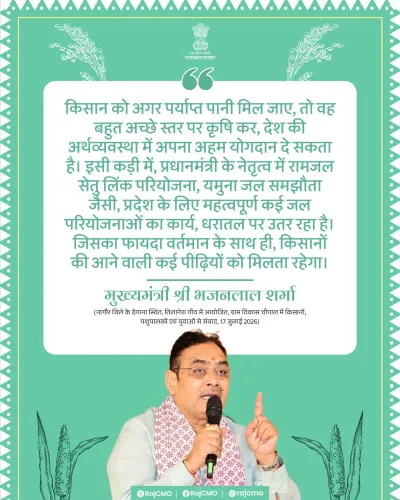
The Chief Minister's Office of Rajasthan on Friday, 24 July 2026, shared a statement from Chief Minister Bhajan Lal Sharma underscoring water conservation as a critical issue tied to the security of present and future generations, marking a renewed public emphasis on the state's long-standing water stewardship agenda.
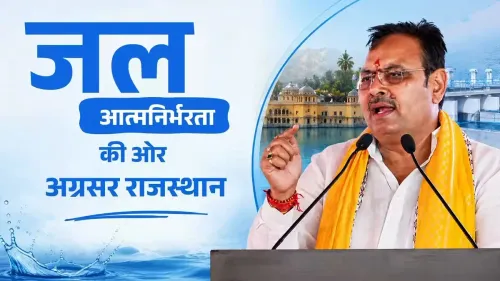
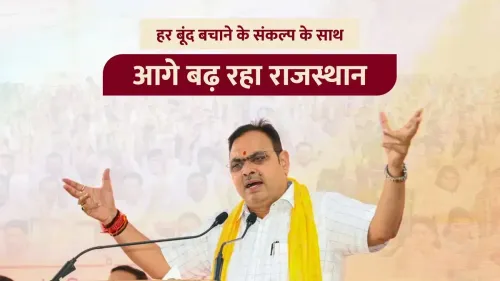
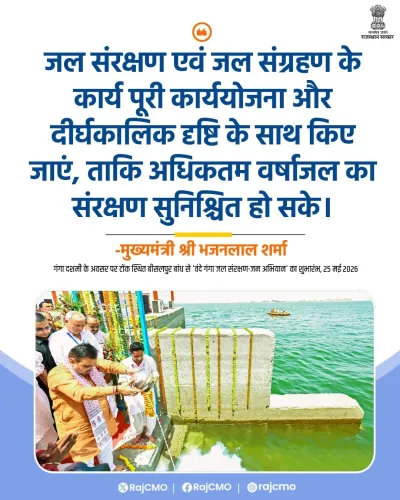
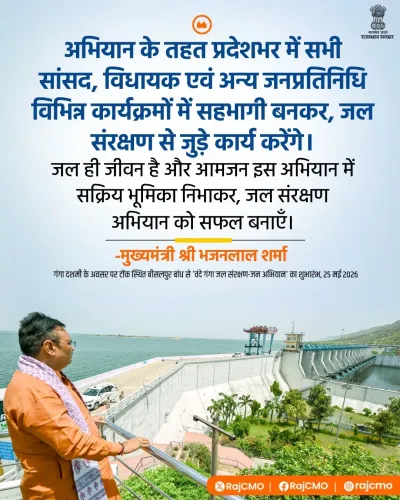
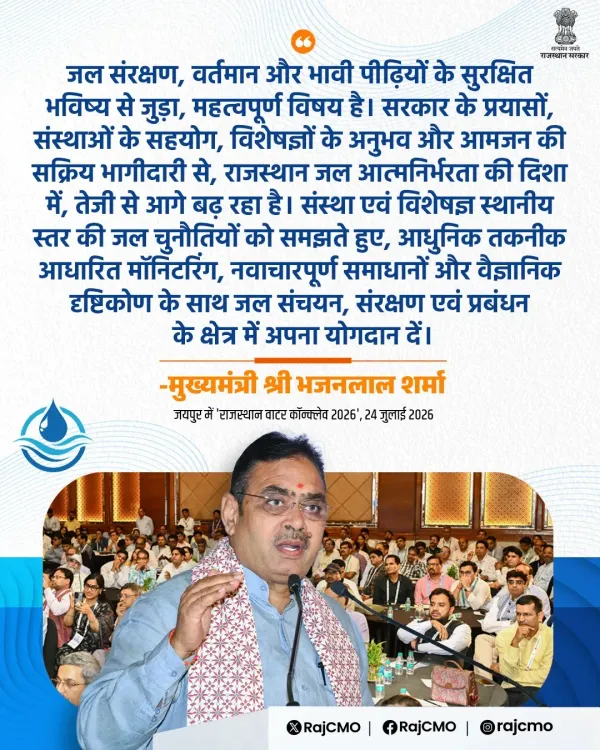
The post, shared under the hashtag #आपणो_अग्रणी_राजस्थान ('Our Leading Rajasthan'), quoted CM Bhajan Lal Sharma as saying: 'Water conservation is an important subject linked to the secure future of present and future generations.' The message was accompanied by an image, signalling a deliberate public communication push on the issue.
Context
Rajasthan is one of India's most water-stressed states, with large swathes of its geography classified as arid or semi-arid. Declining groundwater tables and erratic monsoon patterns have made water security a perennial governance priority across successive administrations. The July statement arrives during the monsoon season, a period when policy attention to water harvesting and recharge structures traditionally intensifies.
The Chief Minister's framing — connecting conservation to the welfare of future generations — mirrors the language increasingly embedded in India's sustainable development discourse, aligning state messaging with broader climate-resilience goals.
Policy Backdrop
Rajasthan has a documented lineage of water conservation policy. In 2016, the state launched the Mukhya Mantri Jal Swavalamban Abhiyan, a flagship programme aimed at achieving village-level water self-reliance through the construction of community tanks, check dams, and aquifer recharge structures. The scheme mobilised communities across hundreds of villages to build decentralised water-harvesting infrastructure.
At the national level, the Jal Jeevan Mission, announced in 2019, has provided funding for household tap connections and source sustainability works across the state. Rajasthan has also integrated its watershed management efforts with the Jal Shakti Abhiyan, a central campaign that promotes intensive water conservation in water-stressed districts. Together, these programmes form the policy scaffolding within which CM Sharma's statement is situated.
Stakeholders and Impact
The constituencies most directly affected by water security in Rajasthan are farmers, who depend on reliable irrigation and groundwater access for crop cycles, and rural households, particularly women and children, who bear the burden of water scarcity in arid districts. Urban local bodies in cities such as Jaipur, Jodhpur, and Bikaner also face growing demand-supply gaps as urban populations expand.
A sustained policy focus on conservation structures and aquifer recharge has the potential to reduce dependence on over-extracted groundwater, improve agricultural resilience, and ease the domestic water burden on rural communities. The Chief Minister's public reaffirmation of this priority signals continued administrative attention to these outcomes.
What's Next
Observers will watch the Rajasthan state budget allocations for 2026-27 and any district-level water security plans that may be announced during the monsoon session of the Rajasthan Legislative Assembly for concrete follow-through on the stated priority. Any expansion of existing schemes or launch of new conservation initiatives would be the next measurable step after this public messaging.
With India's water table under increasing stress from climate variability and population growth, Rajasthan's ability to translate political commitment into durable infrastructure will remain a key test of the Bhajan Lal Sharma government's environmental governance record.
Point of View
The CMO appears to be laying rhetorical groundwork for potential policy announcements in the upcoming assembly session or the 2026-27 budget cycle. The statement also reinforces the BJP government's continuity with Rajasthan's bipartisan tradition of water harvesting policy, lending it cross-political legitimacy. Whether the messaging translates into measurable scheme expansion or fresh capital allocation will determine its real political weight.
NationPress
23 Oct 2026
Frequently Asked Questions
What did Rajasthan CM Bhajan Lal Sharma say about water conservation?
CM Bhajan Lal Sharma stated that water conservation is an important subject linked to the secure future of present and future generations, as shared by the Chief Minister's Office on 24 July 2026.
What is the Mukhya Mantri Jal Swavalamban Abhiyan in Rajasthan?
The Mukhya Mantri Jal Swavalamban Abhiyan is a Rajasthan state scheme launched in 2016 to achieve village-level water self-reliance by constructing community tanks, check dams, and aquifer recharge structures.
Why is water conservation so important for Rajasthan?
Rajasthan has large arid and semi-arid zones with declining groundwater tables and erratic monsoons, making water security a persistent challenge for farmers, rural households, and urban populations alike.
How does the Jal Jeevan Mission help Rajasthan?
The Jal Jeevan Mission, announced in 2019, provides central funding for household tap connections and source sustainability works in Rajasthan, complementing the state's own water conservation programmes.
What policy developments should be watched after CM Bhajan Lal's water conservation statement?
Observers are watching Rajasthan's state budget allocations for 2026-27 and any district-level water security plans or scheme expansions that may be announced in the monsoon session of the Rajasthan Legislative Assembly.