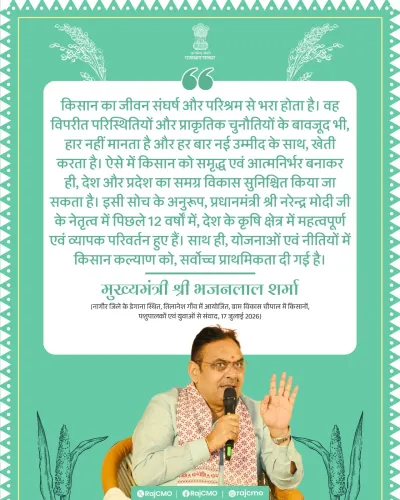
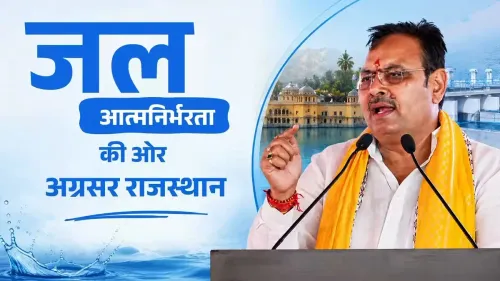
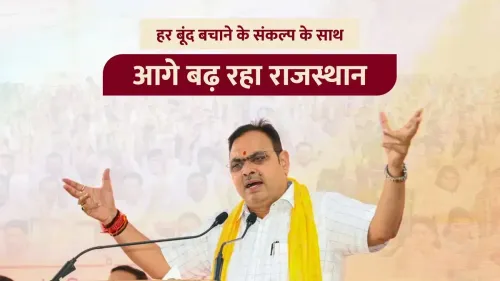
CM Bhajan Lal: Water Access Key to Farmer Prosperity in Rajasthan
Synopsis
Rajasthan Chief Minister Bhajan Lal Sharma has asserted that adequate water supply is the foundation of strong agricultural output, framing irrigation access as central to farmers' contribution to India's economy — a statement aligned with the state's long-running water self-reliance agenda.
Key Takeaways
The Chief Minister's Office of Rajasthan shared a statement on 18 July 2026 from CM Bhajan Lal Sharma linking adequate water access directly to farmer prosperity and national economic contribution.
The post was tagged #आपणो_अग्रणी_राजस्थान ('Our Leading Rajasthan'), the government's development branding hashtag.
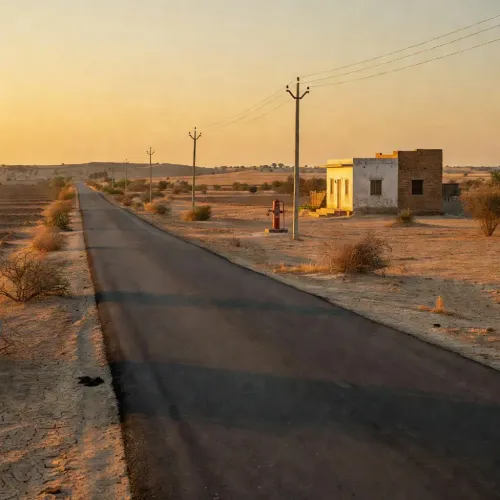
Rajasthan is one of India's most water-stressed states, with large arid and semi-arid zones making irrigation infrastructure critical to farm output.
The Mukhya Mantri Jal Swavalamban Abhiyan (launched 2016 ) and the Pradhan Mantri Krishi Sinchayee Yojana (from 2015 ) form the policy backbone for water security efforts in the state.
Budget allocations for lift irrigation and drip irrigation projects in the upcoming kharif season will be a key indicator of how the government acts on this stated priority.
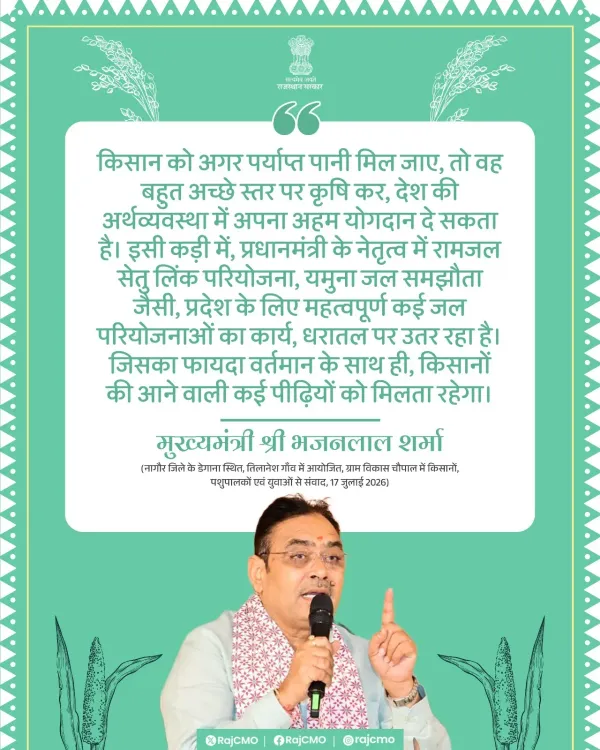
The Chief Minister's Office of Rajasthan, on Saturday, 18 July 2026, shared a statement from Chief Minister Bhajan Lal Sharma underlining that adequate water supply is the single most decisive factor in enabling farmers to contribute meaningfully to India's economy.
The post, attributed to CM Bhajan Lal Sharma and tagged with the hashtag #आपणो_अग्रणी_राजस्थान ('Our Leading Rajasthan'), states in Hindi: 'किसान को अगर पर्याप्त पानी मिल जाए, तो वह बहुत अच्छे स्तर पर कृषि कर, देश की अर्थव्यवस्था में अपना अहम योगदान दे सकता है।' In English: 'If a farmer gets adequate water, he can practise agriculture at a very high level and make an important contribution to the country's economy.'
Context
Rajasthan is one of India's largest states by area and among its most water-stressed, with large swathes of the Thar Desert and semi-arid terrain covering western and central districts. Agricultural productivity in the state is heavily contingent on monsoon reliability and the availability of supplemental irrigation infrastructure. The Chief Minister's statement reflects a long-standing policy consensus that water security and farm income are inseparable in this geography.
The hashtag #आपणो_अग्रणी_राजस्थान — translating to 'Our Leading Rajasthan' — has been used by the Bhajan Lal Sharma government as a branding motif for its development agenda, signalling an aspiration to position the state as a front-runner in governance and economic growth.
Policy Backdrop
Rajasthan has pursued water self-reliance through multiple schemes over successive governments. The Mukhya Mantri Jal Swavalamban Abhiyan, first launched in 2016, aimed to build community water-harvesting structures — including tanks, check dams, and watershed works — to recharge groundwater and support rain-fed agriculture across arid districts.
Alongside state-level efforts, the central government's Pradhan Mantri Krishi Sinchayee Yojana, rolled out from 2015 onward, has channelled funds into expanding irrigated area and promoting micro-irrigation techniques such as drip and sprinkler systems. Rajasthan has been a key beneficiary state given its acute irrigation deficit. Together, these schemes form the policy lineage behind CM Sharma's emphasis on water access as a precondition for agricultural growth.
Stakeholders and Impact
Rajasthan's farming community — predominantly dependent on kharif crops such as bajra, moth bean, and guar in the arid west, and on wheat and mustard in the eastern plains — stands as the primary stakeholder. Reliable irrigation directly determines whether smallholder farmers can shift from subsistence cultivation to surplus production, which in turn affects rural household incomes and state GDP.
Rural households, women who often bear the burden of water collection, and agricultural labourers dependent on farm activity are also directly affected by water availability decisions. State budget allocations for lift irrigation projects and expansion of drip infrastructure in the coming kharif season will be closely watched as indicators of how the government translates this stated priority into on-ground investment.
What's Next
The statement is likely to set the tone for upcoming policy announcements tied to the agricultural calendar, with the kharif sowing season already under way. Observers will look for district-level reporting on irrigated area expansion and any fresh budgetary commitments to water infrastructure in Rajasthan's arid and semi-arid belts.
If the government follows through with enhanced irrigation allocations, the move could measurably improve crop yields in water-scarce districts, reduce farmer distress, and strengthen the state's broader economic output — aligning with the 'leading Rajasthan' vision the Chief Minister has publicly championed.
Point of View
Anchoring his government's rural welfare credentials in the language of economic productivity rather than just welfare relief — a framing designed to broaden political appeal beyond the farm vote. Rajasthan's chronic water scarcity makes irrigation a perennially potent issue, and invoking it publicly allows the BJP government to keep continuity with past state schemes while projecting its own development vision. The 'Our Leading Rajasthan' hashtag suggests a concerted effort to build a regional identity around governance performance. Whether the rhetoric translates into measurable irrigation expansion will determine its durability as a political asset.
NationPress
17 Oct 2026
Frequently Asked Questions
What did Rajasthan CM Bhajan Lal Sharma say about farmers and water?
CM Bhajan Lal Sharma stated that if a farmer receives adequate water, he can practise agriculture at a high level and make an important contribution to India's economy.
What is the Mukhya Mantri Jal Swavalamban Abhiyan in Rajasthan?
The Mukhya Mantri Jal Swavalamban Abhiyan is a Rajasthan state scheme launched in 2016 to promote water self-reliance through community water-harvesting structures such as tanks, check dams, and watershed works in rural areas.
Why is water access so important for farmers in Rajasthan?
Rajasthan is one of India's most water-stressed states, with large arid and semi-arid regions. Irrigation availability directly determines whether farmers can move beyond subsistence farming to surplus production, affecting both rural incomes and the state's GDP.
What is the hashtag #आपणो_अग्रणी_राजस्थान used for?
The hashtag translates to 'Our Leading Rajasthan' and is used by the Bhajan Lal Sharma government as a branding motif for its development and governance agenda.
Which central scheme supports irrigation expansion in Rajasthan?
The Pradhan Mantri Krishi Sinchayee Yojana, implemented from 2015 onward, has channelled central funds into expanding irrigated area and promoting micro-irrigation techniques like drip and sprinkler systems across Rajasthan.