Rajasthan CMO: Rs 750 Cr for RUHS Super-Specialty Upgrade
Synopsis
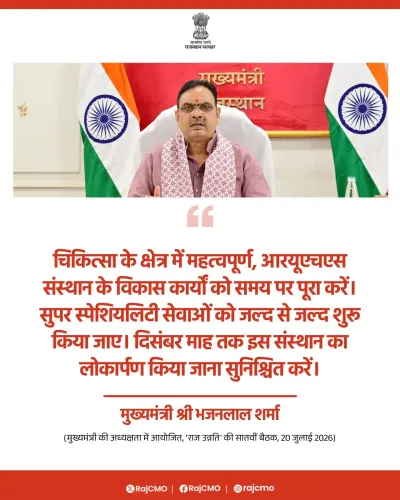
The Chief Minister's Office of Rajasthan has announced Rs 750 crore for super-specialty medical facilities across 13 departments at RUHS, Jaipur — one of the state government's largest single-institution health infrastructure commitments under CM Bhajanlal Sharma.
Key Takeaways
Rs 750 crore will be spent on super-specialty medical facility development at RUHS, Jaipur .
The investment covers 13 departments within the university hospital complex.
The announcement was made by the Chief Minister's Office of Rajasthan on 21 July 2026 , attributed to CM Bhajanlal Sharma .
RUHS was established in 2005 and is the apex body for government health sciences education in Rajasthan.
The outlay aligns with the state's 'Aapno Agrani Rajasthan' development campaign.
Phased budget releases and faculty recruitment will determine the pace of implementation.
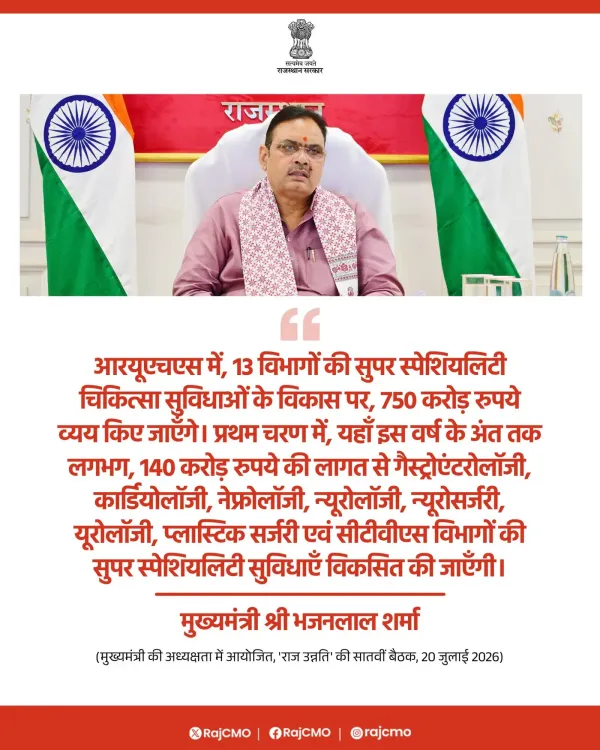
The Chief Minister's Office of Rajasthan announced on Tuesday, 21 July 2026 that Rs 750 crore will be spent on developing super-specialty medical facilities across 13 departments at the Rajasthan University of Health Sciences (RUHS), Jaipur. The announcement, attributed to Chief Minister Bhajanlal Sharma, was shared under the campaign hashtag #आपणो_अग्रणी_राजस्थान ('Our Leading Rajasthan').
Context
The post states: 'आरयूएचएस में, 13 विभागों की सुपर स्पेशियलिटी चिकित्सा सुविधाओं के विकास पर, 750 करोड़ रुपये व्यय किए जाएँगे' — meaning, 'At RUHS, Rs 750 crore will be spent on developing super-specialty medical facilities across 13 departments.' The scale of the outlay signals one of the larger single-institution health infrastructure commitments announced by the current Rajasthan government.
RUHS was established by an Act of the Rajasthan Legislature in 2005 to consolidate medical, dental, nursing, and paramedical education that had previously been dispersed across multiple universities. It serves as the apex body overseeing government medical colleges across the state, which has a population exceeding 68 million.
Policy Backdrop
State governments across India have progressively increased capital outlays for super-specialty blocks in public medical universities since the mid-2010s. Rajasthan has followed this broader national pattern, running parallel tracks of upgrading RUHS-affiliated institutions while also supporting newer projects such as AIIMS and additional medical colleges.
Chief Minister Bhajanlal Sharma, who took office in December 2023 representing the BJP, has positioned health infrastructure expansion as a central plank of the state's development agenda under the 'Aapno Agrani Rajasthan' ('Our Leading Rajasthan') brand. This investment in super-specialty capacity at RUHS fits within that stated priority.
Stakeholders and Impact
The primary beneficiaries of expanded super-specialty infrastructure at RUHS would be patients from across Rajasthan — and adjoining states — who currently travel to metropolitan centres for tertiary care. Strengthening 13 departments within a single public university hospital complex could reduce out-of-pocket costs for patients who depend on government facilities.
Medical faculty, postgraduate residents, and super-specialty students at RUHS stand to benefit from upgraded clinical infrastructure, which typically supports both patient care and research capacity. Phased fund releases in subsequent state budgets and the recruitment of super-specialty faculty will be key indicators of implementation progress.
What's Next
The announcement does not specify a timeline for the Rs 750 crore expenditure or a department-wise breakdown of the allocation. Observers will watch for formal budget notifications, tender issuances, and faculty recruitment drives that would translate this commitment into on-ground construction and service delivery.
If executed at scale, the investment could position RUHS, Jaipur as a significantly stronger hub for tertiary and quaternary public healthcare in northwest India, easing pressure on overburdened district hospitals and reducing patient referral distances across the state.
Point of View
The announcement is as much a political positioning exercise as a policy one, reinforcing the BJP administration's health credentials ahead of future electoral cycles. The real test will be in execution: India's public health capital projects have a well-documented gap between announced outlays and timely disbursement. Watchers should track whether tender issuances and faculty appointments follow within the current fiscal year.
NationPress
21 Jul 2026
Frequently Asked Questions
What is the RUHS super specialty project announced by Rajasthan CMO?
The Rajasthan Chief Minister's Office announced that Rs 750 crore will be spent to develop super-specialty medical facilities across 13 departments at the Rajasthan University of Health Sciences (RUHS) in Jaipur.
How much money is being spent on RUHS development in Rajasthan?
Rs 750 crore has been announced for the development of super-specialty medical facilities at RUHS, Jaipur, covering 13 departments.
What is RUHS and where is it located?
RUHS, the Rajasthan University of Health Sciences, is located in Jaipur and was established in 2005 to oversee medical, dental, nursing, and paramedical education across Rajasthan.
Who announced the Rs 750 crore health investment in Rajasthan?
The announcement was made by the Chief Minister's Office of Rajasthan and is attributed to Chief Minister Bhajanlal Sharma, who has led the BJP government in Rajasthan since December 2023.
What is 'Aapno Agrani Rajasthan'?
'Aapno Agrani Rajasthan' translates to 'Our Leading Rajasthan' and is the development campaign branding used by the Bhajanlal Sharma government to highlight state progress initiatives.