Rajasthan CM Office Announces 'School on Wheels' for Nomadic Children
Synopsis
The Chief Minister's Office of Rajasthan announced a 'School on Wheels' initiative in the state budget on 1 June 2026, promising mobile classrooms for children of nomadic and semi-nomadic communities who are routinely excluded from fixed-location schooling.
Key Takeaways
The Chief Minister's Office of Rajasthan announced the 'School on Wheels' scheme on 1 June 2026 .
The scheme is specifically designed for children of nomadic and semi-nomadic communities such as Banjaras, Raikas, and Gadia Lohars.
The initiative has been formally included in the Rajasthan state budget , signalling an official financial commitment.
The announcement was made by the office of Chief Minister Bhajanlal Sharma , who has led the BJP government in Rajasthan since December 2023 .
Exact funding quantum, number of vehicles, and operational timeline have not yet been specified publicly.
Rajasthan has a history of dedicated welfare provisions for denotified and nomadic tribes under its Social Justice Department.
The Chief Minister's Office of Rajasthan announced on Monday, 1 June 2026 that the state government has included a 'School on Wheels' initiative in its budget, aimed at providing mobile education to children of nomadic and semi-nomadic communities across the state.
Context
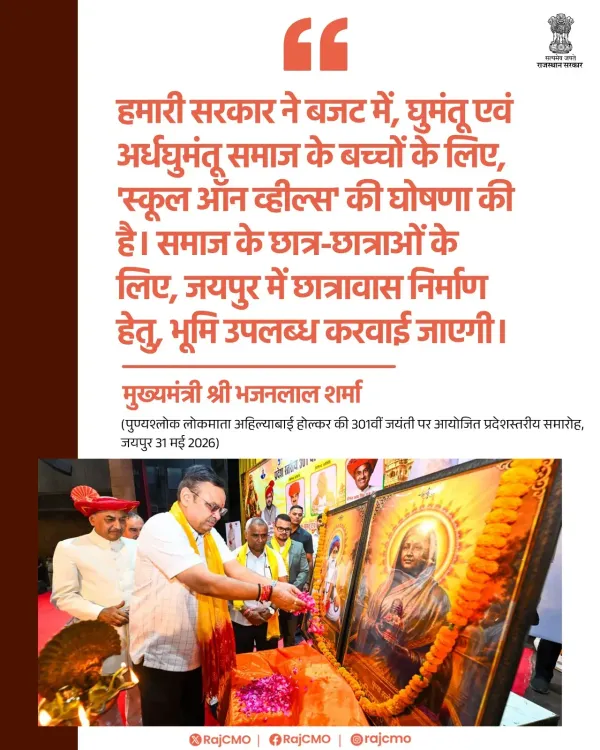
The post, attributed to the office of Chief Minister Bhajanlal Sharma, states in Hindi: 'हमारी सरकार ने बजट में घुमंतू एवं अर्धघुमंतू समाज के बच्चों के लिए, स्कूल ऑन व्हील्स की घोषणा की है' — ('Our government has announced School on Wheels in the budget for children of nomadic and semi-nomadic communities'). The announcement was made under the hashtag #आपणो_अग्रणी_राजस्थान (Our Progressive Rajasthan), a recurring campaign tag used by the state government.
Rajasthan is home to significant populations of nomadic and semi-nomadic groups, including Banjaras, Raikas, and Gadia Lohars, whose seasonal movement patterns have historically kept their children outside the reach of fixed-location government schools.
Policy Backdrop
Indian states have periodically experimented with mobile and residential schooling models to address the educational disruption caused by pastoralist and artisan communities' migratory cycles. Rajasthan's Social Justice Department has maintained dedicated welfare provisions for denotified, nomadic, and semi-nomadic tribes for several years.
The 'School on Wheels' concept — a mobile classroom unit that travels to where migratory families are camped — represents a direct response to the structural barrier that fixed school infrastructure poses for these communities. By embedding the announcement in the state budget, the Bhajanlal Sharma government signals a formal financial commitment rather than a pilot-level gesture.
Stakeholders and Impact
The primary beneficiaries are children of nomadic and semi-nomadic families in Rajasthan who miss formal schooling due to their households' seasonal relocation. Interrupted schooling has historically led to high dropout rates and low literacy levels among these groups.
Community welfare organisations working with denotified and nomadic tribes, as well as state education department officials and potential NGO or private partners who may be tasked with operating the mobile units, are all key stakeholders in the scheme's eventual rollout.
What's Next
The detailed budget document is expected to contain the scheme's financial outlay, the number of vehicles proposed, and the districts to be covered in the first phase. Tendering processes or NGO partnership announcements would follow as the next concrete implementation steps.
Observers will watch whether the government specifies a launch timeline, a per-vehicle operational budget, and measurable enrolment targets — details that will determine whether 'School on Wheels' moves from a budget line to a functioning programme on the ground.
Point of View
The Bhajanlal Sharma government creates a legislative paper trail that is harder to dismiss as tokenism. The real test will be in execution details — outlay per vehicle, districts covered, and enrolment metrics — which are yet to be disclosed. If implemented at scale, the scheme could meaningfully address one of Rajasthan's most persistent educational equity gaps.
NationPress
15 Oct 2026
Frequently Asked Questions
What is the School on Wheels scheme in Rajasthan?
'School on Wheels' is a mobile education initiative announced by the Rajasthan government in its state budget to provide schooling to children of nomadic and semi-nomadic communities who cannot attend fixed-location schools due to their families' seasonal movement.
Who announced the School on Wheels scheme?
The scheme was announced by the Chief Minister's Office of Rajasthan, attributed to Chief Minister Bhajanlal Sharma , on 1 June 2026 .
Which communities will benefit from School on Wheels in Rajasthan?
Children of nomadic and semi-nomadic communities — including groups such as Banjaras, Raikas, and Gadia Lohars — are the intended beneficiaries of the scheme.
How much funding has been allocated to School on Wheels?
The exact funding quantum, number of vehicles, and district-wise coverage have not been publicly specified yet; these details are expected to be contained in the full budget document.
Has Rajasthan run mobile school programmes before?
Rajasthan has a history of welfare provisions for denotified and nomadic tribes through its Social Justice Department, and Indian states have periodically piloted mobile and residential schooling models, but 'School on Wheels' as announced in the 2026 budget is a new formal scheme.