CM Bhajanlal Pushes Rajasthan Water Self-Reliance Drive
Synopsis
The Chief Minister's Office of Rajasthan on 30 May 2026 declared the state government is continuously working to achieve water self-reliance under PM Modi's leadership. The push aligns with central missions like Jal Jeevan Mission and state schemes targeting Rajasthan's chronic water scarcity.
Key Takeaways
The Chief Minister's Office of Rajasthan posted on 30 May 2026 reaffirming the state's goal of water self-reliance.
Chief Minister Bhajanlal Sharma is leading the state-level implementation under the broader framework set by PM Narendra Modi .
Rajasthan , India's largest state by area, faces chronic water scarcity across its arid and semi-arid zones.
Key policy instruments include the Jal Jeevan Mission (2019), Jal Shakti Abhiyan (2019), and the state's own Mukhyamantri Jal Swavlamban Abhiyan (2016).
Farmers in arid districts and rural households are the primary intended beneficiaries of these water security initiatives.
Progress on tap-water coverage and supplementary budget allocations in the next assembly session will be key indicators to watch.
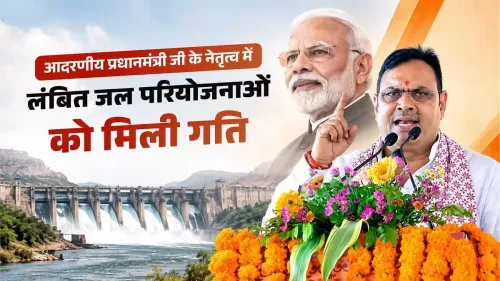
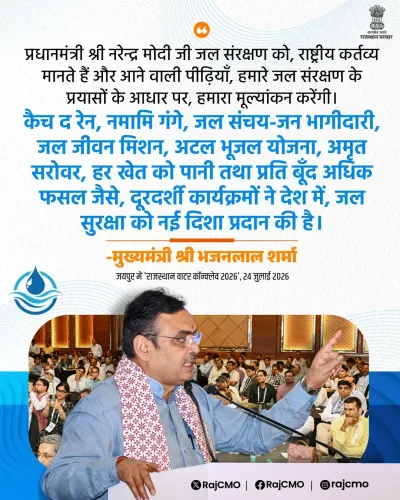
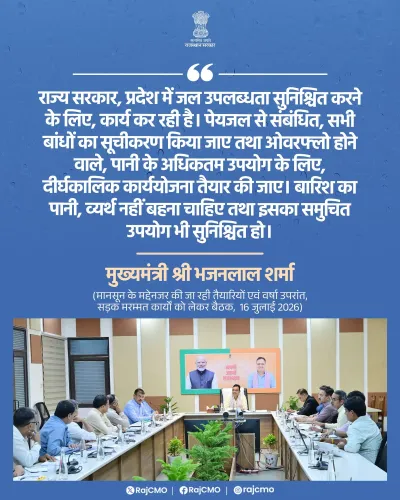
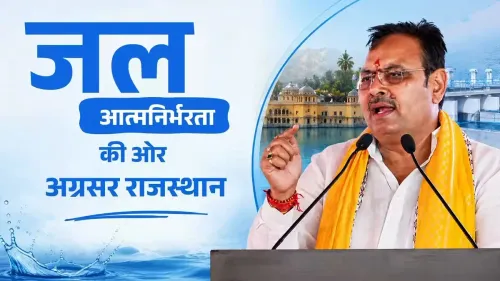
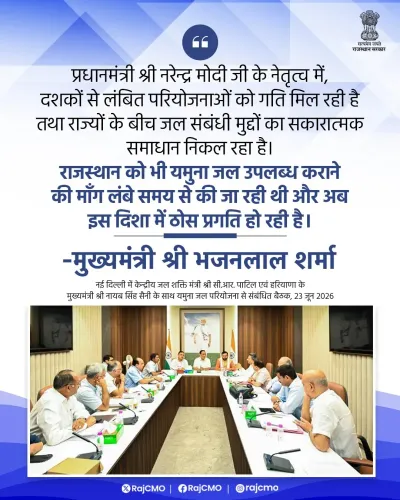
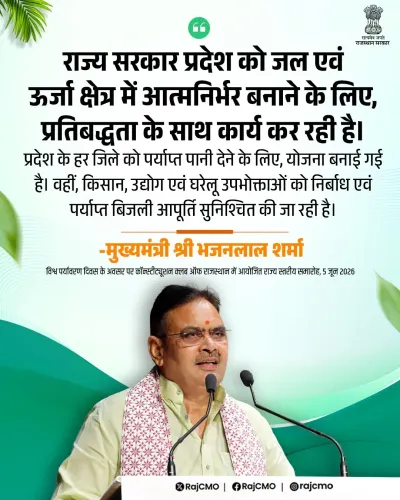
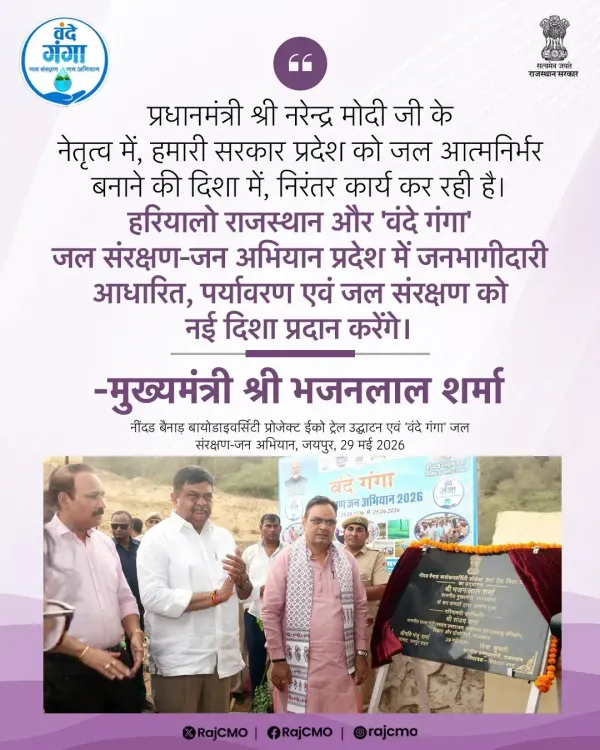
The Chief Minister's Office of Rajasthan on Saturday, 30 May 2026, reaffirmed the state government's commitment to making Rajasthan water self-reliant, citing the leadership of Prime Minister Narendra Modi and the active coordination of Chief Minister Bhajanlal Sharma.
The post, shared from the official @RajCMO handle, stated in Hindi: 'प्रधानमंत्री श्री नरेन्द्र मोदी जी के नेतृत्व में, हमारी सरकार प्रदेश को जल आत्मनिर्भर बनाने की दिशा में, निरंतर कार्य कर रही है' — meaning, 'Under the leadership of Prime Minister Shri Narendra Modi, our government is continuously working towards making the state water self-reliant.' The message was tagged under the hashtag #आपणो_अग्रणी_राजस्थान ('Our Leading Rajasthan'), a branding theme the current BJP government in the state has used to signal development ambitions.
Context
Rajasthan is India's largest state by area and one of its most water-stressed. Large swathes of the state fall within arid and semi-arid zones, where erratic monsoons, declining groundwater tables, and limited perennial river access have historically constrained agriculture and domestic water supply. The challenge of water security has shaped state policy across successive governments. The current BJP government under Chief Minister Bhajanlal Sharma, which assumed office in December 2023, has aligned its water agenda with centrally sponsored programmes, framing water self-reliance as a pillar of its development narrative.Policy Backdrop
The state's approach to water security draws on both legacy state schemes and newer central missions. The Mukhyamantri Jal Swavlamban Abhiyan, launched in 2016, focused on rainwater harvesting and watershed development across villages. Nationally, the Jal Shakti Abhiyan, initiated in 2019, designated 256 water-stressed districts — including several in Rajasthan — for time-bound conservation campaigns. The Jal Jeevan Mission, also launched in 2019 under the central government, has been the flagship vehicle for expanding functional household tap connections in rural areas, with source sustainability as an explicit goal. Rajasthan has been among the priority states for this mission given its geographic vulnerability.Stakeholders and Impact
The primary beneficiaries of water self-reliance efforts in Rajasthan are its farming communities in arid districts and rural households that have historically depended on seasonal or trucked water supply. Groundwater recharge initiatives and canal modernisation projects have direct implications for agricultural productivity and daily domestic needs in districts such as Barmer, Jaisalmer, and Bikaner. The government's framing — invoking Prime Minister Modi's leadership — also signals continued convergence between state-level implementation and centrally funded infrastructure, a pattern consistent with cooperative federalism on environment and natural resources.What's Next
Attention will now turn to concrete progress metrics: tap-water coverage targets under the Jal Jeevan Mission, watershed development milestones, and any supplementary budget provisions for water infrastructure in the upcoming Rajasthan state assembly session. The government's ability to translate its stated commitment into measurable outcomes — particularly in the most drought-prone districts — will determine how this narrative holds up to public scrutiny. With water scarcity remaining a politically and ecologically sensitive issue in the state, announcements of this kind set expectations that will be closely tracked by farmers, civil society, and opposition lawmakers alike.Point of View
Reinforcing BJP's cooperative-federalism branding ahead of any potential policy review or budget cycle. Rajasthan's water crisis is structurally deep, and such statements serve both as governance communication and as pre-emptive credit-claiming for central scheme outcomes. The invocation of 'Jal Atmanirbharta' (water self-reliance) mirrors the broader 'Atmanirbhar Bharat' vocabulary, suggesting a deliberate alignment with the Centre's rhetorical framework. Whether this translates to accelerated on-ground delivery in drought-prone districts remains the critical test.
NationPress
15 Oct 2026
Frequently Asked Questions
What is Rajasthan's water self-reliance plan?
Rajasthan's water self-reliance effort combines central missions like the Jal Jeevan Mission and Jal Shakti Abhiyan with state schemes such as the Mukhyamantri Jal Swavlamban Abhiyan to expand tap-water access, promote rainwater harvesting, and recharge groundwater across the state's arid districts.
What is the Mukhyamantri Jal Swavlamban Abhiyan?
The Mukhyamantri Jal Swavlamban Abhiyan was launched by Rajasthan in 2016 to promote rainwater harvesting and watershed development in villages, aimed at reducing dependence on groundwater and improving water availability in rural areas.
What is the Jal Jeevan Mission and how does it affect Rajasthan?
The Jal Jeevan Mission, launched by the central government in 2019, aims to provide functional household tap connections to every rural home. Rajasthan, being one of India's most water-stressed states, is a priority geography under this mission.
Who is Chief Minister of Rajasthan in 2026?
Bhajanlal Sharma is the Chief Minister of Rajasthan, heading the BJP government that took office in December 2023. He is overseeing the state's water security and development programmes.
Why is water scarcity a problem in Rajasthan?
Rajasthan is India's largest state by area and largely falls within arid and semi-arid zones. Erratic monsoons, declining groundwater levels, and limited perennial river access make water scarcity a chronic challenge for both agriculture and domestic supply across the state.