Rajnath Singh credits RSS with key role in India's defining crises
Synopsis
Union Defence Minister Rajnath Singh on 17 July 2026 posted on X crediting the RSS with a decisive role in safeguarding national interest and democracy across India's most defining crises, from the 1947 Partition and the 1962-65 wars to the integration of Goa and Dadra-Nagar Haveli and the 1975 Emergency.
Key Takeaways
Rajnath Singh posted on X on 17 July 2026 crediting the RSS with protecting national interest and democracy across multiple historical crises.
The post specifically cited the Partition of 1947 , the wars of 1962 and 1965 , integration of Kashmir, Goa and Dadra-Nagar Haveli , and the Emergency of 1975 .
The RSS , founded in 1925 , was banned twice by the Indian government — in 1948 and during the 1975–77 Emergency .
Dadra and Nagar Haveli was integrated into India in 1954 ; Goa was annexed in 1961 .
Senior BJP leaders periodically issue such statements as part of a sustained narrative distinguishing the Sangh Parivar's historical contributions from those of the Congress party .
Opposition responses and any references in upcoming parliamentary sessions are expected to follow.
Union Defence Minister Rajnath Singh on Friday, 17 July 2026, credited the Rashtriya Swayamsevak Sangh (RSS) with playing a pivotal role in protecting national interest, service and democracy across some of India's most turbulent chapters — from the Partition of 1947 to the Emergency of 1975.
Context
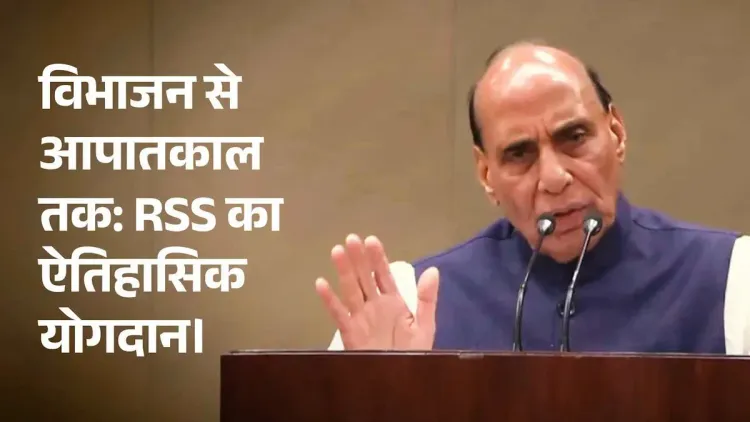
Posting in Hindi on X, Rajnath Singh wrote that from 'देश के विभाजन की विभीषिका' ('the horror of the nation's Partition') through the wars of 1962 and 1965, the integration of Kashmir, Goa and Dadra-Nagar Haveli, and the Emergency of 1975, the RSS had 'played an important role in the protection of national interest, service and democracy in every adverse situation.'
The post carries a video attachment and was published from the minister's verified account. No specific occasion or event was cited in the post, though such statements from senior BJP leaders typically coincide with Sangh-affiliated milestones or ongoing public debate over the RSS's historical legacy.
Policy Backdrop
The RSS, founded in 1925, is the ideological parent organisation of the BJP and describes itself as a Hindu nationalist volunteer body committed to national service and cultural unity. It was banned twice by the Indian government — once in 1948 following the assassination of Mahatma Gandhi, and again during the 1975–77 Emergency, when the organisation became a focal point of underground resistance to the suspension of civil liberties.
The Partition of 1947 triggered mass migration and communal violence that killed over a million people. The 1962 Sino-Indian War resulted in significant military setbacks, prompting a lasting shift in India's defence posture. Dadra and Nagar Haveli was integrated into India in 1954 following local resistance actions; Goa followed in 1961. RSS-affiliated groups have historically claimed roles in the nationalist activities that preceded these integrations, though these attributions remain subjects of historical debate rather than official government record.
Stakeholders and Impact
The statement speaks directly to RSS volunteers and the broader Sangh Parivar ecosystem, reinforcing a narrative that positions the organisation as a consistent force for national cohesion across seven decades of independent India. For BJP supporters, it draws a sharp contrast with the Congress party, which imposed the Emergency and whose governments oversaw the 1962 military defeat.
Opposition parties have historically contested this framing, arguing that the RSS's role in several of these events is overstated or selectively presented. The post is likely to draw responses from political rivals who dispute the characterisation, particularly regarding the Emergency and the 1947 Partition period.
What's Next
Observers will watch for opposition rebuttals in parliamentary sessions or through public statements, as well as whether the post forms part of a coordinated messaging campaign ahead of any RSS foundation-day observances or Sangh Parivar events. Rajnath Singh's continued public affirmations of the RSS's historical role signal that the ruling party intends to keep this narrative prominent in national discourse, particularly as debates over India's institutional history intensify ahead of future electoral cycles.
Point of View
The 1962-65 wars, territorial integrations and the Emergency in a single breath, the statement attempts to make the RSS coextensive with the Indian state's own survival story. This is consistent with a broader BJP strategy of contesting the Congress party's monopoly on the freedom-movement legacy and reframing the post-independence era through a Sangh Parivar lens. The intervention will sharpen an already live debate about the RSS's institutional influence and is likely to provoke pointed counter-narratives from the opposition ahead of future electoral contests.
NationPress
17 Jul 2026
Frequently Asked Questions
What did Rajnath Singh say about the RSS?
Rajnath Singh posted on X on 17 July 2026 that the RSS played an important role in protecting national interest, service and democracy across events including the 1947 Partition, the 1962 and 1965 wars, the integration of Kashmir, Goa and Dadra-Nagar Haveli, and the 1975 Emergency.
What is the RSS and when was it founded?
The Rashtriya Swayamsevak Sangh (RSS) is a Hindu nationalist volunteer organisation founded in 1925. It is the ideological parent body of the BJP and promotes national service and cultural unity.
Was the RSS banned in India?
Yes, the RSS was banned twice — first in 1948 following the assassination of Mahatma Gandhi, and again during the 1975-77 Emergency imposed by Prime Minister Indira Gandhi, when the organisation became a centre of underground resistance.
What role did the RSS play in the 1975 Emergency?
During the 1975-77 Emergency, the RSS was banned and many of its members were jailed for opposing the suspension of civil liberties and press censorship imposed by the Indira Gandhi government. The organisation is credited by BJP leaders with leading democratic resistance during this period.
Why do BJP leaders frequently praise the RSS's historical role?
Senior BJP leaders periodically issue statements crediting the RSS with contributions to national integration and democratic resistance as part of a sustained narrative that distinguishes the Sangh Parivar's historical record from that of the Congress party, particularly on events like the Emergency and post-Partition reconstruction.