Rajnath Singh flags White Collar Terror, Lone Wolf threat
Synopsis
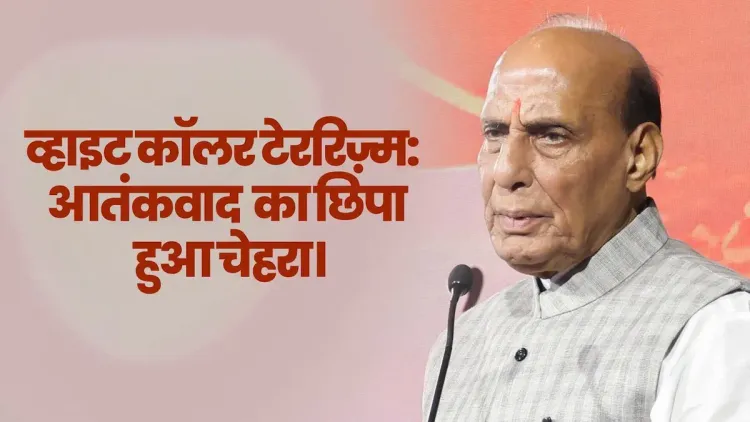
Union Defence Minister Rajnath Singh on October 15, 2026 flagged that white collar terrorism and lone-wolf attacks have merged into a new, faceless challenge for Indian security agencies, calling every citizen's vigilance the country's strongest line of defence.
Key Takeaways
Rajnath Singh posted on October 15, 2026 warning that terrorism threats have evolved beyond organised groups to include white collar terrorism and lone-wolf attacks.
He described these threats as 'faceless' ( adrishya ), making detection harder for conventional security frameworks.
Singh called citizen vigilance and responsibility 'the country's greatest shield' against such threats.
The NIA , set up after the 2008 Mumbai attacks , was designed for organised cross-border threats — the shift to lone actors represents a structural challenge to existing frameworks.
As both a former Home Minister and current Defence Minister, Singh carries direct institutional authority on internal security architecture.
No specific new policy or operational directive was announced; the post signals a doctrinal framing rather than a legislative or executive action.
The enemy, Union Defence Minister Rajnath Singh warned on Thursday, October 15, 2026, no longer wears a uniform or carries an easily traceable identity — and that invisibility is precisely what makes it so dangerous. In a post on X, Singh framed the convergence of 'white collar terrorism' and lone-wolf attacks as the defining security challenge of this moment, and placed the burden of the first line of defence squarely on every Indian citizen.
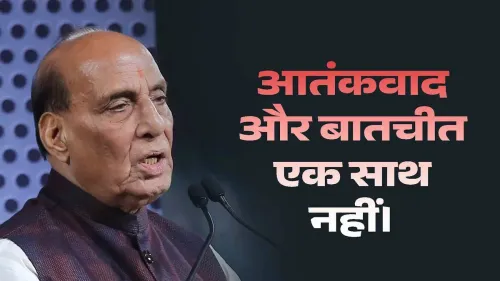
Translating from Hindi, Singh wrote: 'Aaj khatara keval Terrorist Groups tak seemit nahin hai' — 'Today the threat is not limited to terrorist groups alone. The combination of White Collar Terrorism and Lone Wolf Attacks has become a new challenge for security agencies. It is difficult to identify such faceless threats, which is why the vigilance and responsibility of every citizen is today the country's greatest shield.'
The two threats Singh named — and why they matter together
'White collar terrorism' refers to the covert financing, legal-front operations, and digital facilitation that sustain violent networks without a single person ever touching a weapon. 'Lone wolf attacks' describe ideologically motivated violence carried out by individuals who operate outside any formal cell, making pre-emptive detection by agencies exponentially harder. Singh's point is that these two phenomena have begun to feed each other: the former radicalises and resources the latter through online channels, hawala networks, and encrypted communication — all without ever triggering the traditional tripwires that security agencies are built to monitor.
India's security establishment has been tracking this evolution for years. The National Investigation Agency (NIA), established after the 2008 Mumbai attacks, was designed primarily to address organised, cross-border terrorist modules. The drift toward decentralised, self-radicalised actors — many of them with no prior criminal record and a clean professional profile — has compelled a rethink of how intelligence is gathered, shared, and acted upon at every level of government.
Why citizen vigilance is now official doctrine
Rajnath Singh's framing is deliberate and significant. By calling citizen alertness 'the country's greatest shield,' he is effectively articulating a whole-of-society security model — one that moves beyond the assumption that counter-terrorism is exclusively an agency or military function. This is consistent with a broader pattern in Indian official messaging that has increasingly emphasised community-level reporting of suspicious financial activity, online radicalisation, and unusual behavioural signals.
Singh, who has held both the Home Ministry and the Defence Ministry, carries unusual institutional weight when he speaks about internal security architecture. His earlier tenure at the Home Ministry gave him direct oversight of the NIA, the Intelligence Bureau, and state police coordination — which means this is not rhetorical positioning alone. It is a read of the threat landscape from someone who has sat at the centre of it.
The 'faceless' threat and the challenge of standard playbooks
The minister's use of the word 'adrishya' — invisible or faceless — to describe these threats is the sharpest signal in the post. Traditional counter-terrorism frameworks rely on pattern recognition: known associates, travel histories, financial trails, flagged communications. A radicalised professional with no prior contact with monitored networks, acting alone, defeats almost every standard layer of that architecture. The harder question — one Singh raises but does not answer here — is what updated standard operating procedures for state police forces or new public-awareness mechanisms might look like in response.
What the Defence Minister has done is name the problem clearly and publicly. The policy response — and whether it follows — is the next thing to watch.
Point of View
He is signalling that the institutional architecture — built around the NIA and state police coordination — has limits it cannot overcome without community-level intelligence. For a minister who has held both Home and Defence portfolios, this is less a rhetorical flourish and more an honest public acknowledgement that the threat curve has outpaced the detection curve. The unresolved question his post raises is whether revised SOPs and public-awareness mechanisms will follow the doctrine.
NationPress
15 Oct 2026
Frequently Asked Questions
What is white collar terrorism according to Rajnath Singh?
Rajnath Singh used the term to describe covert financing, legal-front operations, and digital facilitation that sustain violent networks — carried out by individuals with clean professional profiles who never directly touch weapons.
What is a lone wolf attack and why is it hard to detect?
A lone wolf attack is carried out by an ideologically motivated individual acting alone, outside any formal terrorist cell. Because there are no known associates or monitored communications to track, traditional intelligence tripwires often fail to flag such actors in advance.
Why is Rajnath Singh talking about terrorism — isn't he the Defence Minister?
Rajnath Singh is the Union Defence Minister, but he also served as Union Home Minister and has deep experience with internal security architecture. Terrorism threats that blend financing networks with lone actors increasingly intersect with both internal security and national defence mandates.
What is the NIA and how was it created?
The National Investigation Agency was established by India in 2008 in the aftermath of the Mumbai attacks to handle terrorism cases involving inter-state and cross-border threats. It operates under the Ministry of Home Affairs.
What should citizens do in response to Rajnath Singh's call for vigilance?
Singh called on every citizen to be alert and responsible as the country's 'greatest shield.' While no specific public-awareness campaign was announced in this post, the broader implication is reporting suspicious financial activity, signs of online radicalisation, or unusual behaviour to local authorities.