Rajnath Singh: India Has Power of Argument and Argument of Power
Synopsis
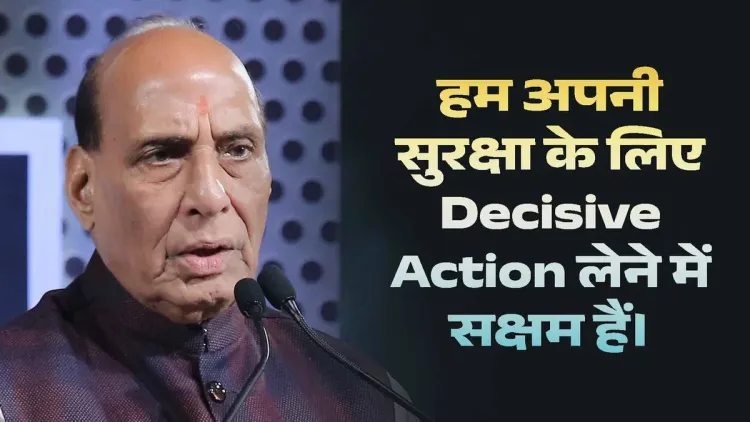
Defence Minister Rajnath Singh declared on 24 September 2026 that India believes in peace, dialogue and diplomacy but is fully capable of decisive action to protect national interests — encapsulating the doctrine as India holding both the 'Power of Argument' and the 'Argument of Power.'
Key Takeaways
Rajnath Singh posted on 24 September 2026 articulating India's twin-track defence and diplomacy doctrine.
India holds both the 'Power of Argument' — diplomacy and dialogue — and the 'Argument of Power' — credible military capability.
The minister stated explicitly: 'Peace is our priority and capability is its foundation.' Singh emphasised India's readiness for 'decisive action' when national security or interests are at stake.
The formulation aligns with India's long-standing 'strategic autonomy' posture combining diplomatic engagement with defence modernisation.
Singh is one of India's most senior political figures, serving as Union Defence Minister after previous roles as Home Minister and Uttar Pradesh Chief Minister.
Peace is the priority — but strength is the foundation. Union Defence Minister Rajnath Singh crystallised India's strategic doctrine in a single, sharply worded post on Thursday, 24 September 2026, drawing a line that is as much a warning as it is a reassurance.
Writing in Hindi, Singh stated: 'भारत शांति, संवाद और डिप्लोमेसी में विश्वास रखता है, लेकिन राष्ट्रीय सुरक्षा और हितों की रक्षा के लिए निर्णायक कार्रवाई करने में भी सक्षम है।' In English: 'India believes in peace, dialogue and diplomacy, but is also capable of decisive action to protect national security and interests.' He then delivered the rhetorical centrepiece: India possesses both the 'Power of Argument' and the 'Argument of Power' — and its policy is unambiguous: peace is the priority, and capability is its foundation.
The Two-Fisted Doctrine in Plain Language
The formulation is deliberate. 'Power of Argument' signals India's commitment to diplomatic engagement — multilateral forums, bilateral talks, international law. 'Argument of Power' is the blunter edge: a credible, modernised military that makes the diplomatic track worth taking seriously. Neither phrase is decorative. Together they describe a posture India has refined across successive governments — engage first, but never negotiate from weakness.
Singh, one of the country's most senior political figures and a former Union Home Minister and Uttar Pradesh Chief Minister, carries particular weight when articulating strategic red lines. His tenure at the Ministry of Defence has coincided with significant investments in border infrastructure, indigenisation of defence production, and landmark acquisitions. When he speaks about 'decisive action,' the words land with institutional authority.
A Doctrine Older Than Any Single Government
India's 'peace through strength' posture is not new — it traces back to the foundational logic of strategic autonomy that has guided New Delhi's foreign and security policy for decades. What shifts across governments is emphasis and capability. The current administration has leaned harder into the second leg: defence budgets have grown, the domestic defence manufacturing push under initiatives like Aatmanirbhar Bharat has expanded the indigenisation pipeline, and border infrastructure along sensitive frontiers has accelerated.
Singh's framing — peace as priority, capability as its base — threads the two together into a single, publicly stated policy position. It is a message aimed simultaneously at domestic audiences, strategic partners, and any actor weighing the cost of testing India's patience.
Why the Phrasing Matters
In the grammar of strategic communication, the order of the phrases matters. 'Peace is our priority' comes first — that is the default setting. 'Capability is its foundation' comes second — that is the condition that makes peace durable rather than merely hoped for. It is a sequencing India has used at the highest levels before, but rarely packaged this concisely. A seven-word formulation that travels across languages and news cycles is not accidental.
The post arrives against a backdrop of ongoing attention to India's northern and western frontiers, continued diplomacy across the region, and a defence modernisation calendar that keeps the ministry in near-constant public view. Whether the post was prompted by a specific development or represents a periodic restatement of doctrine, the message is the same: India is patient, India is principled — and India is ready.
Point of View
Not a routine platitude. It reasserts the classical deterrence logic at a moment when India's defence modernisation pipeline is visible and its diplomatic engagements are active, signalling continuity of doctrine regardless of the geopolitical moment. For the BJP government, it also serves a domestic function: projecting a leadership that is neither aggressive nor naive, but calibrated. The real test of the doctrine, as always, lies not in the phrasing but in how swiftly and proportionately the 'argument of power' is deployed when diplomacy stalls.
NationPress
24 Sept 2026
Frequently Asked Questions
What did Rajnath Singh mean by 'Power of Argument' and 'Argument of Power'?
'Power of Argument' refers to India's use of diplomacy, dialogue and international engagement to resolve disputes. 'Argument of Power' refers to India's credible military strength that backs those diplomatic efforts and deters aggression.
What is India's stated defence and foreign policy doctrine?
India's stated policy, as articulated by Defence Minister Rajnath Singh, is that peace is the primary goal but it is underpinned by military capability — meaning India pursues diplomacy first but is prepared for decisive action to protect national security.
Why is Rajnath Singh's statement significant?
As Union Defence Minister and one of India's most senior political figures — a former Home Minister and former Chief Minister of Uttar Pradesh — Singh's statements carry institutional authority and are widely read as official policy positions.
What is 'strategic autonomy' in India's defence context?
Strategic autonomy is India's long-standing approach of maintaining independent decision-making in foreign and security policy — engaging multilaterally while building self-reliant military capability — rather than anchoring to any single power bloc.
What is Aatmanirbhar Bharat in defence?
Aatmanirbhar Bharat, or 'Self-Reliant India,' is the government's initiative to indigenise defence manufacturing, reduce import dependence and build a domestic defence industrial base — central to the 'Argument of Power' Singh references.