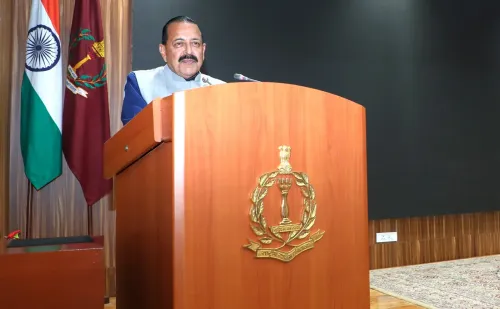
Rajnath Singh: India's defence now targets future warfare

Synopsis
Union Defence Minister Rajnath Singh declared that India's defence preparedness is now oriented toward future warfare, with AI, Quantum and Hypersonic technologies driving a multi-domain capability build-up across the armed forces — backed by DRDO programmes, the National Quantum Mission and the iDEX innovation ecosystem.
Key Takeaways
Rajnath Singh publicly stated that India's defence preparedness is now framed around future warfare , not just present threats.
He named Artificial Intelligence, Quantum technologies and Hypersonic systems as the three pillars of this capability push.
DRDO successfully flew its first Hypersonic Technology Demonstrator Vehicle in 2020 , anchoring the hypersonic programme in verified ground.
The National Quantum Mission includes explicit defence and strategic applications, providing institutional backing for quantum military capability.
The iDEX scheme (launched 2018 ) and Atmanirbhar Bharat form the policy and industrial ecosystem enabling private and startup involvement in advanced defence tech.
India's strategy reflects a global pattern of shifting military planning from conventional platforms to multi-domain, technology-driven deterrence.
India's armed forces are no longer just preparing for today's threats — they are being engineered for the wars of tomorrow. Union Defence Minister Rajnath Singh declared on Sunday, September 27, 2026, that India's defence preparedness has moved beyond present-day challenges, with Artificial Intelligence, Quantum technologies and Hypersonic systems now driving the military's multi-domain capability build-up.
Posting on X, Singh stated — 'भारत की Defence Preparedness अब केवल वर्तमान चुनौतियों तक सीमित नहीं है, बल्कि फ्यूचर वॉरफेयर को ध्यान में रखकर आगे बढ़ रही है' — ('India's defence preparedness is no longer limited to present challenges; it is advancing with future warfare in mind') — and added that the armed forces are continuously strengthening their capability and readiness across every dimension with advanced technologies including AI, Quantum and Hypersonics.
From platform-centric to multi-domain: the strategic pivot
The statement is the clearest ministerial articulation yet of a doctrine that has been quietly reshaping India's defence planning since the late 2010s. The shift — from buying and fielding hardware platforms to cultivating sovereign capability in emerging and disruptive technologies — has been years in the making. Successive defence budgets have channelled resources into AI-driven autonomous systems, quantum communication and long-range hypersonic strike, reflecting an assessment that future conflicts will be decided as much in the digital and quantum domains as on conventional battlefields.
DRDO, India's primary defence research body, demonstrated a key milestone when it conducted its first successful Hypersonic Technology Demonstrator Vehicle (HSTDV) flight in 2020, signalling India's entry into an elite group of nations capable of hypersonic propulsion. That test underpins the longer-range hypersonic strike programme Singh's remarks now publicly anchor to a forward-looking doctrine.
Quantum Mission and iDEX: the policy infrastructure behind the words
The National Quantum Mission, which explicitly incorporated defence and strategic applications when it was framed around 2020, provides the institutional spine for the quantum pillar Singh highlighted. Quantum-secure communications and quantum sensing — both directly relevant to military operations — are among its stated priorities.
On the innovation side, the iDEX (Innovations for Defence Excellence) scheme, launched in 2018, opened the defence technology pipeline to startups and private-sector firms for the first time at scale. That ecosystem now feeds prototype development in AI surveillance, drone swarm management and cyber-hardened command systems — precisely the capabilities a future-warfare doctrine demands. Atmanirbhar Bharat sits over all of it as the strategic imperative to end import dependence in critical technologies.
Why the timing of this message matters
A senior minister's public framing of doctrine is rarely accidental. Singh's post — paired with a video — arrives as India navigates a complex strategic environment involving peer competitors assessed to be advancing their own AI-enabled and hypersonic arsenals. The signal is directed simultaneously inward, at DRDO scientists and defence startups who must deliver on the ambition, and outward, at strategic audiences who read such statements as intent declarations.
The next hard test will come at the next defence budget: whether the R&D allocations for AI, quantum and hypersonic programmes match the scale of the doctrine being proclaimed. Ambition is the easy part. Funding is the proof.
Point of View
Technology-first defence philosophy that has been building in policy documents since 2018. It reinforces the Atmanirbhar Bharat imperative by insisting that strategic autonomy in AI, quantum and hypersonics is not aspirational but operational. The emphasis on 'every dimension' also implicitly addresses critics who argue that India's modernisation has been uneven — heavy on announcements, lighter on verified programme deliverables. Watch whether the next defence budget backs the rhetoric with proportionate R&D allocations: that will determine whether this marks a genuine doctrinal commitment or a well-crafted communications beat.
NationPress
27 Sept 2026
Frequently Asked Questions
What did Rajnath Singh say about India's defence preparedness?
Rajnath Singh said India's defence preparedness is no longer limited to present challenges and is advancing with future warfare in mind, with AI, Quantum and Hypersonic technologies strengthening the armed forces across every dimension.
What is India's hypersonic missile programme?
India's hypersonic programme is led by DRDO , which successfully tested the Hypersonic Technology Demonstrator Vehicle (HSTDV) in 2020 , making India one of a small group of countries with demonstrated hypersonic propulsion capability.
What is the National Quantum Mission and how does it relate to defence?
The National Quantum Mission is an Indian government initiative that includes explicit defence and strategic applications, covering quantum-secure communications and quantum sensing — both directly relevant to military operations.
What is iDEX and how does it support defence innovation in India?
iDEX (Innovations for Defence Excellence) , launched in 2018 , is a scheme that opened India's defence technology pipeline to startups and private-sector firms, accelerating prototype development in areas like AI surveillance, drone systems and cyber-hardened communications.
How is India shifting its defence strategy toward future warfare?
India has moved from a platform-centric modernisation model to a multi-domain capability approach, prioritising AI, quantum, space and hypersonic systems backed by Atmanirbhar Bharat's push for indigenous production and reduced import dependence.