Rajnath Singh: UP moved from 'One District, Many Mafia' to ODOP success
Synopsis
Rajnath Singh's 'One District, Many Mafia to ODOP' line captures the BJP's sharpest political pitch for UP's governance record — framing Yogi Adityanath's administration not just as law-and-order success but as an economic transformation, with Hathras hing and Aligarh locks as the evidence. The speech doubles as both community outreach and a pre-election narrative-setting exercise.
Key Takeaways
Defence Minister Rajnath Singh addressed a Khatik community gathering in New Delhi on 13 September 2026 .
Singh contrasted UP's past 'mafia raj' identity with its current One District, One Product (ODOP) framework, citing exports of Hathras hing , Firozabad glass , Mathura peda , and Aligarh locks .
He credited Chief Minister Yogi Adityanath and the 'double-engine' government for the state's infrastructure and law-and-order turnaround.
Singh honoured the Khatik community's role in the 1857 First War of Independence in Meerut and the 1946 Direct Action Day response led by Gopal Patha .
He urged the community to remain united and resist any attempts to create social divisions.
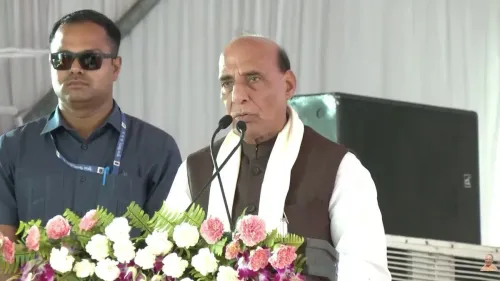
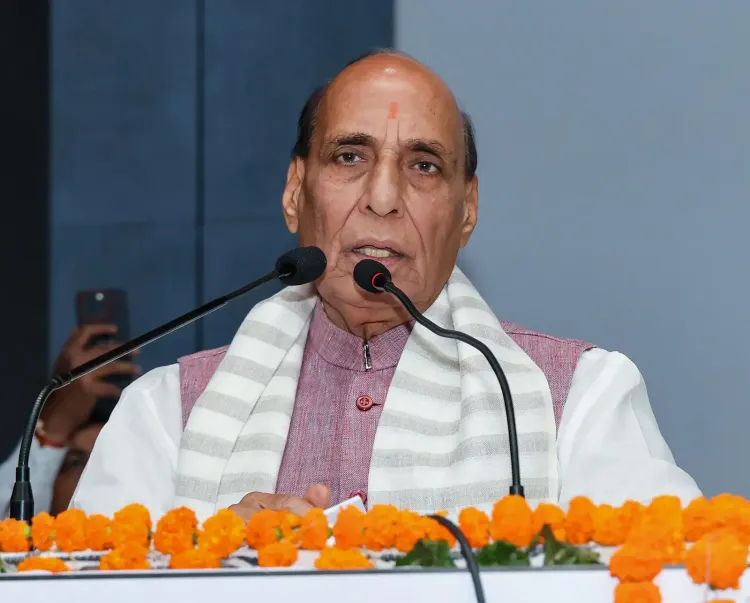
Defence Minister Rajnath Singh on Sunday, 13 September 2026, lauded the Yogi Adityanath government for fundamentally transforming Uttar Pradesh from a state once synonymous with mafia rule and lawlessness into one now earning global recognition for development and law enforcement.
Addressing a gathering of the Khatik community in New Delhi, Singh said the state that was once defined by 'mafia raj', riots, and poor infrastructure is now being celebrated worldwide as a symbol of peace and economic progress.
From Mafia Raj to ODOP: The Core Message
Singh drew a pointed contrast between the state's past and present, framing it around a sharp turn of phrase. "Uttar Pradesh has left behind the identity of One District, Many Mafia and is now known for initiatives like One District, One Dish and One District, One Product (ODOP)," he said. He cited specific examples to illustrate the shift — Hathras's 'hing' (asafoetida), Firozabad's glass sculptures, Mathura's 'peda', and Aligarh's locks — all of which, he claimed, are now gaining international recognition.
The ODOP scheme, a flagship initiative of the Yogi Adityanath administration, aims to identify and promote a distinctive product from each of Uttar Pradesh's districts, connecting local artisans and producers to national and global markets. Critics have noted that while the scheme has raised the profile of traditional crafts, its impact on ground-level incomes has been uneven across districts.
Credit to CM Yogi and the 'Double-Engine' Government
Singh credited Chief Minister Yogi Adityanath directly for the turnaround, recalling a period when roads were in a dilapidated state and an atmosphere of insecurity prevailed. He argued that the alignment between the state government and the Centre — often referred to as the 'double-engine' government — has accelerated Uttar Pradesh's infrastructure development to a standard he described as globally competitive.
This comes amid the Bharatiya Janata Party (BJP)'s broader political narrative ahead of upcoming state-level electoral cycles, positioning UP's governance record as a model for other states.
Khatik Community's Historical Role Acknowledged
A significant portion of Singh's address was devoted to honouring the historical contributions of the Khatik community. He recalled that in 1946, during the violence of Direct Action Day, members of the Khatik community — led by Gopal Patha — stepped up to protect Hindus in Bengal who were being targeted. He also highlighted the community's role in the First War of Independence fought in Meerut in 1857, noting that despite severe oppression by British rulers, the community sacrificed greatly for India's freedom.
Notably, the invocation of both 1857 and 1946 in a single address underlines a pattern seen in BJP outreach events — connecting community identity to nationalist historical memory as a tool of political consolidation.
Call for Unity and Social Cohesion
Singh concluded his address with a call for unity within the community and society at large, cautioning against attempts to create divisions or rifts. He urged everyone to foster a spirit of love and cooperation, summarising his message as: 'Scatter we shall fall, united we shall shine.' The warning against divisive forces, while not directed at any specific group, comes at a time of heightened community sensitivities in several parts of the country.
As Uttar Pradesh continues to position itself as India's most populous and increasingly investment-friendly state, how effectively the ODOP framework translates into sustained economic gains for traditional artisans will be the real measure of the transformation Singh described.
Point of View
Many Mafia' to ODOP — is politically deft, but it papers over a more complicated reality: ODOP's success has been patchy across UP's 75 districts, and crime data, while improved in some categories, remains contested. Invoking Gopal Patha and 1857 before a community audience is a well-worn BJP playbook move — historical pride as political glue. The larger question is whether UP's development story holds up when tested against per-capita income, unemployment, and artisan income data rather than export showcase products. Rajnath's speech signals that BJP intends to fight the next UP cycle on this governance-and-glory narrative, whether or not the ground data fully supports it.
NationPress
13 Sept 2026
Frequently Asked Questions
What did Rajnath Singh say about Uttar Pradesh at the Khatik community event?
Defence Minister Rajnath Singh said Uttar Pradesh has transformed from a state identified with mafia rule and lawlessness to one celebrated for development initiatives like the One District, One Product (ODOP) scheme. He credited Chief Minister Yogi Adityanath and the 'double-engine' government for the change.
What is the ODOP scheme that Rajnath Singh praised?
The One District, One Product (ODOP) scheme is a Uttar Pradesh government initiative that identifies and promotes a signature product from each of the state's districts to link local producers with national and global markets. Singh cited Hathras hing, Firozabad glass sculptures, Mathura peda, and Aligarh locks as examples gaining global recognition.
Who is Gopal Patha and why did Rajnath Singh mention him?
Gopal Patha was a leader of the Khatik community who reportedly organised resistance to protect Hindus during the violence of Direct Action Day in 1946 in Bengal. Singh invoked his name to honour the community's historical contributions to protecting citizens and fighting for Indian independence.
Why did Rajnath Singh address the Khatik community?
Singh addressed the Khatik community gathering to acknowledge their historical bravery — including roles in the 1857 First War of Independence in Meerut and the 1946 Direct Action Day — and to urge unity and social cohesion. The event also served as a platform for the BJP's governance narrative around Uttar Pradesh's development record.
What is the 'double-engine government' that Rajnath Singh referred to?
The 'double-engine government' is a BJP phrase describing the alignment between a BJP-governed state and the BJP-led Centre, arguing that political synchrony accelerates development. Singh used the term to credit both the Yogi Adityanath state government and the Modi government at the Centre for Uttar Pradesh's transformation.