Rajnath Singh warns Pakistan: India ready to strike terror-propagating nations
Synopsis
Rajnath Singh’s warning at the NDTV Defence Summit 2026 was not diplomatic boilerplate — it was a precise, public ultimatum: stop exporting terrorism or India will act. With the Pahalgam attack’s memory still raw and bilateral ties at rock bottom, the Defence Minister has effectively shut the door on dialogue until Pakistan changes course.
Key Takeaways
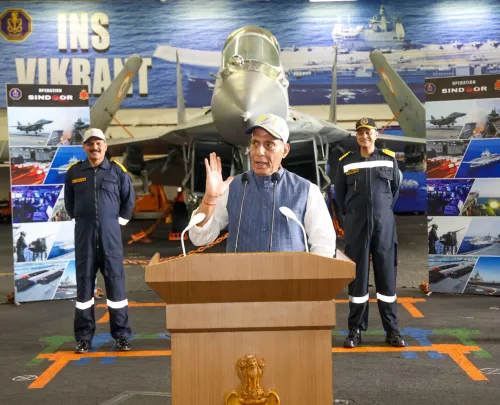
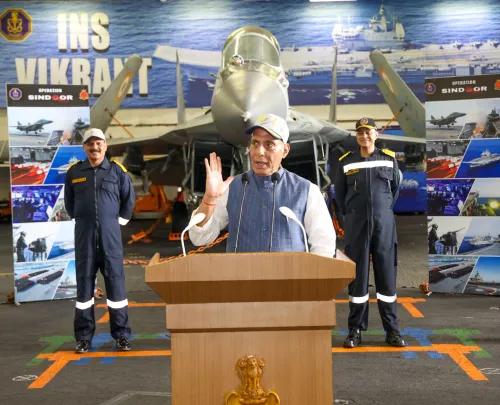
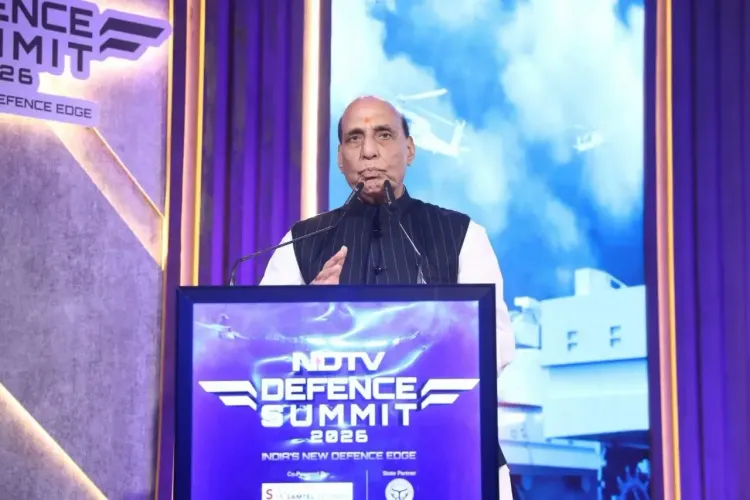
Defence Minister Rajnath Singh warned on 27 September 2026 that India is prepared to strike terrorists in any neighbouring country that ‘propagates terrorism.’ The remarks, made at the NDTV Defence Summit 2026 in New Delhi , were a veiled but pointed reference to Pakistan .
Singh stated that dialogue ‘will end then and there’ if any country supports terrorism, conditioning engagement on a halt to cross-border militant activity.
The warning follows the 22 April 2025 Pahalgam attack in Jammu and Kashmir , in which 26 people were killed by Pakistan-based terrorists.
Singh also outlined India’s Aatmanirbhar defence vision, emphasising domestic manufacturing ‘from chips to ships’ to achieve strategic autonomy.
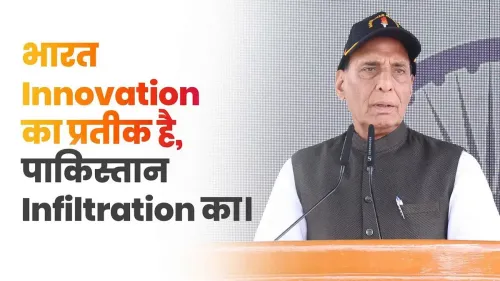
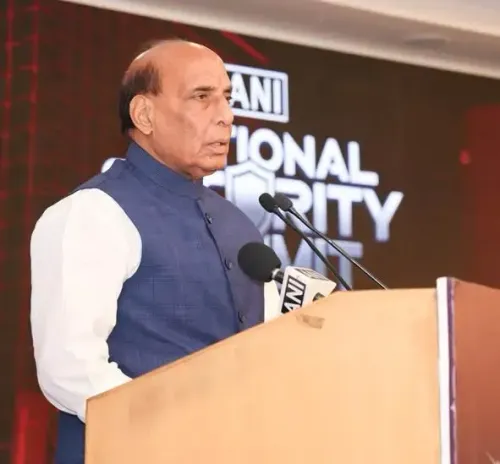
Defence Minister Rajnath Singh on Sunday, 27 September 2026, issued a pointed warning to Pakistan, stating that India stands prepared to carry out strikes against terrorists for as long as any neighbouring country continues to “propagate terrorism.” Speaking at the NDTV Defence Summit 2026 in New Delhi, Singh drew a sharp line between India’s desire for peace and any perception of weakness.
The Warning in Singh’s Own Words
“India believes in peace, does not want war. India does not want to take over another land, does not want to threaten anyone. But there is a difference between silence and weakness,” the Defence Minister said. In what was widely read as a direct reference to Pakistan, he added: “India wants peace, but it will not compromise on its security. Till the time our neighbouring country propagates terrorism, we will be ready for any strikes against terrorists — we want to tell them and the world.”
Singh further underscored that dialogue has its limits: “India believes in dialogue, but if any country propagates terrorism, the dialogue will end then and there.” He added that India “wants cooperation but not at the cost of national interest.”
Context: Pahalgam Attack and India’s Consistent Stance
Singh’s remarks come in the backdrop of India’s longstanding position that Pakistan-based militants have repeatedly targeted Indian civilians and security forces. Most recently, on 22 April 2025, Pakistan-based terrorists attacked tourists in Pahalgam, Jammu and Kashmir, killing 26 people — including one Nepali national — and injuring several others. That attack significantly hardened India’s public posture toward cross-border terrorism. Notably, Sunday’s address represents the sharpest articulation yet of India’s conditions for resuming any form of bilateral engagement.
Defence Readiness and Strategic Autonomy
Beyond the warning, Singh used the summit to outline India’s evolving defence philosophy. He asserted that India’s defence strategy is “future ready,” with energy resources diversified to reduce strategic vulnerability. Invoking a familiar military maxim, he said: “If you want peace, prepare for war… the more you sweat in peace, the less you bleed in war.” He stressed that the modern Indian soldier “operate[s] within a multi-domain environment,” signalling awareness of cyber, space, and information warfare domains.
On domestic defence manufacturing, Singh reiterated India’s Aatmanirbhar Bharat commitment: “Our philosophy is simple: why buy what can be produced here?” He argued that controlling critical links in the defence supply chain is essential for genuine strategic autonomy, adding: “From chips to ships, from screws to complete weapon systems, this will take India to strategic autonomy.”
What This Signals Going Forward
The statement marks a deliberate public escalation in India’s rhetorical posture, delivered at a high-profile media forum rather than through diplomatic back-channels. It places the burden squarely on Pakistan to cease support for militant groups as a precondition for any normalisation of ties. Analysts note that such explicit strike-readiness language from a sitting Defence Minister at a public summit is calibrated for both domestic and international audiences. With bilateral relations at a prolonged low and the Pahalgam attack still fresh in public memory, any near-term diplomatic thaw appears unlikely unless Islamabad signals a concrete policy shift.
Point of View
Designed as much for domestic consumption and international optics as for Islamabad. The framing of ‘silence is not weakness’ echoes the post-Pahalgam political mood, where any suggestion of restraint risks being read as capitulation. What mainstream coverage risks missing: Singh’s conflation of anti-terrorism strikes with strategic autonomy signals that India is building both the political will and the indigenous capability to act unilaterally — and wants Pakistan and the world to know both are in place.
NationPress
27 Sept 2026
Frequently Asked Questions
What did Rajnath Singh say about Pakistan at the NDTV Defence Summit 2026?
Defence Minister Rajnath Singh warned that India is prepared to carry out strikes against terrorists for as long as any neighbouring country — in a clear reference to Pakistan — continues to propagate terrorism. He also stated that dialogue will cease immediately if any country supports terror.
Why did Rajnath Singh issue this warning on 27 September 2026?
Singh’s warning comes against the backdrop of sustained India-Pakistan tensions, including the 22 April 2025 Pahalgam attack in which 26 people were killed by Pakistan-based terrorists. India has consistently held that Pakistan-based militants have carried out multiple attacks on Indian soil over the years.
What is India’s position on dialogue with Pakistan?
According to Singh, India believes in dialogue, but conditions it on the end of state-sponsored or state-tolerated terrorism. He said: ‘If any country propagates terrorism, the dialogue will end then and there.’
What did Rajnath Singh say about India’s defence manufacturing ambitions?
Singh reaffirmed India’s Aatmanirbhar Bharat defence vision, saying the country aims to produce everything ‘from chips to ships, from screws to complete weapon systems.’ He argued that controlling critical parts of the defence supply chain is essential for strategic autonomy.
What was the Pahalgam attack that Singh referred to?
On 22 April 2025 , Pakistan-based terrorists attacked tourists in Pahalgam, Jammu and Kashmir, killing 26 people , including one Nepali national, and injuring several others. India attributed the attack to Pakistan-based militant groups, which significantly escalated bilateral tensions.