Establishing Effective Regulatory Frameworks for Innovation and Fairness: Insights from Jyotiraditya Scindia
Synopsis
In a recent address, Communications Minister Jyotiraditya Scindia emphasized the need for effective regulatory frameworks to balance innovation with fairness and transparency in India's evolving communications landscape. This initiative is critical as the industry transitions from 4G to 5G and beyond.
Key Takeaways
Establishment of regulatory frameworks is essential for balancing innovation and fairness.
TRAI plays a crucial role in ensuring equity in India's communications ecosystem.
Technological advancements necessitate adaptable and transparent regulations.
Universal access to broadcasting is vital for social inclusion.
Maintaining principles of net neutrality is critical as new capabilities are deployed.
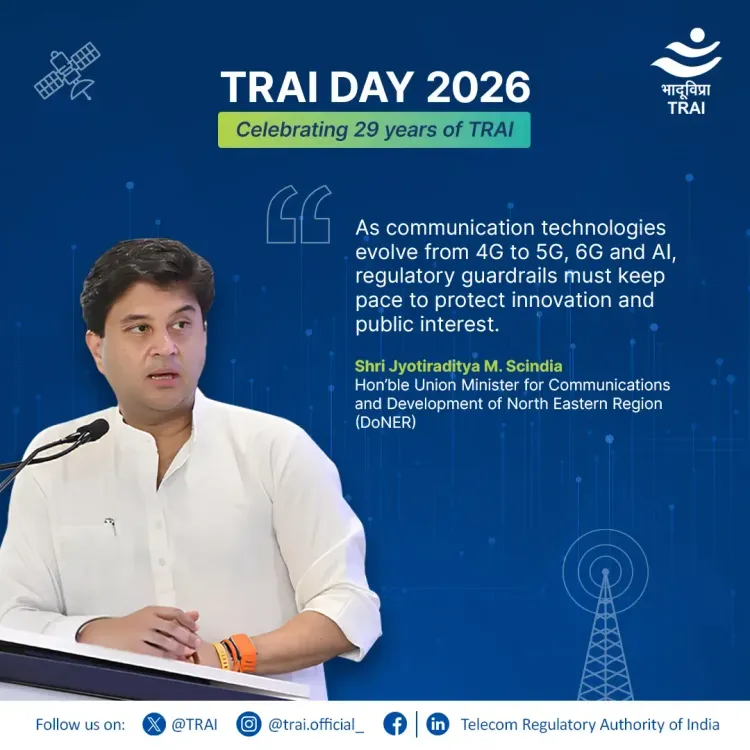
New Delhi, Feb 25 (NationPress) - As emerging technologies are reshaping the communications domain, it is crucial to establish appropriate regulatory frameworks that encourage innovation while ensuring fairness, transparency, and the public interest, stated Communications Minister Jyotiraditya Scindia on Wednesday.
In his remarks during the celebration of the 29th Foundation Day of the Telecom Regulatory Authority of India (TRAI), the minister emphasized its vital role as a foundational entity that promotes equity and a level playing field within India's communications sector.
He also pointed out the swift transition from 4G to 5G, the impending arrival of 6G, and the impact of Artificial Intelligence, commending the inclusion of network slicing in the day's technical discussions.
TRAI Chairman Anil Kumar Lahoti reflected on the Authority's significance as a regulatory body that ensures fair competition and orderly advancement in India's telecom and broadcasting industries.
He mentioned how connectivity now encompasses fixed line, mobile, optical fiber, and satellite networks, facilitating services nationwide.
"The advent of technologies like Artificial Intelligence, 5G, and upcoming 6G networks are transforming the backbone of network architecture and service delivery. As these technologies progress, it is imperative for our regulatory frameworks to be adaptable and transparent, guaranteeing fairness, accountability, and the safeguarding of consumer interests while promoting innovation," he remarked.
TRAI Secretary Atul Kumar Chaudhary reminisced about the Authority's inception in 1997 during India’s shift to a competitive telecom marketplace, highlighting the necessity of an independent regulator in maintaining fair practices, orderly growth, and consumer protection.
The Authority celebrated ‘TRAI Day 2026’ on February 20, 1997, marking 29 years since its establishment. This occasion featured reflections on TRAI's significant contributions to shaping the telecommunications and broadcasting landscape over the years.
Chaudhary emphasized the ongoing importance of television as an accessible medium, especially in rural and semi-urban areas, and stressed that universal access to broadcasting is crucial for social inclusion.
He also noted the rapid advancements in telecom technologies, including network slicing, and underscored the necessity to maintain openness and adhere to the principles of net neutrality as advanced capabilities are implemented.
Members also discussed TRAI’s evolving regulatory philosophy and its pivotal role in guiding India’s communications sector through ongoing technological transitions.
Point of View
Crucial for consumer protection in a rapidly advancing technological landscape.
NationPress
29 Sept 2026
Frequently Asked Questions
What is the significance of the TRAI's 29th Foundation Day?
The TRAI's 29th Foundation Day marks nearly three decades of its role in ensuring fair practices and orderly growth in the telecommunications and broadcasting sectors in India.
How are new technologies impacting communications?
Emerging technologies like 5G and Artificial Intelligence are transforming network architecture and service delivery, necessitating adaptive regulatory frameworks.
Why is net neutrality important?
Net neutrality ensures that all internet traffic is treated equally, promoting fairness and preventing discrimination against specific services or applications.
What role does the TRAI play in consumer protection?
The TRAI acts as an independent regulator that safeguards consumer interests by ensuring fair competition and equitable access to telecommunications services.
What is network slicing in telecommunications?
Network slicing is a technique that allows multiple virtual networks to be created on a single physical network infrastructure, optimizing resource allocation and enhancing service delivery.