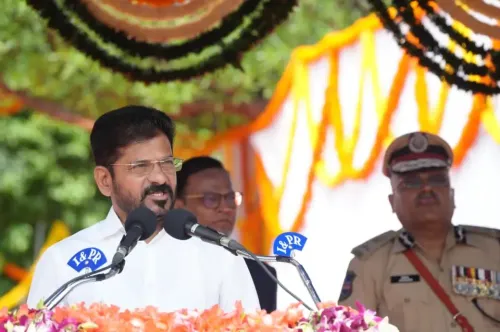
Revanth Reddy invokes Sarvai Papanna Goud to frame Praja Palana as social justice mission

Synopsis
Telangana Chief Minister A. Revanth Reddy invoked Bahujan warrior Sardar Sarvai Papanna Goud on 19 August 2026, framing his government's Praja Palana programme as a social justice mission rooted in the centuries-old struggle of marginalised communities.
Key Takeaways
Revanth Reddy posted on 19 August 2026 invoking the legacy of Sardar Sarvai Papanna Goud , a 17th–18th century Bahujan leader from the Goud community.
The post declares 'social justice as the agenda' of the current Telangana Congress government's Praja Palana framework.
Sarvai Papanna Goud is remembered for leading resistance against Mughal forces and zamindari oppression in the Telangana region.
The Congress government has consistently invoked historical Bahujan figures to differentiate its governance from the previous BRS administration .
The twin hashtags #PrajaPalana and #sardarsarvaipapannagoud signal a deliberate effort to link welfare delivery with Backward Class identity politics.
The spirit of a 17th-century Bahujan warrior is being pressed into the service of 21st-century politics. Telangana Chief Minister A. Revanth Reddy on Wednesday, 19 August 2026, invoked the legacy of Sardar Sarvai Papanna Goud to declare that his government's 'Praja Palana' framework marches forward with social justice as its core agenda.
The post, written in Telugu, frames the Telangana Congress government's governance philosophy in three deliberate layers: the inspiration of Bahujan fighters, the self-respect of the marginalised, and social justice as the operating agenda — 'సామాజిక న్యాయమే ఎజెండాగా' ('social justice as the agenda').
Who was Sarvai Papanna Goud — and why invoke him now?
Sardar Sarvai Papanna Goud was a 17th–18th century leader from the Goud community in the Telangana region, remembered for organising resistance against Mughal forces and zamindari oppression. He is a potent symbol for Backward Class communities across Telangana — a figure who fought entrenched power structures long before the vocabulary of social justice existed.
Invoking him is not incidental. The Telangana Congress government has consistently reached for historical figures from marginalised communities to anchor its welfare narrative, positioning 'Praja Palana' not merely as a scheme-delivery mechanism but as a continuation of a centuries-old struggle for dignity.
Praja Palana and the Congress social-equity playbook
Since taking power in December 2023, the Congress government under Revanth Reddy has sought to distinguish itself from the preceding BRS administration through targeted outreach to Backward Class and Dalit communities. The 'Praja Palana' framework — literally 'People's Governance' — has been the umbrella under which welfare delivery and social justice messaging have been bundled together.
The hashtag #PrajaPalana alongside #sardarsarvaipapannagoud in the Chief Minister's post signals a deliberate alignment: the government wants Bahujan communities to read their historical resistance and the current administration's welfare programmes as a single, unbroken line.
Whether programme rollout and beneficiary coverage match the rhetorical ambition is the question that will define this government's legacy with the very communities it is courting.
Point of View
The Congress government attempts to make welfare delivery feel like historical destiny rather than electoral transaction. This mirrors a broader Congress strategy in Telangana of occupying the social-justice space that the BRS once claimed through Kaleshwaram and KCR's own OBC outreach. The real test will come when beneficiary data and programme outcomes are placed alongside the symbolism — if delivery lags, the historical framing risks looking like theatre.
NationPress
19 Aug 2026
Frequently Asked Questions
Who is Sardar Sarvai Papanna Goud?
Sardar Sarvai Papanna Goud was a 17th–18th century leader from the Goud community in the Telangana region, known for organising resistance against Mughal forces and zamindari oppression. He is considered a Bahujan hero and symbol of backward class self-respect in Telangana.
What is Praja Palana in Telangana?
Praja Palana, meaning 'People's Governance,' is the welfare and governance framework adopted by the Telangana Congress government led by CM A. Revanth Reddy since December 2023. It serves as an umbrella for the government's social justice and welfare delivery programmes.
Why did Revanth Reddy post about Sarvai Papanna Goud?
CM Revanth Reddy invoked Sarvai Papanna Goud to frame his government's Praja Palana programme as a continuation of the Bahujan struggle for dignity and social equity, reinforcing Congress's outreach to Backward Class and Dalit communities in Telangana.
When did the Telangana Congress government come to power?
The Telangana Congress government, led by A. Revanth Reddy, came to power in December 2023 after defeating the Bharat Rashtra Samithi (BRS) in the state assembly elections.
What communities does Praja Palana target?
Praja Palana's social justice agenda is primarily directed at Backward Class (BC), Dalit, and other marginalised communities in Telangana, with the Congress government using Bahujan historical figures to signal its commitment to these groups.