Rijiju Challenges Congress: Apologise for Anti-India Propaganda
Synopsis
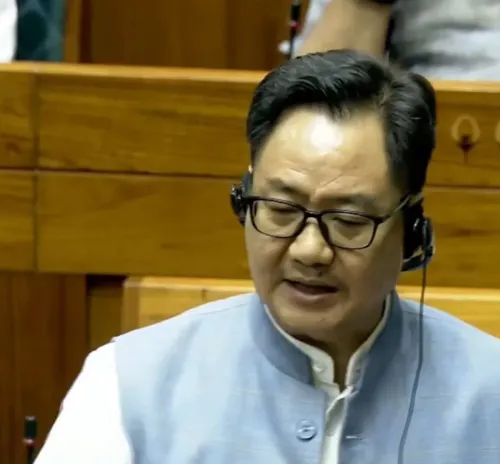
Union Minister Kiren Rijiju publicly challenged the Congress party on 27 October 2026, demanding to know if it had the audacity to support what he called enemy propaganda against India and then refuse to apologise — intensifying an already sharp BJP-Congress political exchange.
Key Takeaways
Union Parliamentary Affairs Minister Kiren Rijiju posted a pointed Hindi-language challenge to the Indian National Congress on 27 October 2026 .
He asked whether Congress had the audacity to openly back 'enemy propaganda' against India without apologising to the nation.
The specific Congress action or statement that triggered the post has not been independently verified.
The rhetoric continues a pattern since 2014 in which BJP leaders accuse Congress of taking positions perceived as soft on national security.
Rijiju represents Arunachal Pradesh , a border state, lending symbolic weight to national-security framing.
Congress had not publicly responded at the time of publication; a parliamentary session confrontation remains a possibility.
A sharp political broadside landed on Tuesday, 27 October 2026, when Union Parliamentary Affairs Minister Kiren Rijiju publicly questioned whether the Indian National Congress had the audacity to openly back what he described as enemy propaganda against the nation — and then walk away without a word of apology to the country.
Posting in Hindi on X, Rijiju asked pointedly: 'कांग्रेस में इतनी हिम्मत है कि वह देश के खिलाफ दुश्मन के दुष्प्रचार का खुलेआम समर्थन करे, और फिर देश से माफी भी न मांगे?' — 'Does Congress have the audacity to openly support the enemy's propaganda against the nation, and then not even apologise to the country?'
A Familiar Battlefield, A Sharper Edge
The post lands squarely in a political conflict that has defined BJP-Congress exchanges for well over a decade. Since 2014, senior BJP leaders have consistently accused the Congress of taking positions they frame as soft on national security — especially on matters relating to Pakistan and China. Rijiju's post sharpens that line considerably, using the word dushman (enemy) and dushprachar (propaganda) — language designed not merely to criticise a political rival but to frame the exchange in the starkest possible national-loyalty terms.
The specific Congress statement or action that prompted this post has not been independently confirmed. What is clear is the register: this is not a policy disagreement. It is an accusation of complicity in a narrative hostile to India, delivered without a diplomatic off-ramp.
Why the Demand for an Apology Matters
Demanding a public apology is a deliberate political manoeuvre. It forces the Congress to choose between two difficult postures: defend the action and risk appearing to validate the 'anti-India' framing, or apologise and implicitly concede the point. Rijiju, a seasoned parliamentarian representing Arunachal Pradesh — a state that sits on India's most sensitive border with China — carries particular symbolic weight when invoking national security concerns.
The tone is combative, but the timing matters too. Political rhetoric of this register typically intensifies around periods of heightened tensions with neighbouring countries, ahead of parliamentary sessions, or in the wake of a specific opposition statement that goes viral. With the next parliamentary session on the horizon, Rijiju's post may well be the opening volley in a floor battle.
Congress has not publicly responded to the post at the time of publication. The opposition's next move — silence, pushback, or counter-accusation — will determine whether this stays a social-media exchange or escalates into the parliamentary chamber itself.
Point of View
' he shifts the debate from policy disagreement to national loyalty, a terrain where the BJP has historically held electoral advantage. Demanding an apology is a pressure tactic that serves dual purposes: it energises the BJP base while placing Congress in a no-win rhetorical trap. The post's timing, ahead of a likely parliamentary session, suggests it may be seeding the ground for a floor offensive. Absent the specific Congress statement being identified, however, the attack risks appearing abstract — which could blunt its sharpness if the opposition refuses to engage.
NationPress
27 Oct 2026
Frequently Asked Questions
What did Kiren Rijiju say about Congress on 27 October 2026?
Rijiju posted in Hindi asking whether Congress had the audacity to openly support enemy propaganda against India and then refuse to apologise to the country.
What is 'dushman ka dushprachar' that Rijiju referred to?
The Hindi phrase means 'enemy's propaganda.' Rijiju used it to accuse Congress of backing a hostile narrative against India, though the specific incident he referenced has not been independently confirmed.
Has Congress responded to Rijiju's accusation?
As of the time of publication, Congress had not issued a public response to Rijiju's post.
Why does BJP frequently accuse Congress of being soft on national security?
Since 2014, BJP leaders have framed several Congress positions on Pakistan and China border issues as insufficiently firm, making the 'soft on national security' charge a recurring element of their political messaging against the opposition.
Who is Kiren Rijiju and why does his voice carry weight on security issues?
Kiren Rijiju is the Union Minister of Parliamentary Affairs and Minority Affairs, and a senior BJP leader from Arunachal Pradesh — a state that shares a sensitive border with China — giving his national-security statements added symbolic resonance.