CM Rio Welcomes Tripartite MoU on Nagaland-Assam Oil Proceeds

Synopsis
Nagaland Chief Minister Neiphiu Rio has welcomed a Government of India-facilitated tripartite MoU that provides for equal sharing of mineral oil proceeds in the Assam-Nagaland Disputed Area Belt, calling for early resumption of operations while protecting the state's special constitutional provisions under Article 371A.
Key Takeaways
CM Neiphiu Rio publicly thanked the Government of India for brokering a tripartite MoU on oil-revenue sharing in the Disputed Area Belt (DAB) between Nagaland and Assam .
The MoU provides for equal sharing of proceeds from mineral oil operations in the contested border zone.
Oil exploration in the Assam-Nagaland border belt has been suspended for decades due to unresolved territorial claims and local opposition.
Article 371A of the Constitution, inserted in 1963 , grants Nagaland exclusive rights over its land and resources, a protection Rio explicitly said must be safeguarded.
The Chief Minister called for the early resumption of mineral oil operations across the entire state.
The tripartite structure reflects the Centre's broader strategy of using negotiated MoUs to resolve Northeast India's inter-state resource disputes.
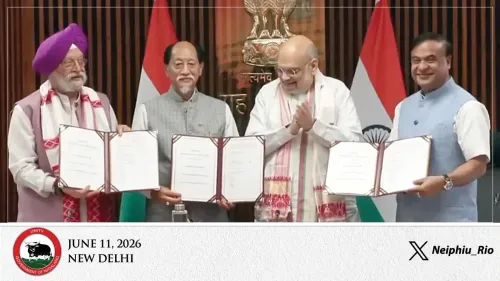
Nagaland Chief Minister Neiphiu Rio on Thursday, June 11, 2026, expressed gratitude to the Government of India for facilitating a tripartite memorandum of understanding that provides for equal sharing of proceeds from mineral oil operations in the Disputed Area Belt (DAB) between Nagaland and Assam. The Chief Minister also called for the early resumption of mineral oil operations across the state, while underscoring the importance of protecting Nagaland's special constitutional provisions.
Context
Rio stated he was 'grateful to GoI for facilitating the Tripartite MoU on equal sharing of proceeds from mineral oil operations in DAB between Nagaland and Assam.' He added that he looks 'forward to early resumption of mineral oil operations for the entire State while safeguarding its special constitutional provisions.' The post signals a significant step toward resolving a long-running resource dispute that has kept oil exploration in the border belt suspended for decades.
The Disputed Area Belt refers to contested border zones between Nagaland and Assam where territorial claims by both states have historically stalled hydrocarbon development. The new MoU, brokered by the Government of India, provides for an equal split of revenues from any oil operations conducted in this sensitive zone.
Policy Backdrop
Article 371A of the Indian Constitution, inserted in 1963, grants Nagaland exclusive rights over its land and natural resources, requiring the state's concurrence before any central legislation on these subjects can apply. This asymmetric constitutional protection has been a central concern in any negotiation involving resource extraction in Nagaland or its border areas.
Inter-state boundary disputes between Nagaland and Assam have persisted since the 1960s, with the central government periodically intervening to maintain peace and enable development. Oil exploration in the border belt has remained largely suspended due to unresolved territorial claims and local opposition, leaving potentially significant hydrocarbon assets idle for years.
The tripartite structure of the MoU — involving Nagaland, Assam, and the Government of India — reflects a model of negotiated federal resource-sharing that the Centre has increasingly favoured over protracted litigation in managing Northeast India's complex inter-state disputes.
Stakeholders and Impact
The agreement has direct implications for Nagaland's tribal communities, who have historically been wary of resource extraction that bypasses customary land rights enshrined under Article 371A. The equal-sharing formula is designed to address both states' fiscal interests while providing a legal framework that does not prejudice the underlying boundary question.
Oil exploration companies — including public-sector undertakings that have long sought access to the belt — stand to benefit from a clearer operational mandate once resumption is authorised. The deal also aligns with national energy-security objectives that seek to revive idle hydrocarbon assets across the Northeast, a region estimated to hold substantial untapped reserves.
For Assam, which hosts major oil and gas infrastructure along its border with Nagaland, the MoU offers a pathway to monetise resources in zones that have been commercially dormant. Both state governments are expected to gain additional non-tax revenues once operations resume.
What's Next
Chief Minister Rio's explicit call for 'early resumption' of mineral oil operations suggests that the political groundwork is in place, but operational timelines remain to be announced. Any restart will likely require coordination with the relevant exploration agencies and further consultations with tribal bodies to ensure compliance with Article 371A protections.
Observers will also watch whether the MoU faces legal challenges that test its compatibility with Nagaland's special constitutional status, or whether it serves as a template for resolving other resource disputes along the Assam-Nagaland border. The broader success of this arrangement could shape how the Centre approaches similar federal resource conflicts across the Northeast in the years ahead.
Point of View
Publicly endorsing the deal while insisting on Article 371A protections is a careful balancing act: it signals cooperative federalism to Delhi while reassuring tribal constituencies that customary rights are non-negotiable. The equal-sharing formula also sets a precedent that other contested resource zones in the Northeast may seek to replicate. Whether the arrangement survives legal scrutiny and translates into actual production will determine its real political value.
NationPress
26 Oct 2026
Frequently Asked Questions
What is the tripartite MoU on Nagaland-Assam oil sharing?
The tripartite MoU is an agreement facilitated by the Government of India between Nagaland and Assam that provides for equal sharing of proceeds from mineral oil operations in the Disputed Area Belt, a contested border zone where oil exploration has been stalled for decades.
What is the Disputed Area Belt between Nagaland and Assam?
The Disputed Area Belt refers to territorially contested border zones between Nagaland and Assam where both states have overlapping claims. Unresolved boundary disputes and local opposition have kept oil exploration in these areas largely suspended since the 1960s.
How does Article 371A affect oil operations in Nagaland?
Article 371A, inserted in the Constitution in 1963, grants Nagaland exclusive rights over its land and natural resources and requires state concurrence before central legislation on these subjects can apply. Any oil operations in Nagaland or its border areas must therefore respect these special constitutional protections.
Why has oil exploration in the Assam-Nagaland border been stalled?
Oil exploration in the Assam-Nagaland border belt has been suspended for decades due to unresolved inter-state territorial claims, local opposition from tribal communities, and the legal complexity introduced by Nagaland's special constitutional status under Article 371A.
What did Nagaland CM Neiphiu Rio say about the oil MoU?
CM Rio expressed gratitude to the Government of India for facilitating the tripartite MoU and called for the early resumption of mineral oil operations across the entire state, while emphasising the need to safeguard Nagaland's special constitutional provisions.