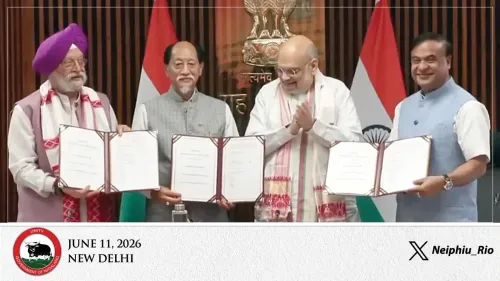
CM Rio Hails Nagaland-Assam MoU as New Era of Brotherhood

Synopsis
Nagaland Chief Minister Neiphiu Rio on June 11, 2026 publicly endorsed a new MoU with Assam, calling it a 'new era of brotherhood.' The pact aims to convert the states' 512-km disputed border into a zone of economic collaboration and shared development under northeastern India's growing bilateral diplomacy framework.
Key Takeaways
CM Neiphiu Rio publicly welcomed the Nagaland-Assam MoU on June 11, 2026 , calling it a 'new era of brotherhood, collaboration, and shared prosperity.' The two states share a disputed boundary of approximately 512 kilometres with a history of periodic clashes dating back decades.
Rio urged that the agreement be implemented 'in both letter and spirit,' signalling awareness of past implementation gaps.
The MoU aligns with a broader northeastern India trend of using bilateral agreements to de-escalate border tensions and promote joint development.
Formation of joint implementation committees and sector-specific follow-up pacts on trade, roads, and resources are the expected next steps.
Assam CM Himanta Biswa Sarma has been a key driver of structured border-management diplomacy in the region.
Nagaland Chief Minister Neiphiu Rio on Thursday, June 11, 2026, publicly welcomed a Memorandum of Understanding between Nagaland and Assam, calling it the opening of 'a new era of brotherhood, collaboration, and shared prosperity' between the two northeastern neighbours.
Context
Responding on X, CM Rio expressed hope that the MoU would be 'implemented in both letter and spirit' — a phrase that signals awareness of the gap between signed agreements and ground-level execution that has historically plagued inter-state compacts in the region. The post marked a rare moment of public, high-level diplomatic warmth between the two states.
Nagaland and Assam share a disputed boundary stretching approximately 512 kilometres, along which friction over land, resources, and administrative jurisdiction has recurred since the 1960s. Earlier rounds of border talks and interim agreements through the 1970s to 2000s produced limited durable outcomes.
Policy Backdrop
The latest MoU fits into a broader pattern across India's northeastern states, where bilateral agreements have increasingly been used to convert long-standing boundary disputes into platforms for joint economic development. The North Eastern Council framework and central government facilitation have both provided institutional scaffolding for such deals.
Assam Chief Minister Himanta Biswa Sarma has been an active proponent of border-management initiatives and regional cooperation since taking office, pushing for structured dialogue with multiple neighbouring states. A similar Assam-Meghalaya border pact signed in 2022 is widely cited as a model for this kind of state-to-state diplomacy.
Stakeholders and Impact
The communities most directly affected are those living along the Nagaland-Assam border, where periodic clashes over land and forest boundaries have disrupted livelihoods, trade, and movement for decades. An effective MoU could open corridors for cross-border commerce, shared infrastructure, and coordinated administration of disputed zones.
State administrations on both sides stand to gain politically from demonstrating that longstanding disputes can be managed through negotiation rather than confrontation. For CM Rio, publicly endorsing the agreement reinforces his positioning as a leader committed to regional stability and development-oriented governance.
What's Next
The critical test will come in the implementation phase. Analysts tracking northeastern governance have consistently noted that joint implementation committees and sector-specific follow-up pacts — on trade routes, road connectivity, and shared natural resources — are the true measure of whether such MoUs deliver tangible change.
Both state governments are expected to constitute working groups to operationalise the agreement. CM Rio's public call for adherence 'in both letter and spirit' may itself serve as political accountability — a benchmark against which progress will be measured by border communities and opposition parties alike.
Point of View
' he is staking personal credibility on an agreement whose implementation record remains to be written. The caveat about adherence 'in both letter and spirit' is a knowing nod to the region's history of agreements that stall at the committee stage. This fits a deliberate pattern in northeastern statecraft: bilateral MoUs are being used to reframe intractable territorial disputes as economic opportunities, with central government facilitation providing political cover for both sides. The real test is whether working-level committees follow through before electoral cycles shift priorities.
NationPress
26 Oct 2026
Frequently Asked Questions
What is the Nagaland-Assam MoU about?
The MoU is an inter-state agreement between Nagaland and Assam aimed at fostering cooperation, shared prosperity, and de-escalation along their approximately 512-kilometre disputed border. The exact provisions of the 2026 agreement have not been publicly detailed yet.
What did Nagaland CM Neiphiu Rio say about the Assam MoU?
CM Rio said the MoU 'opens a new era of brotherhood, collaboration, and shared prosperity' between Nagaland and Assam, and urged that it be implemented 'in both letter and spirit.'
What is the history of the Nagaland-Assam border dispute?
Nagaland and Assam have disputed their roughly 512-kilometre shared boundary since the 1960s, with periodic clashes over land, forests, and administrative jurisdiction. Multiple rounds of talks and interim agreements from the 1970s to 2000s produced limited lasting results.
Who is Himanta Biswa Sarma and what is his role in Assam-Nagaland ties?
Himanta Biswa Sarma is the Chief Minister of Assam and has been an active proponent of structured border management and regional cooperation with neighbouring northeastern states, making inter-state bilateral pacts a signature of his administration.
What happens after a Nagaland-Assam MoU is signed?
The next steps typically involve forming joint implementation committees and negotiating sector-specific follow-up agreements covering trade routes, road connectivity, and shared natural resources — the mechanisms through which broad MoU commitments are translated into ground-level action.