CM Rio Hails Tripartite MoU on Nagaland-Assam Border Oil Ops

Synopsis
Nagaland Chief Minister Neiphiu Rio has welcomed a tripartite MoU signed between the Government of India, Assam, and Nagaland, calling it a momentous step toward mineral oil operations in the long-disputed Disputed Area Belt along the two states' shared border.
Key Takeaways
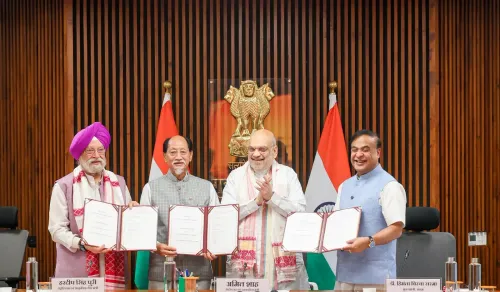
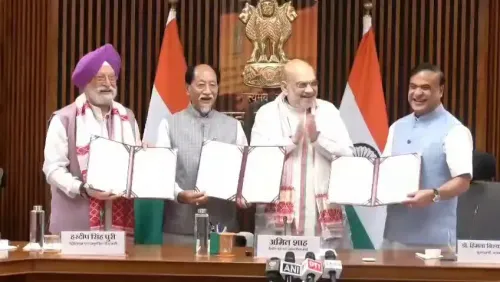
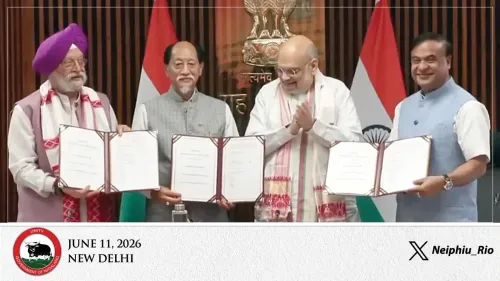
A tripartite MoU was executed between the Government of India , Assam , and Nagaland on June 11, 2026 .
The agreement paves the way for mineral oil operations in the Disputed Area Belt (DAB) along the Nagaland-Assam border.
CM Neiphiu Rio described the signing as 'a momentous step' in a post on X.
The DAB has been contested since Nagaland's statehood in 1963 , with oil-bearing zones adding economic stakes to the territorial dispute.
Next steps include operator selection, environmental clearances, and central regulatory approvals before operations can commence.
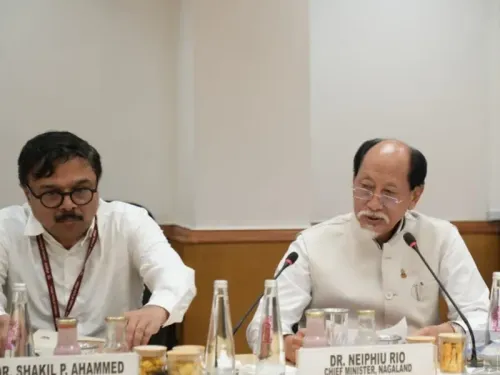
Nagaland Chief Minister Neiphiu Rio on Friday, June 12, 2026, welcomed the execution of a tripartite Memorandum of Understanding between the Government of India, Assam, and Nagaland, calling it 'a momentous step' that paves the way for mineral oil operations in the Disputed Area Belt (DAB) along the Nagaland-Assam border.
Context
In his post on X, CM Rio described the MoU signing — which took place the previous day — as opening a new chapter for hydrocarbon development in a territory long contested by both states. The agreement brings together the central government as a mediating authority alongside the two state governments, reflecting the complexity of resource governance in the region.
The Disputed Area Belt straddles the Assam-Nagaland border and has been at the centre of competing territorial claims since Nagaland's formation as a state in 1963. The presence of oil-bearing zones in this belt has added an economic dimension to what has historically been an ethnic and administrative dispute.
Policy Backdrop
Northeastern India has seen periodic central-government-brokered agreements aimed at unlocking hydrocarbon resources in disputed inter-state zones. Such tripartite frameworks are designed to allow resource extraction to proceed without either state formally conceding territorial claims, effectively ring-fencing economic cooperation from the broader boundary question.
The move also fits within India's wider energy policy objective of boosting domestic crude oil output and reducing dependence on imports. The northeast, with its legacy oil fields and under-explored frontier zones, has been identified as a priority region for stepped-up exploration activity. The North Eastern Council and central ministries have repeatedly flagged the DAB's potential as part of regional development planning.
Stakeholders and Impact
Border communities in both states stand to be directly affected by any mineral oil operations that follow from the MoU. Residents of the DAB have historically lived under administrative ambiguity, and a formal tripartite framework could bring both economic opportunity — in the form of employment and royalty revenues — and environmental scrutiny.
Oil exploration companies operating in the northeast will be watching the agreement closely, as it could open a previously inaccessible belt to licensed operations. The selection of operators and the terms of revenue-sharing between Assam, Nagaland, and the Government of India will be critical details to emerge in the implementation phase. Civil society groups in both states are also likely to engage on questions of land rights and ecological impact.
What's Next
The MoU marks a political commitment, but several procedural steps must follow before operations can begin. These include the selection of exploration and production operators, environmental impact assessments, and any requisite clearances from central regulatory bodies.
Discussions in Parliament and within the North Eastern Council may offer further clarity on timelines and the governance structure for the DAB operations. How both state governments manage local stakeholder expectations — particularly among border communities with long-standing grievances — will shape whether this agreement translates into durable economic benefit or renewed contestation.
Point of View
Using resource-sharing as a lever to move past decades of administrative deadlock. For CM Rio, publicly endorsing the agreement signals a pragmatic development posture ahead of what will be a complex implementation phase. The central government's role as a co-signatory — rather than merely a facilitator — suggests a deliberate strategy to give the agreement legal weight and reduce the risk of either state walking back its commitments. Whether the MoU holds through the politically sensitive stages of operator selection and revenue-sharing will be the real test of its durability.
NationPress
16 Sept 2026
Frequently Asked Questions
What is the tripartite MoU between GoI, Assam, and Nagaland about?
The MoU is an agreement between the Government of India, Assam, and Nagaland to enable mineral oil operations in the Disputed Area Belt along the Nagaland-Assam border, a territory subject to competing territorial claims by both states.
What is the Disputed Area Belt (DAB)?
The Disputed Area Belt is a territory along the Assam-Nagaland border that has been contested since Nagaland became a state in 1963. It contains oil-bearing zones that have added an economic dimension to the long-standing boundary dispute.
What did Nagaland CM Neiphiu Rio say about the MoU?
CM Neiphiu Rio described the MoU signing as 'a momentous step,' saying it paves the way for mineral oil operations in the DAB along the Nagaland-Assam border.
What happens after the tripartite MoU is signed?
Following the MoU, the next steps include selection of oil exploration and production operators, environmental impact assessments, and obtaining regulatory clearances from central authorities before actual operations can begin.
Why is oil exploration in the Nagaland-Assam border area significant?
The northeast is a priority region for India's domestic energy output goals. Unlocking the oil potential of the DAB could generate state revenues and employment for border communities, while also contributing to India's broader objective of reducing crude oil import dependence.