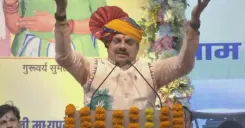
CM Rio: Tripartite MoU Unlocks Nagaland-Assam Border Sectors

Synopsis
Nagaland Chief Minister Neiphiu Rio has welcomed a Tripartite MoU covering Sectors A through F of the Nagaland-Assam border, calling it a move that transforms a long-disputed zone into an economic growth corridor. The agreement fits a wider Northeast India pattern of linking border resolution to development under India's Act East framework.
Key Takeaways
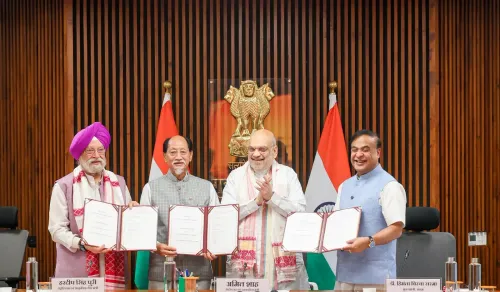
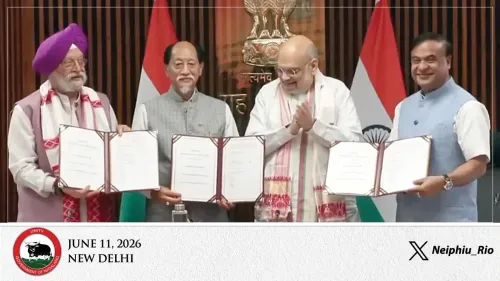
Nagaland CM Neiphiu Rio endorsed a Tripartite MoU on June 11, 2026 covering the Nagaland-Assam border.
The MoU addresses Sectors A, B, C, D, E and F — the lettered stretches of the long-contested inter-state boundary.
Nagaland was separated from Assam in 1963 , leaving border sectors disputed for over six decades.
The agreement aims to convert areas of administrative uncertainty into a corridor of economic growth .
Border communities and traders along the Nagaland-Assam corridor are the most direct beneficiaries.
The model mirrors comparable inter-state MoU frameworks used along Assam's borders with Meghalaya and Arunachal Pradesh .
Nagaland Chief Minister Neiphiu Rio on Thursday, June 11, 2026, hailed a Tripartite Memorandum of Understanding as a transformative step for the long-disputed boundary between Nagaland and Assam, declaring that Sectors A, B, C, D, E and F along the inter-state border would be converted from zones of uncertainty into a 'vibrant corridor of economic growth.'
Context
The Nagaland-Assam border dispute is one of the oldest unresolved inter-state territorial questions in Northeast India. When Nagaland was carved out of Assam as a separate state in 1963, the demarcation of boundary sectors was left contested, producing decades of friction between border communities and periodic flare-ups that disrupted trade and daily life. The disputed corridor has historically been divided into lettered sectors — A through F — each representing distinct stretches of contested land.
Chief Minister Rio's statement frames the newly signed Tripartite MoU as a mechanism to resolve that ambiguity and redirect energy toward development. In his own words, the agreement 'unlocks the economic potential of Sectors A, B, C, D, E and F along the Nagaland-Assam border, turning an area of uncertainty into a vibrant corridor of economic growth.'
Policy Backdrop
The Tripartite MoU fits into a broader pattern visible across Northeast India, where states have increasingly linked border dispute resolution to economic corridor development under India's Act East Policy. Central government facilitation of inter-state memoranda has become the preferred instrument for converting contested zones into areas eligible for investment, road connectivity, and market integration.
Comparable frameworks have been deployed along Assam's borders with Meghalaya and Arunachal Pradesh, where phased sector-by-sector agreements preceded infrastructure rollout. The involvement of a third party — implied by the 'Tripartite' designation — suggests the Ministry of Home Affairs or another central authority is a co-signatory, lending institutional weight to the commitment.
For Nagaland, economic integration along the border is particularly significant given the state's landlocked geography and its dependence on connectivity through Assam for access to national markets and supply chains.
Stakeholders and Impact
The most immediate beneficiaries of the MoU are the border communities in all six sectors, who have lived under administrative uncertainty that has long discouraged private investment, land development, and formal commerce. Traders operating along the Nagaland-Assam corridor stand to gain from clearer jurisdictional rules and the prospect of improved road and market infrastructure.
Broader gains could flow to the wider Northeast regional economy if the corridor becomes a functional trade and logistics route. State governments on both sides would also benefit from reduced law-and-order costs historically associated with disputed border zones.
What's Next
Attention will now turn to the rollout of specific projects under the Tripartite MoU across Sectors A through F, and to any high-level review meetings that may follow involving the Ministry of Home Affairs and the two state governments. The pace of on-ground implementation — land demarcation, connectivity works, and investment facilitation — will determine whether the agreement translates into the economic corridor Chief Minister Rio has envisioned.
If the model proves effective, it could serve as a template for resolving remaining inter-state boundary disputes elsewhere in the Northeast, reinforcing the region's strategic role in India's Act East engagement with Southeast Asia.
Point of View
He makes the agreement easier to sell to border communities who have long been sceptical of top-down boundary deals. The 'Tripartite' structure signals central government buy-in, which is essential for any inter-state border compact to hold. Placed within India's Act East Policy arc, the Nagaland-Assam corridor carries connectivity significance well beyond the two states. Whether the MoU produces durable results will hinge on implementation speed and the willingness of both state administrations to subordinate local political pressures to the corridor's long-term economic logic.
NationPress
26 Oct 2026
Frequently Asked Questions
What is the Tripartite MoU between Nagaland and Assam?
The Tripartite MoU is a three-party agreement aimed at resolving the long-standing border dispute between Nagaland and Assam across Sectors A through F, and converting those areas into an economic growth corridor. The 'tripartite' designation indicates a central government party — likely the Ministry of Home Affairs — alongside the two state governments.
What are Sectors A to F on the Nagaland-Assam border?
Sectors A, B, C, D, E and F are the designated stretches of the contested inter-state boundary between Nagaland and Assam, a dispute that dates to Nagaland's creation as a separate state from Assam in 1963.
How does the Nagaland-Assam border dispute compare to other Northeast India border issues?
The Nagaland-Assam dispute is one of several inter-state boundary conflicts in Northeast India. Similar MoU-based resolution frameworks have been used along Assam's borders with Meghalaya and Arunachal Pradesh, where phased sector agreements preceded infrastructure development.
What happens next after the Tripartite MoU is signed?
The focus shifts to on-ground implementation: land demarcation, connectivity infrastructure, and investment facilitation across Sectors A through F. High-level review meetings involving the Ministry of Home Affairs and both state governments are expected to follow.