CM Rio: Nagaland-Assam Border MoU Turns Decades of Talks into Action

Synopsis
Nagaland Chief Minister Neiphiu Rio on 11 June 2026 welcomed a Memorandum of Understanding with Assam, saying it converts decades of unresolved border dialogue into a development framework for communities on both sides of the disputed inter-state boundary.
Key Takeaways
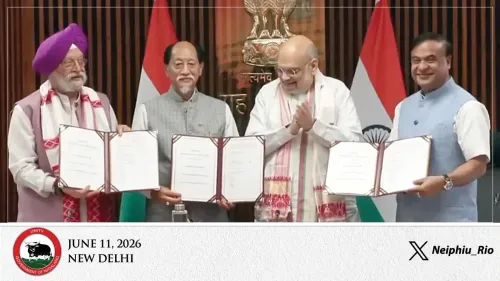
Nagaland CM Neiphiu Rio publicly welcomed a new MoU signed between Nagaland and Assam on 11 June 2026 .
The Nagaland-Assam border has remained partially undemarcated since Nagaland's creation in 1963 , constraining local resource use for over six decades.
Previous central government-mediated talks in the 1990s and 2000s produced only interim confidence-building measures, not a permanent settlement.
Border communities stand to benefit through improved access to land, forests and potential infrastructure and mining development in disputed sectors.
Operationalising the MoU will require follow-up joint surveys, resource-sharing clauses and possible central government notification.
The agreement follows a regional pattern of bilateral MoUs being used to break long-standing Northeast India boundary deadlocks.
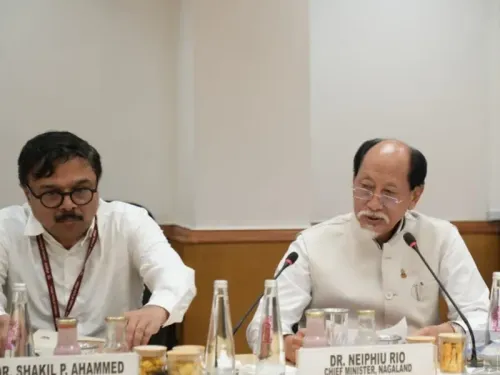
Nagaland Chief Minister Neiphiu Rio on Thursday, 11 June 2026, hailed a newly signed Memorandum of Understanding between Nagaland and Assam as a landmark step that converts years of dialogue on their long-disputed inter-state boundary into a workable framework for development.
Context
Responding to the announcement on X, Chief Minister Rio wrote: 'For decades, unresolved issues along the Nagaland-Assam border limited the development of resources in the area. Today's MoU transforms years of dialogue into a framework that will benefit present and future generations.'
The border between the two states has remained partially undemarcated since Nagaland's creation in 1963, when it was carved out of Assam. That ambiguity has for more than six decades created legal uncertainty over land, forests and mineral resources straddling the boundary.
Policy Backdrop
Central government-mediated talks through the 1990s and 2000s produced confidence-building measures but stopped short of a permanent settlement. The pattern is not unique to this border: inter-state boundary disputes across India's Northeast have repeatedly stalled infrastructure, mining and forestry projects by leaving jurisdiction over land in legal limbo.
Successive administrations at the state and central levels have therefore turned to bilateral MoUs and joint surveys as instruments to convert prolonged negotiations into enforceable arrangements — a model that the Assam-Meghalaya partial boundary agreement of 2022 demonstrated could yield tangible results even without a full constitutional settlement.
Stakeholders and Impact
Border communities on both sides stand to gain most directly. Decades of jurisdictional uncertainty have restricted access to forest produce, agricultural land and potential mining or infrastructure development in the affected sectors, keeping local economies suppressed relative to their resource potential.
The Nationalist Democratic Progressive Party-led government in Kohima and the government in Dispur both have political stakes in demonstrating progress on a dispute that has periodically flared into local tensions. A durable framework also reduces the administrative burden on security forces deployed to manage boundary flashpoints.
What's Next
The practical impact of the MoU will depend on follow-up steps: joint surveys to physically demarcate agreed sectors, resource-sharing clauses that specify revenue arrangements, and any central government notification required to give the framework statutory force.
Observers will watch whether the two state governments constitute a joint implementation committee and set a timeline for field surveys — the stage at which previous agreements in the region have historically stalled. Chief Minister Rio's framing of the MoU as a benefit to 'present and future generations' signals an intent to anchor the agreement in long-term development rather than immediate political gains.
Point of View
If incremental, step in one of the Northeast's most entrenched inter-state disputes — one that has outlasted multiple central and state administrations. Rio's choice to frame the agreement in generational terms is a deliberate political signal: it repositions a long-stalled boundary question as a development opportunity rather than a territorial contest. The real test will come at the implementation stage, where joint surveys and resource-sharing clauses have historically become the graveyard of similar accords. If the two governments can sustain momentum through those technical steps, the Nagaland-Assam MoU could serve as a template for other unresolved Northeast boundaries.
NationPress
26 Oct 2026
Frequently Asked Questions
What is the Nagaland-Assam border MoU signed in June 2026?
The MoU is a bilateral agreement between the governments of Nagaland and Assam intended to provide a framework for resolving long-standing boundary disputes and enabling development of resources in contested border areas. Its exact terms and signatories have not yet been officially detailed in public records.
Why has the Nagaland-Assam border been disputed for so long?
When Nagaland was created in 1963 by being carved out of Assam, several sectors along the inter-state boundary were left without final demarcation. This legal ambiguity has persisted for over six decades, causing periodic tensions and restricting infrastructure and resource development in affected areas.
Who is Neiphiu Rio and which party does he lead?
Neiphiu Rio is the Chief Minister of Nagaland and the leader of the Nationalist Democratic Progressive Party (NDPP) . He has held the Chief Minister's post across multiple terms since 2003 , making him one of the most experienced political figures in the Northeast.
How does this MoU compare to other Northeast border agreements?
It follows a pattern seen across India's Northeast, where states have used bilateral MoUs and joint surveys to break boundary deadlocks without waiting for full constitutional settlements. The Assam-Meghalaya partial boundary agreement of 2022 is a recent precedent that showed such accords can yield tangible results.
What needs to happen for the Nagaland-Assam MoU to take effect?
Follow-up steps include joint field surveys to demarcate agreed sectors, finalisation of resource-sharing clauses, and potentially a central government notification to give the framework statutory force. Formation of a joint implementation committee with a clear timeline will be a key indicator of seriousness.