Owaisi's AIMIM Gets SC Notice in ECI Plea Joined with INDIA Bloc
Synopsis
The Supreme Court issued notice on AIMIM president Asaduddin Owaisi's plea challenging ECI electoral roll revision, consolidating it with a petition by Rahul Gandhi and the INDIA bloc. Advocate M. Nizam Pasha represented Owaisi in the matter.
Key Takeaways
The Supreme Court of India issued notice on a plea filed by AIMIM president Asaduddin Owaisi related to ECI's Special Intensive Revision (SIR) of electoral rolls.
Owaisi's plea has been clubbed with a petition by Rahul Gandhi and the INDIA bloc , placing both on the same side of the legal challenge.
Nizam Pasha represented Owaisi before the Supreme Court in this matter.
The court's decision to issue notice signals it found prima facie grounds to require the ECI to formally respond.
The case is part of a broader pattern of opposition judicial challenges to Election Commission actions, particularly around election cycles.
Further hearings, ECI counter-affidavits, and potential interventions by other parties are the immediate next steps to watch .
The Supreme Court of India has issued notice on a plea filed by AIMIM president Asaduddin Owaisi, consolidating it with a related petition by Rahul Gandhi and the INDIA bloc challenging the Election Commission of India's actions on electoral roll revisions — signalling that the apex court is willing to hear opposition concerns about procedural fairness in the voter-list process.
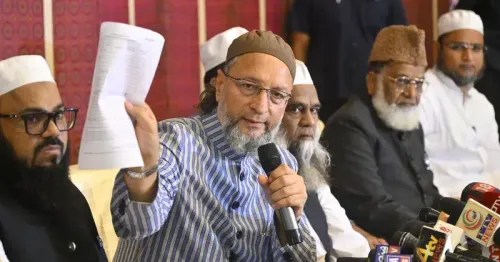
Owaisi confirmed the development on Thursday, 15 October 2026, noting that he was represented before the court by advocate M. Nizam Pasha. 'The Top Court has also issued notice on plea filed by AIMIM Chief and I was represented by the very capable Advocate M. Nizam Pasha,' he posted on X, signalling his satisfaction with how the case was placed before the bench.
What the INDIA Bloc Is Asking the Supreme Court
The consolidated matter before the Supreme Court centres on the Election Commission of India's (ECI) handling of the Special Intensive Revision (SIR) of electoral rolls — a process that determines who stays on, or gets removed from, voter lists. Opposition parties, including Congress and now AIMIM, argue the process raises questions of procedural fairness that require judicial oversight. The court's decision to issue notice means it has found prima facie grounds to ask the ECI to respond formally.
That AIMIM's plea has been clubbed with the INDIA bloc petition is itself significant. It places Owaisi — whose party has often maintained an arm's-length distance from the Congress-led alliance — on the same side of a courtroom argument as Rahul Gandhi on a core electoral-integrity question. Whether this marks a tactical alignment or merely a convergence of legal interests will be watched closely.
AIMIM's History of Electoral Litigation
AIMIM, with its base in Telangana and a presence in Maharashtra, has a track record of filing petitions on electoral and minority-rights issues before constitutional courts. For a party whose core constituency — Muslim voters in urban and semi-urban constituencies — is acutely sensitive to any changes in voter-roll enumeration, a challenge to SIR procedures is not a peripheral legal exercise. It is a direct representation of its base's anxieties about enfranchisement.
Advocate M. Nizam Pasha, whom Owaisi praised publicly, is known for handling constitutional matters. Owaisi's decision to name him in his post reflects the political value of demonstrating competent legal representation — a signal to supporters that the party is mounting a serious, professional challenge, not a symbolic one.
A Recurring Pattern of Judicial Scrutiny on ECI
This is far from the first time Indian opposition parties have knocked on the Supreme Court's door over Election Commission conduct. Petitions challenging voter-list revisions, electoral bond schemes, and ECI appointment processes have become a recurring feature of India's judicial calendar — particularly in the months around election cycles. Each time the court issues notice rather than dismissing at the threshold, it keeps the pressure on the commission to account for its procedures in public.
The next steps will tell the story: the ECI's counter-affidavit, the bench's framing of the legal question, and whether other political parties file intervention applications. For now, the Supreme Court has opened the door — and both the INDIA bloc and AIMIM are walking through it together.
If the court ultimately rules on the merits of SIR procedures, it could reshape how voter-list revisions are conducted ahead of every future election. That is a much larger prize than any single notice.
Point of View
Underscoring that concerns about voter-roll integrity can override routine political distances. Repeated apex-court interventions on ECI processes are gradually building a body of jurisprudence that constrains the commission's administrative discretion. How the ECI frames its counter-affidavit will define the legal battlefield for months.
NationPress
15 Oct 2026
Frequently Asked Questions
Why did the Supreme Court issue notice on Owaisi's plea against the ECI?
The Supreme Court issued notice because it found prima facie grounds to examine AIMIM chief Owaisi's challenge to the Election Commission of India's electoral roll revision process, clubbing his plea with a related petition by Rahul Gandhi and the INDIA bloc.
What is the Special Intensive Revision (SIR) of electoral rolls?
The Special Intensive Revision (SIR) is an ECI-conducted process to update voter lists by adding new eligible voters and removing ineligible ones. Opposition parties have challenged its procedural fairness before the Supreme Court.
Who is representing Asaduddin Owaisi in the Supreme Court ECI case?
Advocate M. Nizam Pasha is representing AIMIM president Asaduddin Owaisi in the Supreme Court matter concerning the Election Commission of India's electoral roll revision.
Is Owaisi's AIMIM part of the INDIA bloc?
AIMIM is not formally a member of the Congress-led INDIA bloc, but Owaisi's plea has been consolidated with the INDIA bloc's Supreme Court petition on the ECI issue, representing a convergence on this specific legal challenge.
What happens next in the Supreme Court ECI plea by Owaisi and INDIA bloc?
The next steps include the Election Commission of India filing a counter-affidavit in response to the Supreme Court notice, further bench hearings, and possibly intervention applications from other political parties.