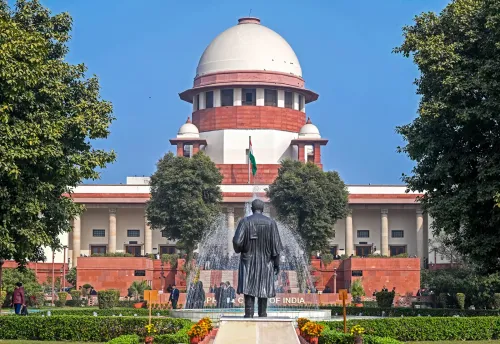
Supreme Court: Society office bearers face cheque bounce case if tied to transaction
Synopsis
The Supreme Court has drawn a sharp distinction between holding a title and bearing liability: society office bearers can be prosecuted in cheque bounce cases only if documentary evidence ties them to the transaction — not merely because they hold a designation. The ruling reinstates proceedings against three functionaries in a ₹5.12 crore dishonour case while shielding a fourth who had no proven link to the deal.
Key Takeaways
The Supreme Court ruled that office bearers of a society can face prosecution under Section 141 of the NI Act only if prima facie material links them to the dishonoured cheque transaction.
A bench of Justice Prashant Kumar Mishra and Justice N.V.
Anjaria partly allowed the appeal of M/s Mansi Finance (Chennai) Ltd.
Proceedings were restored against the Vice-President , Treasurer , and Manager of Ravindra Bharathi Educational Society , who were signatories to key financial documents.
The Executive Member was shielded as no specific material connected him to the ₹5.12 crore dishonoured cheque.
The court clarified that mere designation as an office bearer, without factual foundation, is insufficient to attract vicarious liability.
All contentions remain open before the trial court; the Supreme Court's observations do not constitute a finding on the merits.
The Supreme Court of India has ruled that office bearers of a society can face criminal prosecution under the Negotiable Instruments (NI) Act if there is prima facie material establishing their active involvement in the financial transaction linked to a dishonoured cheque. The judgment, delivered by a bench of Justice Prashant Kumar Mishra and Justice N.V. Anjaria, draws a clear line between titular designation and actionable liability.
Background of the Case
The dispute centres on M/s Mansi Finance (Chennai) Ltd., which allegedly advanced ₹4.5 crore to Ravindra Bharathi Educational Society in 2018 for development and business requirements. A cheque of over ₹5.12 crore issued towards repayment was dishonoured in November 2019 with the endorsement 'Account Blocked'.
The finance company filed a criminal complaint against four office bearers of the Society under Section 141 of the NI Act, which governs vicarious liability in cheque dishonour cases involving companies and organisations. The Madras High Court had quashed proceedings against all four, holding that the complaint contained only omnibus allegations without the specific averments required to attract vicarious liability.
What the Supreme Court Decided
Partly allowing the appeal filed by Mansi Finance, the apex court restored criminal proceedings against the Society's Vice-President, Treasurer, and Manager, while upholding the quashing of proceedings against the Executive Member. The court found that no specific material linked the Executive Member to the underlying transaction.
The bench observed that the Vice-President, Treasurer, and Manager were signatories to several antecedent financial documents — including promissory notes and the memorandum of understanding executed between the parties. The court held that this documentary material furnished the factual foundation necessary for continuation of prosecution at this stage.
Key Legal Principle Laid Down
'Mere designation as an office bearer of a company or society is not sufficient to attract Section 141 of the NI Act. Equally, a complaint containing only a bald reproduction of the statutory language without factual foundation cannot be sustained,' the Justice Mishra-led bench stated.
The court further held that participation in the transaction giving rise to the debt constituted 'a relevant and proximate circumstance' for determining whether office bearers were responsible for the affairs of the Society within the meaning of Section 141. This is a significant clarification, as courts have historically grappled with where to draw the line between nominal and substantive responsibility in such cases.
Scope of Quashing Proceedings Clarified
The Supreme Court also clarified the limits of judicial intervention at the quashing stage. Courts, it said, are not required to assess the truthfulness of allegations or weigh evidence at this preliminary juncture. 'Whether respondent nos. 1, 2 and 4 were in fact in charge of and responsible for the conduct of the affairs of the Society is ultimately a matter of evidence to be established at trial,' the bench noted.
The apex court expressly left all contentions open before the trial court, clarifying that its observations shall not be construed as any expression on the merits of the allegations in the complaint.
Significance for Organisations and Lenders
The ruling carries practical implications for both lending institutions and non-profit or educational societies that routinely issue cheques through office bearers. Lenders can now invoke criminal proceedings against specific functionaries — not merely the organisation — provided they can demonstrate documentary linkage to the transaction. Conversely, office bearers whose roles are purely administrative and unconnected to a specific financial transaction retain protection from prosecution. The trial court will now determine the full merits of the case against the three reinstated accused.
Point of View
Forcing individuals with no financial role into prolonged criminal proceedings. By insisting on a documentary link to the specific transaction, the Supreme Court raises the evidentiary bar at the complaint stage itself. The flip side is that it also strengthens lenders' hands: where the paper trail exists, there is now clearer authority to pursue individuals rather than just the entity. The real test will be how trial courts operationalise 'proximate circumstance' — a phrase the judgment uses but does not exhaustively define.
NationPress
11 Oct 2026
Frequently Asked Questions
What did the Supreme Court rule on cheque bounce cases involving society office bearers?
The Supreme Court ruled that office bearers of a society can face prosecution under Section 141 of the Negotiable Instruments Act only if there is prima facie documentary material showing their active participation in the financial transaction linked to the dishonoured cheque. Mere designation as an office bearer is not sufficient to attract criminal liability.
What is the Mansi Finance vs Ravindra Bharathi Educational Society case about?
M/s Mansi Finance (Chennai) Ltd. allegedly advanced ₹4.5 crore to Ravindra Bharathi Educational Society in 2018. A repayment cheque of over ₹5.12 crore was dishonoured in November 2019 with the endorsement 'Account Blocked', leading to a criminal complaint against four of the Society's office bearers under the NI Act.
Why were proceedings restored against three office bearers but not the fourth?
The Vice-President, Treasurer, and Manager were signatories to promissory notes and the memorandum of understanding, providing a factual foundation for prosecution. The Executive Member had no specific material linking him to the transaction, so the quashing of proceedings against him was upheld.
What is Section 141 of the Negotiable Instruments Act?
Section 141 of the NI Act extends criminal liability in cheque dishonour cases beyond the company or organisation to individuals who were in charge of and responsible for its conduct at the time of the offence. The Supreme Court has clarified that this requires a specific factual link to the transaction, not just a designation.
What happens next in this case?
The criminal proceedings against the Vice-President, Treasurer, and Manager of Ravindra Bharathi Educational Society will resume before the trial court. The Supreme Court has left all contentions open and clarified that its observations do not amount to a finding on the merits of the allegations.