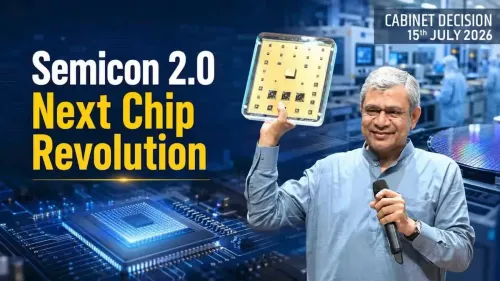
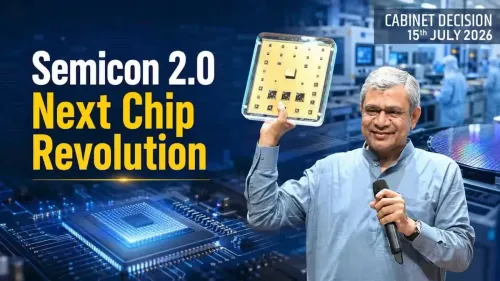
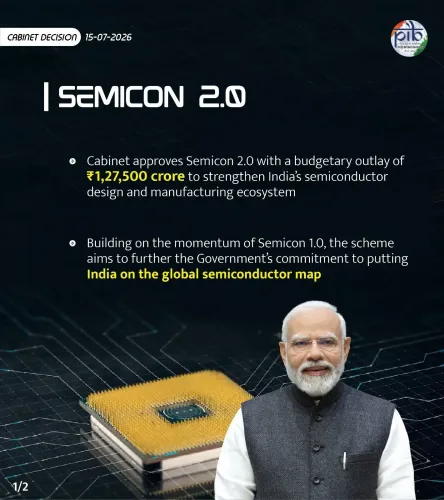
Vaishnaw Opens Semicon 2.0 Portal for Semiconductor Applications
Synopsis
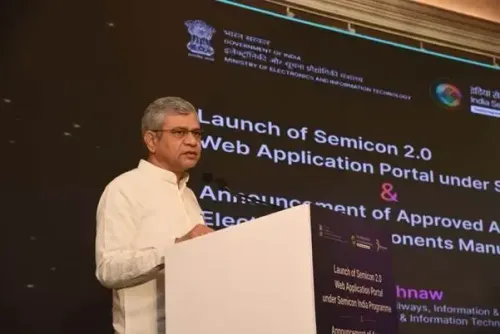
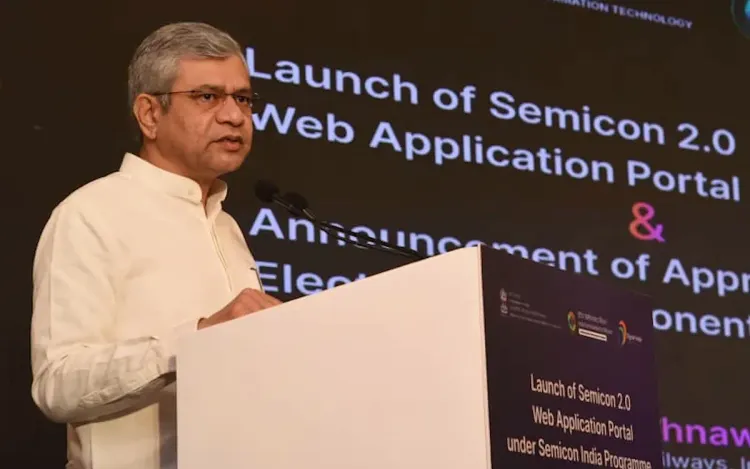
Union Minister Ashwini Vaishnaw has opened the Semicon 2.0 portal for applications, the latest operational step under the Rs 76,000 crore Semicon India programme aimed at building a domestic semiconductor and chip-design ecosystem as part of Atmanirbhar Bharat.
Key Takeaways
The Semicon 2.0 portal is now live and open for project applications as of November 6, 2026 .
The portal operates under the India Semiconductor Mission (ISM) , the nodal body inside MeitY .
The overarching Semicon India programme was Cabinet-approved in 2021 with an outlay of Rs 76,000 crore .
Incentives cover fabrication, assembly, testing, packaging, and chip design — the full semiconductor value chain.
India's push is part of a global effort to diversify chip production beyond East Asia , with the US, EU, and Japan running parallel programmes.
Application volumes and approval timelines from the new portal will be the key near-term indicators of scheme momentum.
India's semiconductor ambition just got a new front door. Union Minister Ashwini Vaishnaw announced on Friday, November 6, 2026 that the Semicon 2.0 portal is now open for applications — the latest operational step in New Delhi's drive to build a self-reliant chip ecosystem under the Atmanirbhar Bharat vision.
What the Semicon 2.0 portal means for chip applicants
The portal opening marks a fresh application window under the India Semiconductor Mission (ISM), the nodal body that sits inside the Ministry of Electronics and Information Technology (MeitY). The mission was stood up specifically to operationalise the government's flagship Semicon India programme — a Rs 76,000 crore Cabinet-approved scheme that offers fiscal incentives across the full chip value chain: fabrication, assembly, testing, packaging, and design.
Successive portals and application rounds have been the government's preferred mechanism to onboard investors into that framework. The '2.0' label signals a new or revised iteration of that gateway — inviting manufacturers, design firms, and electronics investors to register their project proposals directly with the mission.
India's Rs 76,000 crore bet on domestic chip-making
The Semicon India programme, approved by the Union Cabinet in 2021, was India's formal declaration that it would no longer sit out the global semiconductor race. The rationale was stark: India imports billions of dollars in chips annually, leaving electronics manufacturing exposed to supply-chain shocks — a vulnerability the COVID-19 pandemic and subsequent global chip shortage made impossible to ignore.
The programme's design-linked incentive track also targets the upstream end of the industry — chip architects and intellectual-property firms — recognising that hardware self-reliance starts on a whiteboard before it reaches a fab floor. India already punches above its weight in chip design talent, and the policy attempts to anchor that talent domestically.
Where India fits in the global semiconductor scramble
New Delhi's semiconductor push sits inside a broader geopolitical reordering of chip supply chains. The United States, the European Union, and Japan have all launched multi-billion-dollar incentive programmes to reduce concentration risk in East Asia — and India has positioned itself as an alternative destination for diversifying investors.
Attracting a credible anchor fab — the kind that transforms an incentive framework into a living industrial cluster — remains the central challenge. Application volumes from the Semicon 2.0 portal, and the speed of project approvals that follow, will be the next hard data points on how that challenge is progressing.
India's chip ambition has been a long time in the making. Whether the Semicon 2.0 portal accelerates the journey from policy to production is now, quite literally, an open application.
Point of View
It reflects pressure to show tangible pipeline activity, not just policy architecture. Vaishnaw's framing — 'self-reliant semiconductor ecosystem for Bharat' — is a deliberate callback to Atmanirbhar Bharat, keeping the semiconductor push anchored to a larger economic-sovereignty narrative that resonates electorally. The harder test will be whether the portal accelerates India's journey from an incentive destination to an actual chip-producing nation.
NationPress
6 Nov 2026
Frequently Asked Questions
What is the Semicon 2.0 portal in India?
The Semicon 2.0 portal is an application gateway under India's Semiconductor Mission that allows semiconductor manufacturers, chip designers, and electronics investors to submit project proposals for fiscal incentives under the Semicon India programme.
What is the Semicon India programme and its budget?
The Semicon India programme is a Union Cabinet-approved scheme from 2021 with an outlay of Rs 76,000 crore. It provides incentives for setting up semiconductor fabrication units, assembly, testing, packaging, and design facilities in India.
Who oversees the India Semiconductor Mission?
The India Semiconductor Mission (ISM) operates under the Ministry of Electronics and Information Technology (MeitY), which is currently headed by Union Minister Ashwini Vaishnaw.
Why is India investing in semiconductor manufacturing?
India imports a large share of its chip requirements, leaving electronics supply chains vulnerable to global shortages. Building domestic capacity is central to the Atmanirbhar Bharat initiative and allows India to participate in global efforts to diversify chip production beyond East Asia.
How can companies apply under the Semicon India programme?
Companies can submit project applications through the Semicon 2.0 portal, which was opened by Union Minister Ashwini Vaishnaw on November 6, 2026. The portal is managed by the India Semiconductor Mission under MeitY.