Amit Shah: 40% of Yamuna Purification Target Met Under BJP Delhi Govt
Synopsis
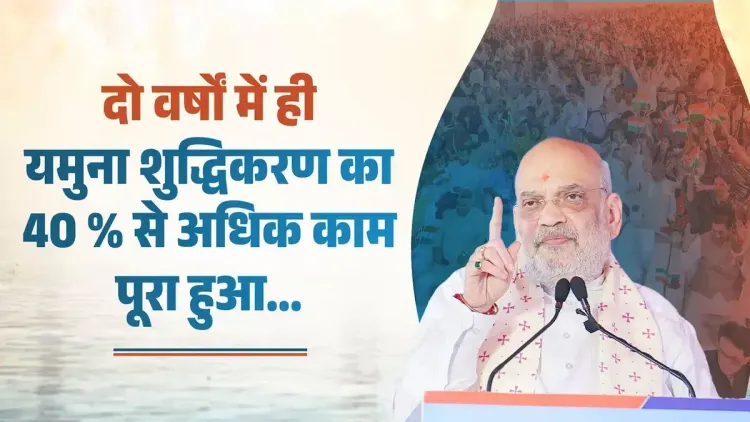
Union Home Minister Amit Shah announced on October 22, 2026 that over 40 per cent of Yamuna purification targets have been met after PM Modi assigned joint responsibility for the project to the Delhi government and the Ministry of Home Affairs following the BJP's Delhi election victory.
Key Takeaways
PM Narendra Modi assigned Yamuna purification responsibility jointly to the Delhi government and the Ministry of Home Affairs after BJP formed the Delhi government.
More than 40 per cent of the stated Yamuna purification targets have been completed, according to Union Home Minister Amit Shah .
The Ministry of Home Affairs co-owning an environmental project is structurally unusual and signals central-level prioritisation of the Yamuna cleanup.
The Yamuna 's 22-km Delhi stretch contributes an estimated 80 per cent of the river's total pollution load, making it the critical intervention zone.
The current effort builds on infrastructure laid under the Namami Gange programme launched in 2014 .
Detailed benchmarks and independent metrics for the 40 per cent progress claim are yet to be publicly released.
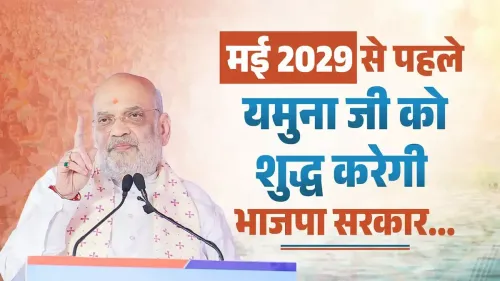
A river that has defined Delhi for millennia and frustrated policymakers for decades is finally showing measurable progress — at least according to the Union government. On Thursday, October 22, 2026, Union Home Minister Amit Shah posted on X that more than 40 per cent of the Yamuna purification targets set after the BJP government's formation in Delhi have already been achieved, crediting a joint mandate assigned by Prime Minister Narendra Modi to both the Delhi government and the Ministry of Home Affairs.
The mandate Modi assigned — and what 40% means
Shah's post states plainly: 'दिल्ली में भाजपा सरकार बनते ही मोदी जी ने यमुना शुद्धिकरण की जिम्मेदारी दिल्ली सरकार और गृह मंत्रालय को सौंपी थी' — 'As soon as the BJP government was formed in Delhi, Modi ji assigned the responsibility of Yamuna purification to the Delhi government and the Home Ministry.' The claim of over 40 per cent target completion marks the first public quantification from this particular joint mandate, making it politically as much as administratively significant.
The unusual pairing — a state government and the Ministry of Home Affairs — as co-owners of an environmental project underscores how seriously the current dispensation has chosen to frame river cleanup: not as a routine civic task but as a security-grade priority requiring central co-ownership. Shah, as MHA head, now holds accountability alongside the Delhi government.
Decades of pledges, one stubborn river
The Yamuna flows roughly 22 kilometres through Delhi, and that short urban stretch accounts for nearly 80 per cent of the river's total pollution load — a figure that has dogged every administration since the first Yamuna Action Plan in 1993. Sewage treatment capacity, industrial effluent discharge, and unauthorised drains have made cleaning the river one of Indian environmental policy's most expensive unsolved problems.
The Namami Gange programme, launched in 2014, brought the Yamuna under a broader Ganga rejuvenation umbrella, channelling central funds into interceptor sewers, sewage treatment plants, and real-time pollution monitoring. The current effort appears to build on that infrastructure while adding a direct MHA accountability layer — a structural novelty the post highlights as its core claim to differentiation.
What the 40% figure sets up
A progress claim without a published benchmark invites scrutiny. The figure of 'more than 40 per cent' raises the immediate follow-on question: 40 per cent of what, measured how? Whether those metrics track biochemical oxygen demand, faecal coliform counts, volume of untreated sewage intercepted, or something else entirely will determine whether the number holds up to independent review. The next test will be whether the central and Delhi governments release granular progress data to substantiate the milestone Shah has now put on record.
For millions of Delhiites who live alongside or downstream of the river — and the broader Yamuna basin population — the stakes are visceral, not statistical. A cleaner Yamuna by any measurable standard would be among the most tangible environmental wins an urban government could claim. Shah has now staked political credibility on the trajectory.
Point of View
The BJP is attempting to shift the Yamuna narrative from a symbol of governance failure (weaponised heavily during Delhi elections) to a proof point of central-state delivery. Placing the MHA in the ownership chain is also strategically shrewd: it ties a high-visibility environmental win directly to Shah's own ministerial record, not just the Delhi government's. The absence of a published measurement framework, however, means the claim remains politically assertive until backed by independently auditable data — the exact detail opposition parties and civil society groups are likely to demand next.
NationPress
22 Oct 2026
Frequently Asked Questions
What is the Yamuna purification project Amit Shah mentioned?
It is a joint initiative between the Delhi government and the Ministry of Home Affairs to clean the Yamuna River flowing through Delhi, assigned by PM Narendra Modi after the BJP formed the Delhi government. Shah announced on October 22, 2026 that over 40 per cent of the targets have been met.
Why is the Ministry of Home Affairs involved in cleaning the Yamuna?
PM Modi specifically assigned co-responsibility for Yamuna shuddhikaran to the Ministry of Home Affairs alongside the Delhi government, an unusual arrangement that signals the project is being treated as a high-priority central-state coordination effort rather than a routine environmental task.
What is Namami Gange and how does it relate to the Yamuna?
Namami Gange is a central government programme launched in 2014 to rejuvenate the Ganga and its tributaries, including the Yamuna . It funds sewage treatment plants, interceptor sewers, and pollution monitoring infrastructure that form the foundation of current Yamuna cleanup efforts in Delhi.
How polluted is the Yamuna in Delhi?
The Yamuna 's roughly 22-kilometre stretch through Delhi is estimated to contribute around 80 per cent of the river's total pollution load, driven by untreated sewage, industrial effluents, and unauthorised drains — making it the single most critical segment of the river to address.
What does '40 per cent target completion' for the Yamuna actually mean?
Union Home Minister Amit Shah stated that over 40 per cent of the Yamuna purification targets have been completed, but a detailed public breakdown of how those targets are measured — whether by sewage treatment capacity, water-quality parameters, or other metrics — has not yet been officially published.