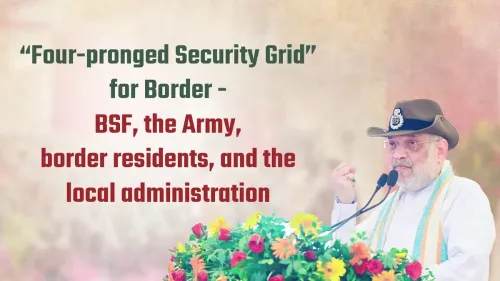
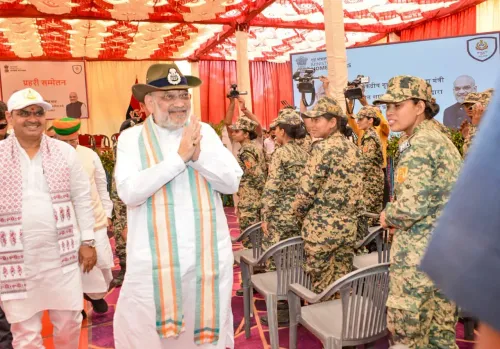
Amit Shah Directs BSF to Monitor Demographic Shifts in 50 km Border Belt
Synopsis
Union Home Minister Amit Shah has directed the BSF to monitor unnatural demographic changes in villages within 50 km of India's international borders and to alert local administrations about illegal construction, reinforcing a long-standing Home Ministry policy on border-belt surveillance.
Key Takeaways
Amit Shah directed the BSF to monitor villages within 50 km of India's international border for unnatural demographic changes.
The BSF has been asked to alert local administrations about any illegal construction detected within the border belt.
The BSF , raised in 1965 , reports to the Ministry of Home Affairs and guards borders with Pakistan and Bangladesh .
The directive aligns with commitments under the Assam Accord of 1985 to detect and address illegal immigration and demographic shifts in border districts.
State governments in Assam , West Bengal and Punjab are expected to issue follow-up administrative orders to district authorities.
The move may lead to formalisation of the 50 km surveillance corridor as standing BSF operational policy.
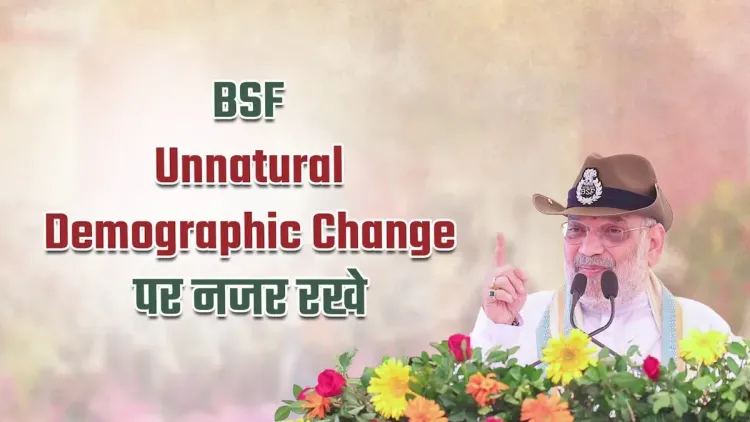
Union Home Minister Amit Shah on Tuesday, May 26, 2026 directed the Border Security Force (BSF) to keep a close watch on unnatural demographic changes in villages within 50 kilometres of the international border and to alert local administrations about any illegal construction detected in that zone.
Context
In his post on X, Shah stated — 'BSF sīmā se 50 km ke gāṃvoṃ meṃ Unnatural Demographic Change par nazar rakhe, kisī tarah ke avaidh nirmāṇ par sthānīy prashāsan ko āgāh kare' — meaning the BSF should monitor villages within 50 km of the border for unnatural demographic change and alert local administration to any illegal construction. The directive underscores the Home Ministry's emphasis on using border-guarding forces not only for perimeter security but also for regulatory and surveillance functions within a defined territorial depth.
The BSF, raised in 1965 following the Indo-Pakistan war of that year, is tasked with guarding India's land borders with Pakistan and Bangladesh and reports directly to the Ministry of Home Affairs. Its mandate has historically combined armed border patrolling with intelligence gathering on cross-border movement and settlement patterns.
Policy Backdrop
Concerns about demographic shifts in India's border districts have a long legislative and administrative history. The Assam Accord of 1985 formally committed the central government to detect and deport illegal immigrants and to address demographic pressures in border districts — a commitment that has shaped successive policy directives from the Home Ministry.
Successive governments have issued coordination orders between the Ministry of Home Affairs and state administrations — particularly in Assam, West Bengal and Punjab — directing central paramilitary forces to flag illegal construction and population influxes in sensitive border belts. Shah's latest directive fits within this established pattern, extending the BSF's functional role beyond the zero line into a broader surveillance corridor.
Stakeholders and Impact
The directive has direct implications for border villagers, local district administrations and BSF field units operating along the frontiers with Pakistan and Bangladesh. District collectors and superintendents of police in border districts are the intended recipients of BSF alerts under this framework, making inter-agency coordination a central operational requirement.
For communities living within the designated 50 km belt, the directive signals increased administrative scrutiny of land use, construction activity and population movement. Civil society groups and state governments in border regions are likely to be called upon to align their own monitoring mechanisms with the BSF's field intelligence.
What's Next
Attention will now turn to whether state governments in Assam, West Bengal and Punjab issue corresponding administrative orders to their district authorities to act on BSF alerts. Parliamentary questions in the upcoming session and annual reports from the Ministry of Home Affairs on border surveillance outcomes will be key indicators of how systematically this directive is implemented on the ground.
The directive also sets the stage for a possible review of the BSF's operational guidelines, potentially formalising the 50 km surveillance corridor as a standing policy rather than a situational instruction — a move that would have significant administrative and legal implications for border-state governments.
Point of View
Not merely a reactive security measure. By specifying a 50 km depth and linking BSF field intelligence to local administration alerts, the order effectively creates a layered civil-military monitoring framework that goes beyond the zero line. This fits a broader pattern under the current Home Ministry of converting informal coordination practices into explicit, documented directives — raising the stakes for state compliance and parliamentary accountability. The directive is likely to intensify political debate in border states, particularly West Bengal and Assam, where demographic change and illegal immigration remain deeply contested electoral issues.
NationPress
11 Oct 2026
Frequently Asked Questions
What did Amit Shah direct the BSF to do?
Amit Shah directed the BSF to monitor villages within 50 km of India's international borders for unnatural demographic changes and to alert local administrations about any illegal construction found in that zone.
What is the BSF's jurisdiction inside Indian territory?
The BSF is primarily tasked with guarding India's land borders with Pakistan and Bangladesh. It reports to the Ministry of Home Affairs and its operational remit can extend into a defined depth inside the border, as directed by the Home Ministry.
Why is demographic change near borders a concern for India?
Demographic shifts in border districts have long been a security and policy concern in India, particularly related to illegal immigration from Bangladesh. The Assam Accord of 1985 formally committed the government to detecting and deporting illegal immigrants and addressing resulting population pressures in border areas.
Which states are most affected by this BSF directive?
The directive is most directly relevant to border states such as Assam, West Bengal and Punjab, which share international land borders with Bangladesh and Pakistan and have historically been focal points for Home Ministry border-management orders.
What happens after the BSF flags illegal construction or demographic changes?
Under the framework outlined by Shah, the BSF is expected to alert local district administrations, which are then responsible for taking regulatory or law-enforcement action. State governments may also issue follow-up orders to district authorities to coordinate with BSF field units.