Shekhawat Hails ₹2,814 Cr Cabinet Push for Critical Minerals
Synopsis
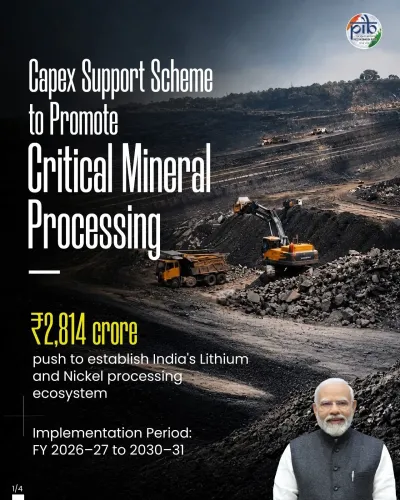
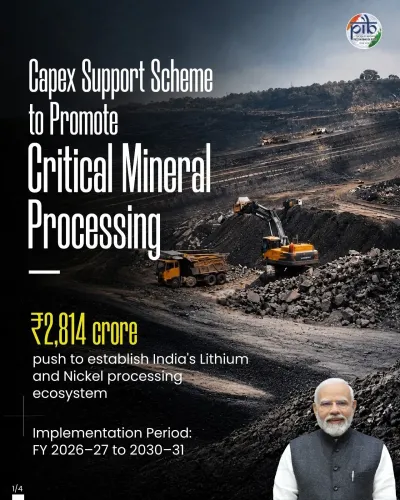
The Union Cabinet approved a ₹2,814 crore capex support scheme for critical mineral processing, operative from 2026-27 to 2030-31. Minister Gajendra Singh Shekhawat called it a landmark step toward import substitution and industrial self-reliance under PM Modi's Atmanirbhar Bharat framework.
Key Takeaways
The Union Cabinet approved a ₹2,814 crore capex support scheme to promote domestic processing of critical minerals.
The scheme runs from financial year 2026-27 to 2030-31 , a five-year implementation window.
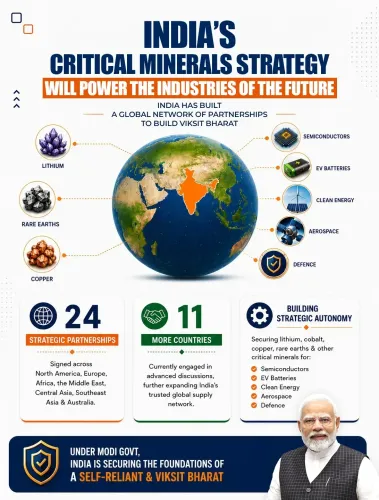
The goal is to reduce India's import dependence on critical minerals such as lithium, cobalt, and rare earths.
The decision builds on the Mines and Minerals (Development and Regulation) Amendment Act, 2023 , which opened mineral block auctions to private players.
Key beneficiaries include mining companies, EV manufacturers, and battery cell producers dependent on processed mineral inputs.
Minister Gajendra Singh Shekhawat linked the decision to India's broader Atmanirbhar Bharat and strategic capability goals.
India moved decisively to close one of its most consequential supply-chain gaps on Wednesday, 4 November 2026, when the Union Cabinet approved a ₹2,814 crore capex support scheme to accelerate domestic processing of critical minerals — a strategic bet that spans five financial years from 2026-27 to 2030-31. Union Culture and Tourism Minister Gajendra Singh Shekhawat welcomed the decision on X, calling it a vital step toward making India self-reliant in a sector it has long been forced to depend on others for.
Posting in Hindi, Shekhawat said the Cabinet approval — taken under the 'visionary leadership' of Prime Minister Narendra Modi — would 'strengthen the country's critical mineral processing capacity, help reduce dependence on imports, and lend new strength to India's industrial and strategic capabilities.' The hashtag #CabinetDecisions anchored the post to a broader series of approvals announced the same day.
Why critical minerals sit at the heart of India's industrial future
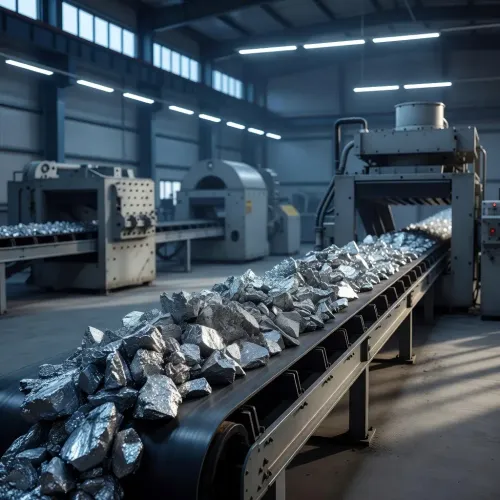
Minerals such as lithium, cobalt, and rare earth elements are the invisible spine of modern industry — powering everything from electric vehicle batteries and consumer electronics to precision defence systems. India consumes them in growing volumes but processes almost none at home, leaving it exposed to supply shocks from a handful of dominant global suppliers. That vulnerability has been a known policy concern for years.
The Mines and Minerals (Development and Regulation) Amendment Act, 2023 was the first structural fix: it opened critical mineral block auctions to private players and enabled greater domestic production. But mining the ore is only half the equation. Processing — refining raw ore into usable industrial inputs — remained the missing link. The ₹2,814 crore capex support scheme is designed to fill exactly that gap, using government capital expenditure backing to de-risk private investment in processing infrastructure.
Atmanirbhar Bharat's most strategic frontier
The scheme fits squarely within the Atmanirbhar Bharat framework that has guided India's industrial policy since 2020, but the critical minerals piece carries higher geopolitical stakes than most. Global competition for processing capacity — dominated overwhelmingly by China — has pushed every major economy, from the United States to the European Union, into a scramble to build sovereign supply chains. India, with its expanding clean-energy commitments and defence modernisation programme, cannot afford to stay on the sidelines of that race.
The five-year window through 2030-31 aligns the scheme with India's medium-term EV adoption targets and production-linked incentive timelines in sectors that depend on critical mineral inputs. Mining companies, EV manufacturers, and battery cell producers are among the direct beneficiaries if the capex support unlocks the processing plants the country urgently needs.
What implementation will determine
Approval of the outlay is a beginning, not an outcome. The real test lies in the guidelines that the Ministry of Mines will now draw up — the capacity targets, project eligibility criteria, and disbursement timelines that will determine whether the ₹2,814 crore translates into operational refineries or stalls in bureaucratic process. Any linked project approvals and early capacity additions will be the clearest early signals of execution quality.
India has the minerals underground, the market demand above ground, and now a government-backed financial instrument to bridge the two. Whether the country can convert a Cabinet decision into processing plants before the next global supply crunch arrives is the only question that matters from here.
Point of View
814 crore capex approval represents a deliberate pivot from India's earlier mining-focused reforms toward the processing end of the critical minerals value chain — historically the harder and more capital-intensive challenge. By backstopping private investment with government capex support, the Modi administration is effectively using industrial policy tools more commonly associated with China and South Korea to compete in a sector where first-mover advantage is compounding fast. For the BJP, the announcement also serves a political narrative: concrete, rupee-quantified proof of Atmanirbhar Bharat moving from slogan to balance sheet. The five-year horizon stretching to 2030-31 means the scheme's real outcomes — processing capacity online, import bills falling — will largely be tested by the next government, making execution discipline and transparent capacity targets the only honest metrics to watch.
NationPress
4 Nov 2026
Frequently Asked Questions
What is the ₹2,814 crore critical minerals scheme approved by the Cabinet?
It is a capex support scheme approved by the Union Cabinet to promote domestic processing of critical minerals such as lithium, cobalt, and rare earths in India. The scheme is designed to reduce import dependence and runs from financial year 2026-27 to 2030-31.
Which ministry will implement the critical minerals processing scheme?
The Ministry of Mines is expected to issue implementation guidelines and project approval frameworks under the scheme, though full operational details are pending.
Why does India need domestic critical mineral processing?
India relies heavily on imports for processed critical minerals essential to EV batteries, electronics, and defence equipment. Building domestic processing capacity reduces supply-chain vulnerability, particularly from concentrated foreign suppliers.
How does this scheme relate to Atmanirbhar Bharat?
Critical mineral processing has been identified as a strategic gap within India's Atmanirbhar Bharat self-reliance framework. The capex support scheme directly targets import substitution in a sector considered vital for clean energy and defence manufacturing.
What was the earlier policy step on critical minerals in India?
The Mines and Minerals (Development and Regulation) Amendment Act, 2023, opened critical mineral block auctions to private players and enabled greater domestic production, setting the foundation that the new processing scheme now builds upon.