Shekhawat Hails Rare Earth Find in Rajasthan as Tech Game-Changer

Synopsis
Union Minister Gajendra Singh Shekhawat has welcomed a reported rare earth minerals discovery in Rajasthan's Barmer-Balotra region, saying it will help India cut foreign dependence in smartphones, EV batteries, semiconductors, and advanced defence systems, in line with the Critical Minerals Mission and Atmanirbhar Bharat goals.
Key Takeaways
Union Minister Gajendra Singh Shekhawat on 26 May 2026 highlighted a reported rare earth minerals deposit in Barmer-Balotra, Rajasthan .
Rare earth elements are essential for smartphones, semiconductor chips, EV batteries, missiles, and fighter jets .
The find is positioned as advancing the Critical Minerals Mission and the broader Atmanirbhar Bharat self-reliance agenda.
In 2023 , the Ministry of Mines notified 30 critical minerals , including rare earths, to guide domestic exploration and block auctions.
India joined the Mineral Security Partnership to diversify global supply chains away from China-dominated sources.
Further GSI survey reports and critical mineral block auctions are expected in the coming fiscal year.
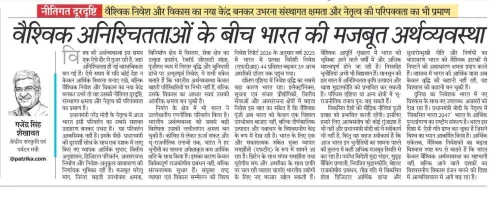
Union Culture and Tourism Minister Gajendra Singh Shekhawat on Tuesday, 26 May 2026, welcomed the reported discovery of a vast rare earth minerals deposit in the Barmer-Balotra region of Rajasthan, calling it a defining moment for India's technological and defence self-reliance.
Context
In his post, Shekhawat described the find as a 'new strength of Atmanirbhar Bharat' — Atmanirbhar Bharat ki nayi taakat — and said the discovery of rare earth minerals in the Barmer-Balotra belt had given India's technological future 'a new direction.' He argued the deposit would prove to be a 'big game-changer' in India's 'chip politics' and global supply chain positioning.
Rare earth elements are a group of 17 metals critical to the manufacture of smartphones, semiconductor chips, electric vehicle batteries, missiles, and fighter jets. Global supply of these minerals has historically been concentrated in China, creating strategic vulnerabilities for technology-importing nations including India.
Policy Backdrop
The minister's remarks align with two flagship Central Government initiatives. The Atmanirbhar Bharat campaign, launched in 2020, set out to reduce import dependence across strategic sectors, including electronics and defence manufacturing. Complementing this, the Critical Minerals Mission was designed to accelerate domestic exploration, mining, and processing of minerals deemed essential for future industries.
In 2023, the Ministry of Mines formally notified a list of 30 critical minerals — rare earth elements among them — to guide block auctions and exploration priorities. Successive Union Budgets have since allocated resources to fast-track surveys and auctions of critical mineral blocks. India has also joined the Mineral Security Partnership, a multilateral initiative to diversify global supply chains away from single-country dependence.
Rajasthan is already among India's most mineral-rich states, and the Barmer-Balotra corridor, better known for its oil and gas reserves, has drawn renewed attention from the Geological Survey of India (GSI) for its broader mineral potential.
Stakeholders and Impact
If confirmed at scale, a significant rare earth deposit in Rajasthan would have far-reaching implications for India's semiconductor and electronics ecosystem, which the government is actively building through the India Semiconductor Mission. Domestic EV battery producers and defence-sector manufacturers — who currently depend heavily on imported rare earth compounds — stand to benefit most directly.
For the broader economy, reduced import dependence on rare earths could ease pressure on India's current account and strengthen the country's negotiating position in global technology supply chains. Shekhawat specifically noted that the discovery would help India eliminate foreign dependence in the production of cutting-edge defence equipment such as missiles and fighter jets.
What's Next
The Ministry of Mines is expected to release further GSI survey reports in the coming fiscal year that will provide verified quantity and quality assessments of critical mineral deposits across the country. Upcoming auctions of critical mineral blocks will be a key indicator of how quickly the government moves to operationalise such finds.
For India's ambition to become a self-sufficient hub in the global technology and defence supply chain, the pace of exploration confirmation, environmental clearances, and processing infrastructure development will determine whether the Barmer-Balotra discovery translates from a geological find into an industrial reality.
Point of View
Tying a geological development in his home state of Rajasthan to the BJP government's flagship self-reliance narrative ahead of what are likely to be contested economic messaging cycles. By invoking 'chip politics' and global supply chains, the minister frames a domestic mineral find within a geopolitical register — implicitly referencing India's strategic anxiety about Chinese dominance of rare earth processing. The post also serves to reinforce the government's technology-sovereignty story at a moment when the India Semiconductor Mission and EV policy are under scrutiny for delivery timelines. Whether the Barmer-Balotra deposit lives up to its billing will ultimately depend on independent geological verification and the speed of the mining-to-processing pipeline — factors that political messaging alone cannot accelerate.
NationPress
12 Oct 2026
Frequently Asked Questions
What rare earth minerals were found in Rajasthan?
The reported discovery in the Barmer-Balotra region of Rajasthan involves rare earth minerals — a group of 17 metals critical to smartphones, EV batteries, semiconductor chips, and advanced defence equipment. Specific mineral compositions and verified quantities from official geological surveys have not yet been publicly confirmed.
Where exactly is the Barmer-Balotra rare earth deposit in Rajasthan?
The deposit is located in the Barmer-Balotra belt in western Rajasthan, a region historically known for oil and gas reserves that has more recently attracted attention for its broader mineral potential under Geological Survey of India exploration programmes.
What is India's Critical Minerals Mission?
India's Critical Minerals Mission is a Central Government initiative under the Ministry of Mines to accelerate the exploration, extraction, and processing of minerals deemed strategically essential for technology and defence industries. In 2023, the ministry notified a list of 30 critical minerals, including rare earth elements, to prioritise domestic block auctions and reduce import dependence.
Why are rare earth minerals important for India's defence and technology sectors?
Rare earth elements are indispensable inputs for manufacturing semiconductors, EV batteries, smartphones, guided missiles, and fighter jet components. Because global supply has been heavily concentrated in China, securing domestic sources is a strategic priority for India's technology sovereignty and defence indigenisation goals.
What is Atmanirbhar Bharat and how does this discovery relate to it?
Atmanirbhar Bharat, launched in 2020, is the Central Government's self-reliance campaign aimed at reducing India's dependence on imports across strategic sectors. A confirmed domestic rare earth deposit would directly support this goal by supplying raw materials for electronics, EVs, and defence manufacturing without relying on foreign — particularly Chinese — supply chains.