Culture Minister Shekhawat hails urea plants for farmers
Synopsis
Union Culture and Tourism Minister Gajendra Singh Shekhawat said the Modi government stood like a rock for farmers after global fertilizer prices rose and West Asia faced crisis-like conditions. He cited new urea plants, technology upgrades and Atmanirbhar Bharat as the reason farmers were getting relief.
Key Takeaways
Union Culture and Tourism Minister Gajendra Singh Shekhawat posted on 28 November 2026 that the Centre had stood like a rock for farmers amid global fertilizer price spikes.
He credited Prime Minister Narendra Modi and used the slogans cheap fertilizer, a strong farmer, and Atmanirbhar Bharat .
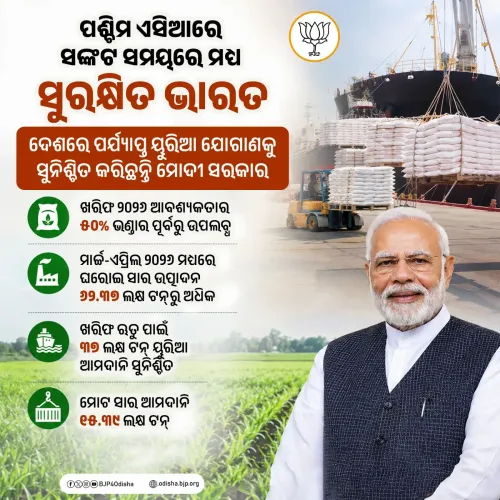
Shekhawat cited a mega investment of ₹54,000 crore and six new state-of-the-art urea plants as bringing relief from shortage and high prices.
Atmanirbhar Bharat Abhiyan was announced in May 2020 to boost domestic manufacturing, including agricultural inputs.
Earlier urea revival projects included units at Gorakhpur , Sindri and Barauni .
Union Culture and Tourism Minister Gajendra Singh Shekhawat on Saturday framed cheap urea as national insurance for the farm, arguing that New Delhi had stood like a rock for India's farmers after fertilizer prices surged worldwide and West Asia slid into crisis-like conditions.
Posting on X, the senior BJP leader and Lok Sabha MP from Jodhpur opened with सस्ता खाद, मजबूत अन्नदाता (cheap fertilizer, a strong farmer) and a new flight of self-reliant India. He wrote that when fertilizer prices rose across the world, the government under Prime Minister Narendra Modi had remained 'a strong rock' in farmers' interest.
Shekhawat said relief from shortage and expensive prices had come with what he described as a mega investment of ₹54,000 crore and six new state-of-the-art urea plants. New technology and world-class infrastructure, he added, were strengthening India's fertilizer sector so that farmers stay prosperous and the resolve of Atmanirbhar Bharat grows firmer. He tagged the message #NewUreaPlants and #AtmanirbharKisan.
West Asia shock meets a domestic urea bet
Global urea markets have been jolted again and again by energy-price spikes and geopolitical disruption, because natural gas is both feedstock and fuel for most plants. India, a large importer for years, has treated those shocks as a food-security risk: if fertilizer dries up or turns unaffordable, sowing and yields take the hit first.
That is the cause-and-effect Shekhawat was selling. A Culture and Tourism minister reaching for fertilizer numbers is itself a tell. The ruling party wants the urea story told as a whole-of-government achievement, not a ministry circular. The claim is simple: build plants at home, blunt the import wave, keep the annadata solvent.
From Gorakhpur, Sindri and Barauni to Atmanirbhar Bharat
The lineage is longer than one Saturday post. Capacity decisions after 2015 included revival projects at Gorakhpur, Sindri and Barauni. In May 2020, Atmanirbhar Bharat Abhiyan put agricultural inputs, including fertilizers, inside a national self-reliance frame aimed at cutting import dependence.
Governments have paired subsidy reform with capital spending on newer technology plants, trying to stabilize supply for grain-production targets. Shekhawat's post folds that industrial track into a farmer-welfare pitch: cheaper urea as proof that self-reliance is reaching the field, not just the factory gate.
Output at the plants will write the next chapter
Rhetoric is cheap. Commissioning is not. The test ahead is whether new units actually lift domestic output, ease import bills, and keep farmgate prices from jumping through the next sowing window. Union Budget fertilizer-subsidy numbers and plant-wise production will matter more than slogans.
For now, Shekhawat has put a Culture Ministry voice on a core farm-industry claim: that India can ride out a global fertilizer storm if it keeps building urea capacity at home.
Point of View
Build capacity at home and protect the annadata when global prices spike. Delivery will be judged on plant output and subsidy math, not on a Saturday hashtag.
NationPress
28 Nov 2026
Frequently Asked Questions
What did Gajendra Singh Shekhawat say about new urea plants?
On 28 November 2026 he said the Modi government had stood like a rock for farmers and cited a mega investment of ₹54,000 crore and six new state-of-the-art urea plants as bringing relief from shortage and high prices. He tied the plants to cheaper fertilizer and Atmanirbhar Bharat.
Why is India expanding domestic urea production?
India has sought to cut import reliance after repeated global price spikes driven by energy-market volatility and geopolitical disruption. Fertilizer security is treated as a foundation for food-grain production targets.
How does Atmanirbhar Bharat relate to fertilizers?
Atmanirbhar Bharat Abhiyan, announced in May 2020, includes measures to promote domestic manufacturing and reduce import dependence in key agricultural inputs such as fertilizers. Shekhawat framed the new urea plants as part of that self-reliance resolve.
Which urea plants were revived earlier in India?
Revival and capacity-addition projects approved between 2015 and 2019 included plants at Gorakhpur, Sindri and Barauni. Those projects sit in the longer line of domestic urea expansion that later governments have continued.
Who is Gajendra Singh Shekhawat?
He is the Union Minister of Culture and Tourism, a senior BJP leader, and the Lok Sabha MP from Jodhpur, Rajasthan. His Saturday post focused on fertilizer capacity rather than his Culture and Tourism portfolio.