Shekhawat Highlights PM Surya Ghar Scheme's Solar Push
Synopsis
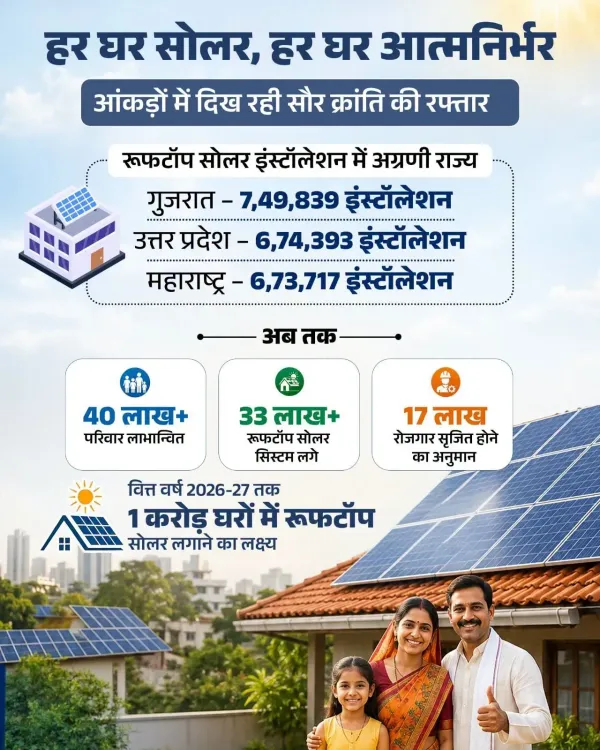
Union Minister Gajendra Singh Shekhawat on 20 July 2026 highlighted PM Surya Ghar: Muft Bijli Yojana's reach, citing 40 lakh+ beneficiary families, 33 lakh+ rooftop solar installations, and an estimated 17 lakh jobs, with Gujarat, UP, and Maharashtra leading implementation.
Key Takeaways
Union Minister Gajendra Singh Shekhawat posted on 20 July 2026 promoting the PM Surya Ghar: Muft Bijli Yojana .
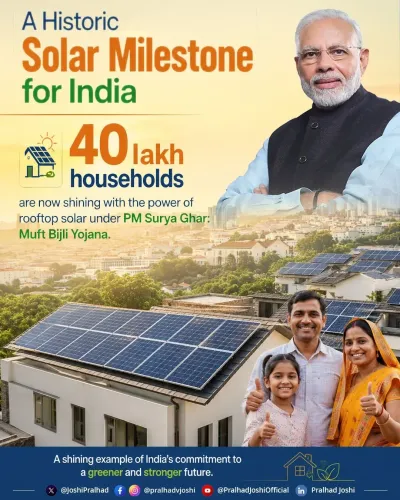
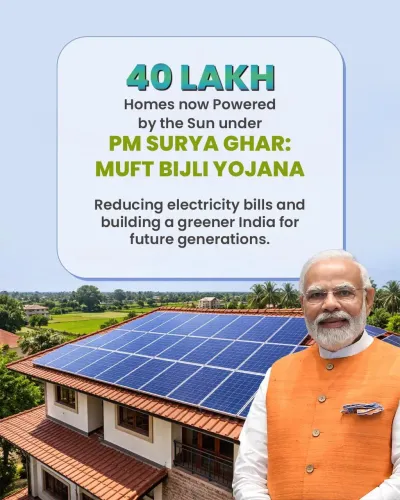
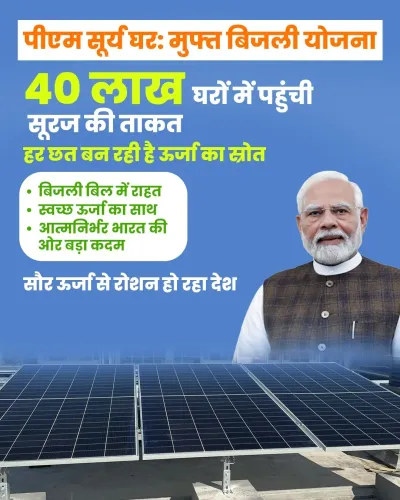
The scheme claims to have benefited more than 40 lakh families across India.
Over 33 lakh homes have had rooftop solar systems installed under the programme.
An estimated 17 lakh-plus jobs have been projected as linked to the scheme's rollout.
Gujarat , Uttar Pradesh , and Maharashtra are the top three states in implementation.
The scheme was launched in February 2024 with a Rs 75,000 crore outlay targeting one crore households .
Union Culture and Tourism Minister Gajendra Singh Shekhawat on Monday, 20 July 2026, highlighted the expanding reach of the central government's flagship rooftop solar programme, citing figures that show over 40 lakh families have benefited from the PM Surya Ghar: Muft Bijli Yojana.
Context
Shekhawat's post, written in Hindi, declared: 'बिजली का बिल अब बोझ नहीं, बचत की ताकत बन रहा है!' ('The electricity bill is no longer a burden — it is becoming the power of savings!'). He described the scheme as driving a 'solar revolution' across the country, framing it not merely as a bill-reduction measure but as a step toward making every household energy self-reliant (ऊर्जा आत्मनिर्भर).
The post listed four headline figures: more than 40 lakh families benefited, more than 33 lakh homes fitted with rooftop solar panels, an estimated 17 lakh-plus jobs created, and Gujarat, Uttar Pradesh, and Maharashtra identified as the leading states in implementation.
Policy Backdrop
The PM Surya Ghar: Muft Bijli Yojana was launched in February 2024 by the Modi government with a target of reaching one crore households and a budgetary outlay of Rs 75,000 crore. The scheme provides central financial assistance for rooftop solar installations and is designed to deliver up to 300 units of free electricity per month to eligible beneficiaries.
The programme sits within a longer arc of solar policy that began with the National Solar Mission approved in 2010, which was later revised to a target of 100 GW of solar capacity by 2022 and subsequently extended. The current administration has set an overarching goal of 500 GW of non-fossil fuel capacity by 2030, with decentralised rooftop generation forming a key pillar of that ambition.
Stakeholders and Impact
Gujarat brings a long-standing state-level solar policy framework that has historically driven high rooftop uptake, while Uttar Pradesh, as the country's most populous state, is implementing the scheme at scale through its state electricity distribution companies and local bodies. Maharashtra's urban demand and supportive policy environment have made it a third high-performing state.
Beyond individual households, the scheme is designed to ease financial pressure on state electricity boards by enabling net-metering and reducing peak-hour procurement costs. The renewable energy sector — from panel manufacturers to local installers — stands to gain from sustained installation momentum at this scale.
What's Next
Attention will now turn to state-wise installation dashboards and any mid-term review of the one-crore-household target. The employment generation figure of 17 lakh-plus jobs is likely to face scrutiny in parliamentary proceedings, where questions on methodology and verification of estimates are expected. Progress on the scheme is also expected to feature in pre-budget discussions for 2025-26.
If installation rates sustain their current trajectory across the three leading states and replicate in laggard regions, the programme could become a template for India's broader push to democratise clean energy access ahead of its 2030 renewable capacity commitments.
Point of View
Framing a welfare programme in the language of empowerment rather than subsidy. The choice to highlight three states — Gujarat, Uttar Pradesh, and Maharashtra — is politically significant, as all three are BJP-governed and represent the party's core electoral geography. The employment figure of 17 lakh-plus, flagged as an estimate, will be the most contested data point and could invite opposition scrutiny in Parliament. Broader context suggests the post is part of a coordinated communications effort to build public awareness of a scheme whose one-crore-household target requires sustained political momentum to achieve.
NationPress
21 Jul 2026
Frequently Asked Questions
What is PM Surya Ghar Muft Bijli Yojana?
PM Surya Ghar: Muft Bijli Yojana is a central government scheme launched in February 2024 that provides financial assistance for rooftop solar installations, aiming to deliver up to 300 units of free electricity per month to one crore households at a total outlay of Rs 75,000 crore.
How many families have benefited from PM Surya Ghar scheme so far?
According to Union Minister Gajendra Singh Shekhawat's post on 20 July 2026, more than 40 lakh families have benefited from the scheme, with rooftop solar installed in over 33 lakh homes.
Which states are leading in PM Surya Ghar rooftop solar installations?
Gujarat, Uttar Pradesh, and Maharashtra are the top three states in implementation of the PM Surya Ghar scheme, according to the minister's post.
How many jobs has the PM Surya Ghar scheme created?
The scheme is estimated to have generated over 17 lakh jobs, though this figure is an estimate and subject to independent verification through official records.
What is India's solar energy target by 2030?
India has set a target of 500 GW of non-fossil fuel electricity capacity by 2030, with decentralised rooftop solar generation — supported by schemes like PM Surya Ghar — forming a key component of that goal.