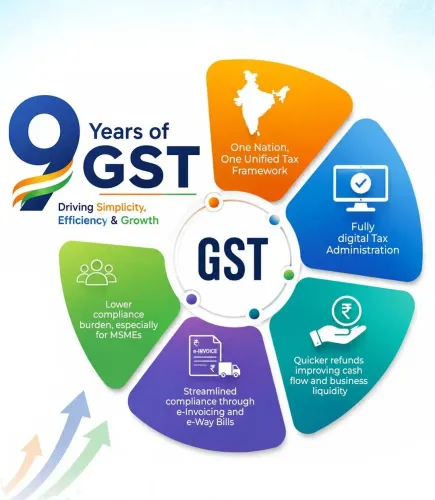
Shekhawat Marks 9 Years of GST With Revenue Milestones
Synopsis
Union Minister Gajendra Singh Shekhawat marked nine years of GST on 3 July 2026, citing revenue growth from ₹11.77 lakh crore in 2018-19 to a record ₹2.42 lakh crore in a single month in April 2026, calling the reform a shift to a simpler, unified tax system.
Key Takeaways
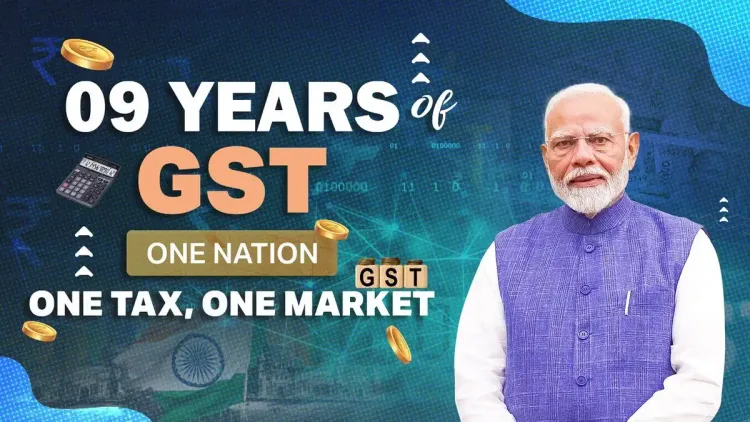
GST was launched on 1 July 2017 , replacing a fragmented system of central and state indirect taxes under the principle of 'One Nation, One Tax, One Market' .
Annual GST revenue stood at ₹11.77 lakh crore in 2018-19 , the first full year of collection.
Average monthly GST collection crossed ₹1.8 lakh crore by 2024-25 .
April 2026 recorded the highest-ever single-month GST collection of ₹2.42 lakh crore .
The Constitution (101st Amendment) Act, 2016 provided the legal basis for the unified tax, administered through the GST Council .
Key policy decisions ahead include the future of the compensation cess and potential inclusion of petroleum products in the GST framework.
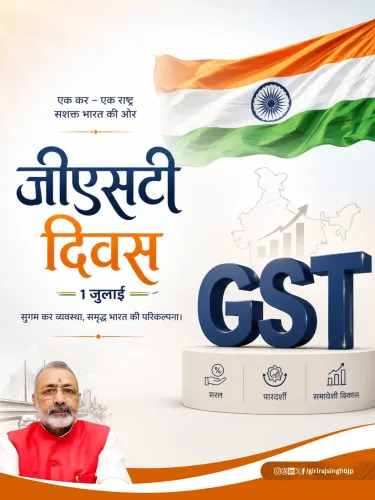
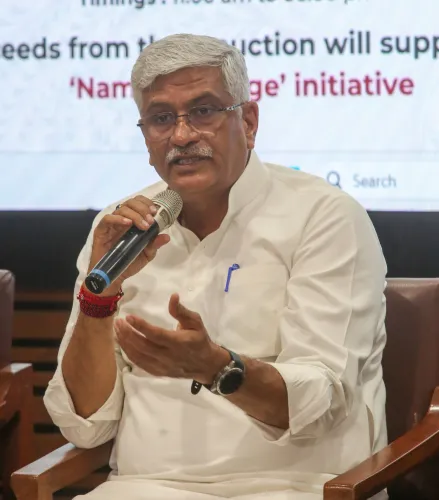
Union Culture and Tourism Minister Gajendra Singh Shekhawat on Friday, 3 July 2026, took to X to mark nine years of the Goods and Services Tax, highlighting a revenue journey from ₹11.77 lakh crore in its first full year to a record single-month collection of ₹2.42 lakh crore in April 2026. The minister framed GST as a structural break from a fragmented, corruption-prone tax regime that had burdened ordinary citizens and businesses since Independence.
Context
Shekhawat's post, written in Hindi, opens by describing the pre-GST landscape as 'kaafi jatil aur bikhra hua' ('quite complex and scattered'), with multiple taxes and conflicting rules imposing the heaviest compliance costs on common people and traders. He credits the replacement of that system on 1 July 2017 with the principle of 'One Nation, One Tax, One Market' — a unified, more transparent and integrated regime.
The post presents three data points to illustrate GST's revenue trajectory: annual collections of ₹11.77 lakh crore in 2018-19, an average monthly collection crossing ₹1.8 lakh crore by 2024-25, and a record monthly collection of ₹2.42 lakh crore in April 2026. The minister invites readers to understand 'how GST transformed the tax system in nine years — through data.'
Policy Backdrop
GST replaced a web of central levies — including central excise and service tax — as well as state-level VAT, octroi and entry taxes, subsuming them into a single destination-based levy administered jointly by the Centre and states through the GST Council. The legal foundation was laid by the Constitution (101st Amendment) Act, 2016, which inserted Articles 246A, 269A and 279A to create shared taxing authority.
The idea had a longer gestation: the Empowered Committee of State Finance Ministers had recommended a national GST model as far back as 2009, building on the nationwide shift from sales tax to VAT in 2005. It was the BJP-led government under Prime Minister Narendra Modi, with then Finance Minister Arun Jaitley steering the legislation, that carried the reform to implementation on the midnight of 1 July 2017.
Since rollout, successive GST Council meetings have rationalised rate slabs, expanded the e-way bill system and tightened input-tax-credit verification — measures aimed at broadening the tax base and reducing classification disputes.
Stakeholders and Impact
Traders, MSMEs and state governments were the most directly affected constituencies at GST's launch. Small businesses initially struggled with the compliance architecture — multiple return filings, invoice-matching requirements and a new digital portal — but subsequent simplification rounds reduced the burden. States were guaranteed compensation for any revenue shortfall against a 14 per cent annual growth baseline for the first five years of implementation.
The revenue figures cited by Shekhawat reflect two converging trends: higher formalisation of the economy — accelerated by linked reforms such as e-invoicing and the Faceless Assessment scheme — and a broad economic recovery after the contraction of 2020. Rising monthly collections have also reduced states' dependence on compensation cess transfers, strengthening the fiscal federalism argument for GST.
What's Next
The GST Council's agenda for the coming months includes decisions on extending or winding down the compensation cess beyond June 2026, and further rate rationalisation across the four-slab structure. Revenue buoyancy data for 2025-26 is expected to feature prominently in the Union Budget 2027-28 discussion. As GST enters its tenth year, the policy debate is likely to centre on whether the number of slabs can be compressed further and how to bring petroleum products — still outside GST — into the unified framework.
Point of View
Timed to GST's ninth anniversary, designed to reinforce the BJP's economic-reform narrative ahead of a politically active budget cycle. The framing — contrasting post-Independence tax complexity with a unified, digital regime — echoes the party's broader argument that structural reforms under the Modi government have delivered measurable fiscal dividends. The inclusion of a record April 2026 collection figure serves as a forward-looking proof point, signalling that the reform's momentum is accelerating rather than plateauing. As debates over GST's remaining fault lines — petroleum inclusion, slab rationalisation, cess extension — intensify, such milestone messaging helps set the political baseline for those negotiations.
NationPress
3 Jul 2026
Frequently Asked Questions
When was GST launched in India?
GST was launched on 1 July 2017 , replacing a range of central and state indirect taxes including excise duty, service tax and VAT with a single unified levy.
What is the highest-ever monthly GST collection in India?
According to Union Minister Gajendra Singh Shekhawat 's post, the highest-ever single-month GST collection was ₹2.42 lakh crore , recorded in April 2026 .
What does 'One Nation, One Tax, One Market' mean?
'One Nation, One Tax, One Market' is the guiding principle of GST, meaning a single, uniform indirect tax applies across all states and union territories, replacing the earlier patchwork of central and state levies.
What was India's GST revenue in 2018-19?
India's total GST revenue in 2018-19 — the first complete financial year after the tax's launch — was ₹11.77 lakh crore , as cited by Minister Shekhawat.
What is the GST Council and what does it do?
The GST Council is a constitutional body comprising the Union Finance Minister and state finance ministers. It decides GST rates, exemptions, threshold limits and compliance rules for the entire country.