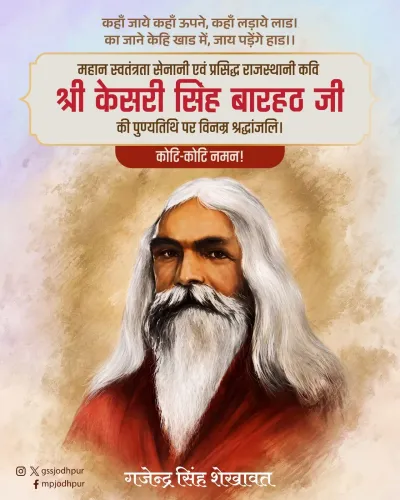
Shekhawat Pays Tribute to Freedom Fighter Pratap Singh Barhath
Synopsis
Union Culture and Tourism Minister Gajendra Singh Shekhawat on 24 May 2026 paid tribute to Pratap Singh Barhath, revolutionary son of Rajasthani freedom fighter Kesari Singh Barhath, on his birth anniversary, aligning with the ministry's focus on regional independence movement heroes.
Key Takeaways
Gajendra Singh Shekhawat , Union Minister of Culture and Tourism, posted a tribute to Pratap Singh Barhath on his birth anniversary on 24 May 2026 .
Pratap Singh Barhath was a revolutionary freedom fighter who died in British custody and is the son of Rajasthani poet-revolutionary Kesari Singh Barhath .
The tribute aligns with the Ministry of Culture's Azadi Ka Amrit Mahotsav initiative, launched in 2021 , which highlights unsung regional freedom fighters.
The Barhath family's legacy is especially significant in Rajasthan , where both father and son are revered as symbols of local sacrifice in the independence struggle.
State-level commemorative events in Rajasthan around 15 August or the state foundation day may follow such ministerial acknowledgements.
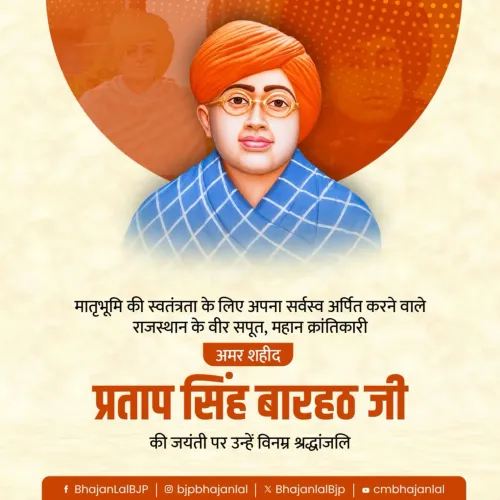
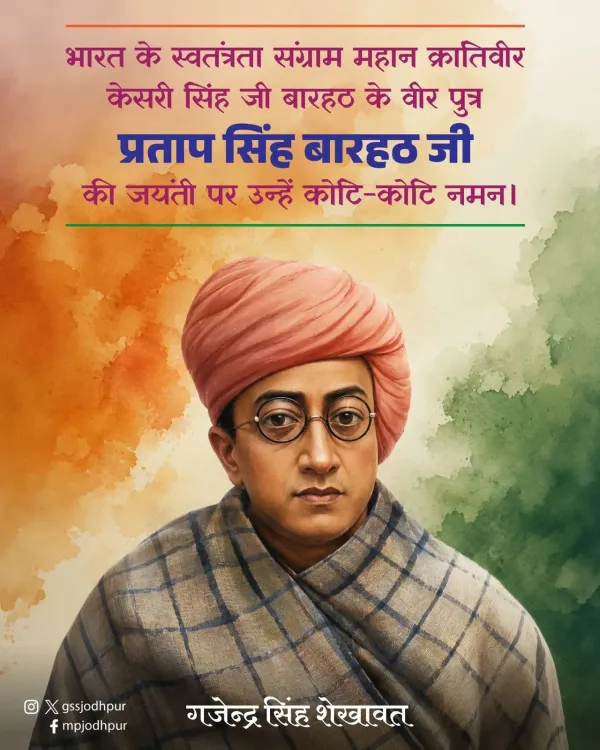
Union Culture and Tourism Minister Gajendra Singh Shekhawat on Sunday, 24 May 2026 paid homage to Pratap Singh Barhath, the revolutionary son of Rajasthani freedom fighter Kesari Singh Barhath, on the occasion of Pratap Singh's birth anniversary.
Posting on X, Shekhawat wrote in Hindi: 'भारत के स्वतंत्रता संग्राम के महान क्रांतिवीर केसरी सिंह बारहठ जी के वीर पुत्र प्रताप सिंह बारहठ जी की जयंती पर उन्हें कोटि-कोटि नमन' — translated: 'Heartfelt salutations to Pratap Singh Barhath, the brave son of the great revolutionary of India's freedom struggle, Kesari Singh Barhath, on his birth anniversary.'
Context
Pratap Singh Barhath was a revolutionary freedom fighter who gave his life resisting British colonial rule in the early twentieth century. He was the son of Kesari Singh Barhath, a celebrated Rajasthani poet, revolutionary, and key figure in anti-colonial activities in the region. Pratap Singh was arrested by British authorities and died in custody, becoming a symbol of sacrifice in Rajasthan's contribution to the independence movement.
The Barhath family's legacy is particularly revered in Rajasthan, where both father and son are remembered as emblematic of the state's deep but often under-documented role in the national freedom struggle.
Policy Backdrop
Shekhawat's tribute aligns with the Ministry of Culture's broader mandate under the Azadi Ka Amrit Mahotsav initiative, launched in 2021 to commemorate 75 years of Indian independence by spotlighting unsung and regional revolutionaries across the country.
The ministry has undertaken documentation and memorialisation projects focused specifically on early twentieth-century figures from Rajasthan and neighbouring states, with the aim of broadening the national narrative of the independence movement beyond its most prominent icons.
Stakeholders and Impact
Central ministers routinely issue social-media tributes to regional freedom fighters to underscore the geographically diverse contributions to India's independence. For Rajasthan, such acknowledgements carry particular resonance, given that figures like the Barhaths remain less prominent in national textbooks compared to their historical significance.
Researchers studying the freedom struggle, educators, and the broader Rajasthani public are the primary audiences for such commemorations, which also serve to reinforce the cultural ministry's outreach to regional communities.
What's Next
Tributes of this nature from senior Union ministers often precede or accompany state-level commemorative programmes, and Rajasthan may see events around 15 August or the state's foundation day that honour the Barhath legacy. The Culture Ministry's ongoing documentation projects could potentially include expanded archival or curriculum-level recognition of figures such as Pratap Singh Barhath and Kesari Singh Barhath in the coming months.
Point of View
Honouring the Barhath family also carries local political resonance, reinforcing a connection to the state's own revolutionary heritage. The post reflects how social media has become a primary vehicle for ministers to perform institutional memory-keeping at minimal cost. Over time, such tributes collectively build pressure for more substantive recognition — curriculum inclusion, memorials, or dedicated archival projects — that could follow through the Culture Ministry's ongoing work.
NationPress
9 Oct 2026
Frequently Asked Questions
Who was Pratap Singh Barhath?
Pratap Singh Barhath was a revolutionary Indian freedom fighter from Rajasthan who was arrested by British colonial authorities and died in custody. He was the son of Kesari Singh Barhath, a renowned Rajasthani poet and anti-colonial activist.
Who was Kesari Singh Barhath?
Kesari Singh Barhath was a prominent Rajasthani revolutionary, poet, and key figure in early twentieth-century anti-colonial activities. He is widely regarded as one of Rajasthan's most significant contributors to India's independence movement.
Why did Gajendra Singh Shekhawat pay tribute to Pratap Singh Barhath?
Shekhawat posted the tribute on the occasion of Pratap Singh Barhath's birth anniversary, consistent with the Culture Ministry's broader effort to highlight regional and unsung freedom fighters across India.
What is Azadi Ka Amrit Mahotsav?
Azadi Ka Amrit Mahotsav is an initiative launched by the Ministry of Culture in 2021 to commemorate 75 years of Indian independence, with a focus on documenting and memorialising lesser-known freedom fighters from all regions of the country.
What is Gajendra Singh Shekhawat's role?
Gajendra Singh Shekhawat is the Union Minister of Culture and Tourism, a senior BJP leader, and a Lok Sabha Member of Parliament from Jodhpur, Rajasthan.