Shivraj Singh Chouhan Pays Tribute to Raja Ram Mohan Roy

Synopsis
Union Agriculture Minister Shivraj Singh Chouhan honoured Raja Ram Mohan Roy on his death anniversary, calling the Brahmo Samaj founder and anti-sati campaigner a principal architect of modern India whose contribution will be remembered for ages.
Key Takeaways
Shivraj Singh Chouhan posted a tribute to Raja Ram Mohan Roy on 27 September 2026 , the reformer's death anniversary.
Roy, born in 1772 , founded the Brahmo Samaj in 1828 to promote monotheism and social modernisation.
His campaign against sati led to the colonial ban on the practice in 1829 .
Roy also campaigned against polygamy and child marriage in 19th-century Bengal.
Cross-party tributes to Roy on his death anniversary have become a regular feature of Indian political life.
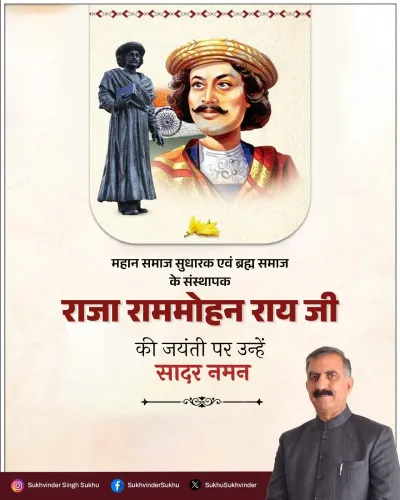
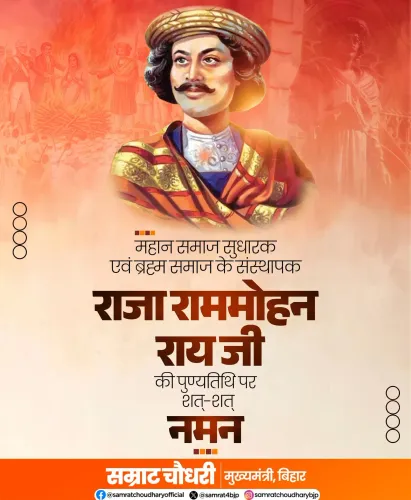
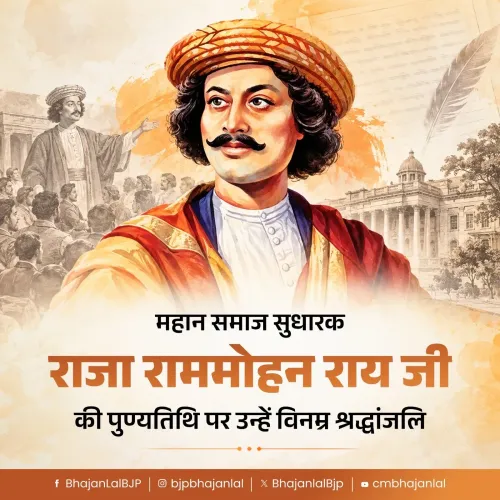
A reformer who challenged child marriage, outlawed sati, and founded India's first organised monotheist movement — Raja Ram Mohan Roy died on 27 September 1833, and nearly two centuries on, his death anniversary still draws official tribute from across India's political spectrum. Union Agriculture Minister Shivraj Singh Chouhan on Sunday honoured Roy's memory, calling him a pioneer of the Indian renaissance and a principal architect of modern India.
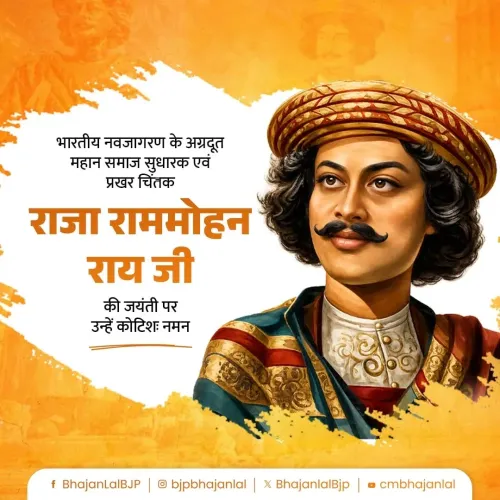
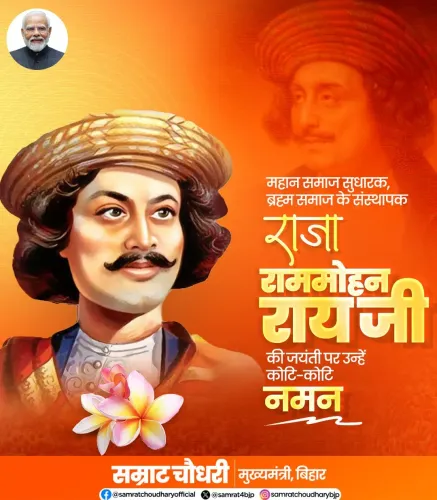
Posting on X, Minister Chouhan wrote in Hindi: 'Bhartiya punarjagaran ke agradoot, mahan samaj sudharak evam Brahmo Samaj ke sansthapak Raja Ram Mohan Roy ji ki punyatithi par vinamra shraddhanjali arpit karta hoon' — 'I offer humble tribute on the death anniversary of Raja Ram Mohan Roy, the herald of the Indian renaissance, a great social reformer and founder of the Brahmo Samaj.' He added that Roy's contribution as one of modern India's foremost creators 'will be remembered for ages to come.'
The man who unsettled 19th-century India
Raja Ram Mohan Roy was born in 1772 in Bengal and spent his life dismantling social structures that had calcified across centuries. His most consequential campaign was against sati — the practice of widows immolating themselves on their husbands' funeral pyres — which he pursued relentlessly until the colonial administration banned it in 1829. He also campaigned against polygamy and child marriage at a time when questioning such norms carried serious social cost.Brahmo Samaj and the architecture of reform
In 1828, Roy established the Brahmo Samaj, a reformist Hindu movement that rejected idol worship and caste hierarchy in favour of monotheism and rational inquiry. The Samaj became the intellectual engine of the Bengal Renaissance — a period that shaped thinkers, writers and nationalists well into the 20th century. Roy's insistence on grounding reform in both Indian philosophical tradition and Enlightenment rationalism gave the movement a durability that outlasted his own lifetime. Tributes to Roy on his death anniversary have become a fixture in Indian public life, offered by leaders across parties as a gesture of continuity with a modernising impulse that predates the republic itself. The frequency and bipartisan nature of these commemorations signals how foundational Roy's legacy remains to India's self-understanding as a reforming, plural society. Nearly 200 years after his death, the farmer-welfare minister of a 21st-century India still finds it worth saying: some contributions do not age.Point of View
Using death anniversaries to signal alignment with modernisation, social justice and national pride simultaneously. For a BJP leader, invoking Roy — whose Brahmo Samaj challenged orthodox Hindu practice — reflects the party's broader effort to position itself within a progressive-reformist nationalist tradition. The tribute carries no new policy signal but reinforces a rhetorical continuity between India's colonial-era social reform legacy and its contemporary democratic self-image. Roy's enduring bipartisan appeal suggests his legacy has been successfully absorbed into the national consensus rather than claimed by any single ideological camp.
NationPress
27 Sept 2026
Frequently Asked Questions
When did Raja Ram Mohan Roy die?
Raja Ram Mohan Roy died on 27 September 1833 in Bristol, England. His death anniversary is marked every year on this date across India.
Who founded the Brahmo Samaj?
The Brahmo Samaj was founded by Raja Ram Mohan Roy in 1828 as a reformist Hindu movement promoting monotheism and opposing caste-based discrimination.
What did Raja Ram Mohan Roy campaign against?
Roy campaigned most prominently against sati , the practice of widow immolation, which was banned in 1829 . He also opposed polygamy and child marriage.
Why did Shivraj Singh Chouhan pay tribute to Raja Ram Mohan Roy?
Shivraj Singh Chouhan paid tribute on 27 September 2026 , Roy's death anniversary, calling him a herald of the Indian renaissance and one of modern India's foremost creators.
What is the Bengal Renaissance?
The Bengal Renaissance was a 19th-century intellectual and reform movement centred in Bengal, of which Raja Ram Mohan Roy was a founding figure. It combined Indian philosophical traditions with Enlightenment-era rationalism to challenge social orthodoxy.