CM Siddaramaiah Marks 3 Years, Touts Gruha Jyothi Reach
Synopsis
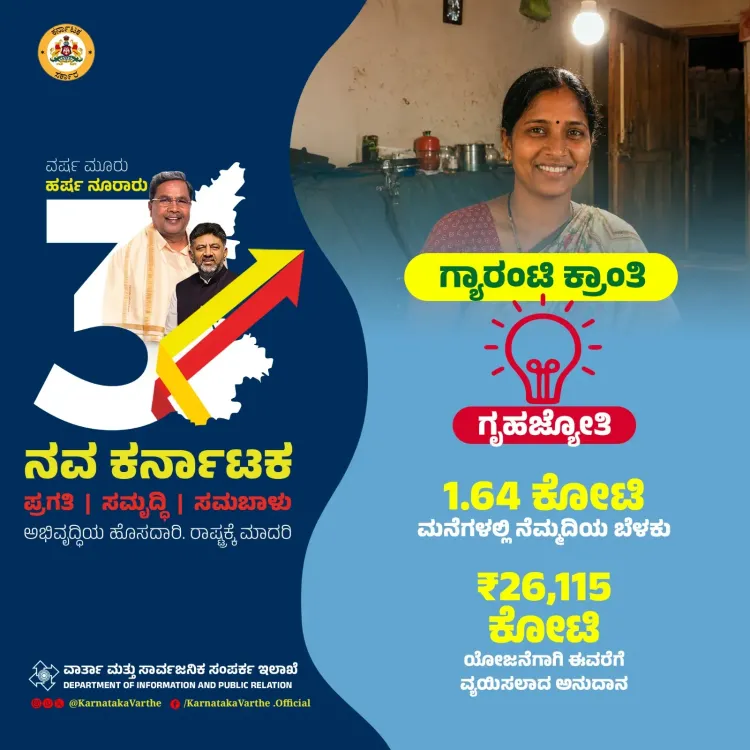
Karnataka Chief Minister Siddaramaiah marked three years in office on 27 May 2026, crediting every Kannadiga for the government's achievements and highlighting that the Gruha Jyothi free-electricity scheme has reached 1.64 crore families with ₹26,115 crore spent to date.
Key Takeaways
Karnataka CM Siddaramaiah completed three years in office on 27 May 2026 , marking the anniversary with a Kannada post on X.
The Congress government claims all five pre-poll guarantee schemes have been implemented and delivered to every household in the state.
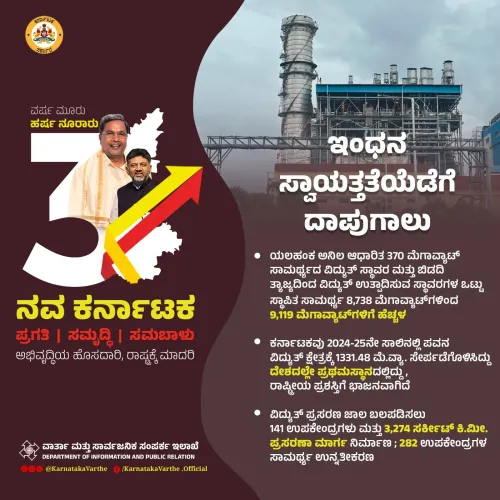
The Gruha Jyothi scheme provides up to 200 units of free electricity per month to eligible families.
1.64 crore Karnataka families are stated to be receiving free electricity under the scheme.
The government says it has spent ₹26,115 crore in grants on the Gruha Jyothi scheme since its launch.
The anniversary campaign is being promoted under the hashtag #NavaKarnataka and #3YearsOfNavaKarnataka .
Karnataka Chief Minister Siddaramaiah on Wednesday, 27 May 2026 marked three years of the Congress government in the state, crediting every Kannadiga for the administration's achievements and reaffirming the government's delivery on its five pre-poll guarantee schemes — with the Gruha Jyothi free-electricity programme at the centre of his message.
Context
Posting in Kannada, Siddaramaiah wrote: 'ರಾಜ್ಯದ ಜನರ ಆಶೀರ್ವಾದದೊಂದಿಗೆ ನಾವು ಅಧಿಕಾರಕ್ಕೆ ಬಂದು ಮೂರು ವರ್ಷಗಳು ಪೂರೈಸಿರುವ ಈ ಸಾರ್ಥಕ ಸಂದರ್ಭದಲ್ಲಿ' ['On this meaningful occasion of completing three years in power with the blessings of the people of the state']. He said the government takes pride in having kept every promise made before the elections and successfully implementing the five guarantee schemes in every household.
The post was accompanied by the hashtags #3YearsOfNavaKarnataka and #NavaKarnataka, signalling a coordinated anniversary communication campaign by the state's ruling Congress unit.
Policy Backdrop
The Indian National Congress won the Karnataka assembly elections in May 2023 on a platform of five guarantee schemes: free electricity for households, a monthly cash transfer to women heads of families, free bus travel for women, a food subsidy programme, and an unemployment stipend for educated youth. The Gruha Jyothi scheme — providing up to 200 units of free electricity per month — was among the most widely discussed of these commitments.
According to figures cited by Siddaramaiah in the post, 1.64 crore families across the state are currently receiving free electricity under the scheme, and the government has spent ₹26,115 crore in grants on the programme since its launch. The scheme's lineage can be traced to earlier targeted power subsidies in the state, including welfare-oriented electricity programmes during Siddaramaiah's previous tenure as Chief Minister between 2013 and 2018.
Stakeholders and Impact
Karnataka's electricity consumers — particularly low- and middle-income urban and rural households — are the primary beneficiaries of Gruha Jyothi. The scheme has been politically significant for the Congress government as a tangible, household-level delivery that lends itself to direct voter communication.
The programme exists within a broader pattern of competitive welfare politics across Indian states. Tamil Nadu, Andhra Pradesh, and Punjab have run comparable free or subsidised power schemes, raising recurring questions about the financial health of state electricity distribution companies. The sustainability of such programmes typically comes under scrutiny in state budget cycles and audit reviews.
What's Next
With the government now entering its fourth year, attention will turn to the Karnataka state budget allocations for 2026-27 and any audit assessments of expenditure on the five guarantee schemes. The three-year mark also sets the political clock ticking toward the next assembly election cycle, making the government's ability to sustain and expand these programmes a key variable in Congress's electoral calculus in the south.
Point of View
The Congress government signals that its re-election pitch will rest on direct welfare delivery. The ₹26,115 crore expenditure figure, cited prominently, is a double-edged sword: it demonstrates fiscal commitment to voters but will inevitably invite opposition scrutiny over state finances and power-sector debt. Karnataka's welfare model is now a reference point in Congress's national narrative, making its perceived success or failure consequential well beyond the state. How the government manages scheme sustainability heading into the pre-election period will be the central test of this political strategy.
NationPress
14 Sept 2026
Frequently Asked Questions
What is the Gruha Jyothi scheme in Karnataka?
Gruha Jyothi is a Karnataka government scheme that provides up to 200 units of free electricity per month to eligible households. It was one of five guarantee schemes promised by the Indian National Congress before the 2023 Karnataka assembly elections.
How many families benefit from Karnataka's Gruha Jyothi scheme?
According to Chief Minister Siddaramaiah, 1.64 crore families in Karnataka are currently receiving free electricity under the Gruha Jyothi scheme.
How much has Karnataka spent on Gruha Jyothi?
The Karnataka government has spent ₹26,115 crore in grants on the Gruha Jyothi free-electricity scheme since its launch, according to figures cited by CM Siddaramaiah on 27 May 2026.
What are the five guarantee schemes of the Karnataka Congress government?
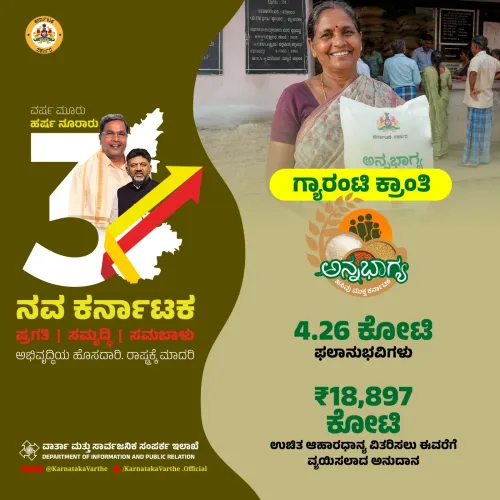
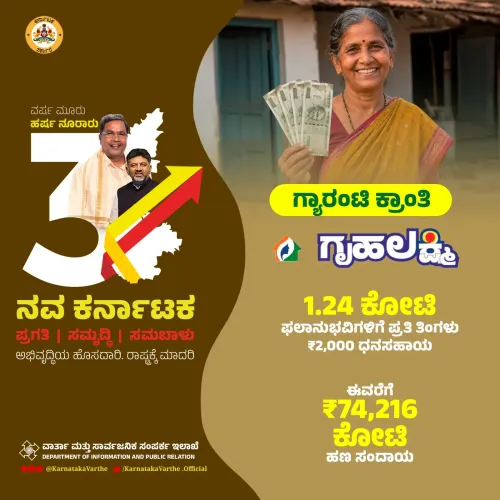
The five guarantee schemes promised by Congress in the 2023 Karnataka elections include Gruha Jyothi (free electricity), Gruha Lakshmi (monthly cash transfer to women heads of households), Shakti (free bus travel for women), Anna Bhagya (food subsidy), and Yuva Nidhi (stipend for educated unemployed youth).
When did Siddaramaiah become Chief Minister of Karnataka?
Siddaramaiah became Chief Minister of Karnataka in May 2023 after the Indian National Congress won the state assembly elections. He is a senior Congress leader and had previously served as Chief Minister from 2013 to 2018.