Sitharaman champions Jan Dhan, digital credit at Aix forum
Synopsis
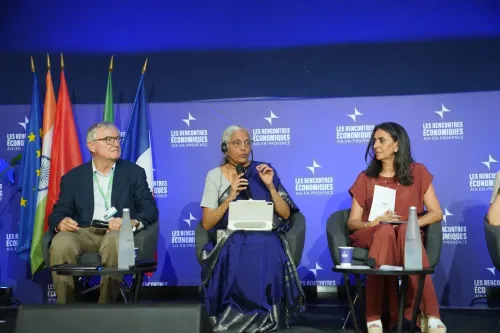
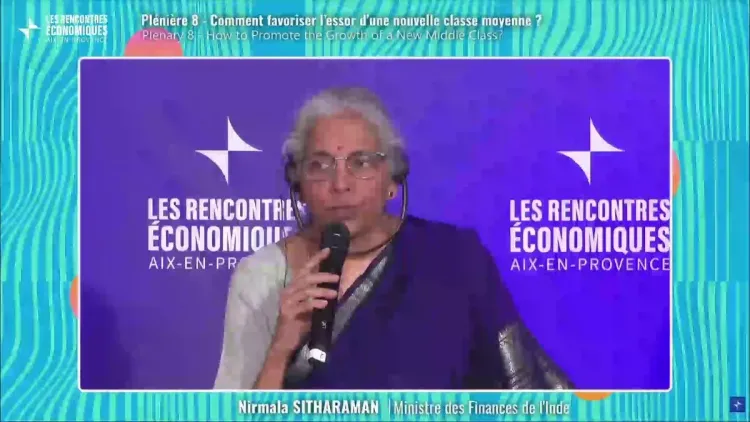
Union Finance Minister Nirmala Sitharaman addressed the Rencontres Économiques d'Aix-en-Provence on 3 July 2026, presenting PM Jan Dhan Yojana and India's digital public infrastructure as the twin engines of a social transformation that brought crores of unbanked citizens into the formal economy and enabled collateral-free credit.
Key Takeaways
Nirmala Sitharaman represented India at the Rencontres Économiques d'Aix-en-Provence on 3 July 2026 , a leading global economic policy forum in France.
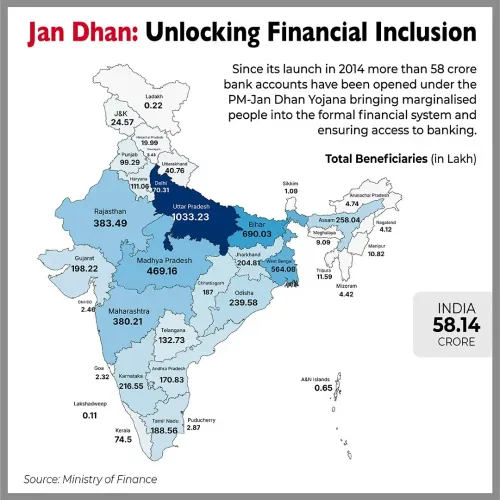
PM Jan Dhan Yojana , launched 28 August 2014 , opened zero-balance bank accounts for crores of previously unbanked Indians.
Sovereign-backed, collateral-free credit schemes such as Pradhan Mantri Mudra Yojana (loans up to ₹10 lakh ) enabled first-time borrowers to build formal credit histories.
India's digital infrastructure — Aadhaar , UPI , and mobile connectivity — empowered account holders to become entrepreneurs and transact in the formal economy.
Sitharaman framed India's JAM-trinity model as a scalable template for other emerging economies seeking to reduce cash dependence and improve credit access.
The next RBI Financial Inclusion Index and potential Union Budget announcements on sovereign credit guarantees are key near-term markers to watch.
Union Finance Minister Nirmala Sitharaman on Friday, 3 July 2026, addressed the Rencontres Économiques d'Aix-en-Provence in France, highlighting India's financial inclusion journey as a model of social transformation driven by banking access, sovereign-backed credit, and digital infrastructure.
Context
Speaking at the prestigious annual economic forum in Aix-en-Provence, France, Sitharaman credited Prime Minister Narendra Modi with bringing 'crores of unbanked citizens into the formal banking system' through the Pradhan Mantri Jan Dhan Yojana (PMJDY). She described this as the foundational step of a broader transformation that has since reshaped how low-income Indians access credit and participate in the economy.
The Rencontres Économiques d'Aix-en-Provence is a high-profile international forum that draws heads of government, central bankers, and economists to deliberate on global growth challenges. Sitharaman's address positioned India's inclusion architecture as a replicable model for emerging economies.
Policy Backdrop
PM Jan Dhan Yojana, launched on 28 August 2014, opened zero-balance bank accounts for previously unbanked households across India, forming the first pillar of the government's JAM (Jan Dhan–Aadhaar–Mobile) trinity. The scheme enabled direct benefit transfers, eliminating intermediaries and reducing leakage in welfare delivery.
Sitharaman also highlighted 'collateral-free credit backed by a sovereign guarantee,' a reference to schemes such as the Pradhan Mantri Mudra Yojana, launched in April 2015, which extended loans of up to ₹10 lakh to micro-enterprises without requiring traditional collateral. This credit layer allowed first-time borrowers — many of them women and informal workers — to build a formal credit history.
India's digital public infrastructure, including Aadhaar-based identity verification and the Unified Payments Interface (UPI), further layered onto these banking foundations to enable real-time, low-cost transactions at scale. Sitharaman described this stack as empowering citizens 'to become entrepreneurs, build creditworthiness and participate in the formal economy.'
Stakeholders and Impact
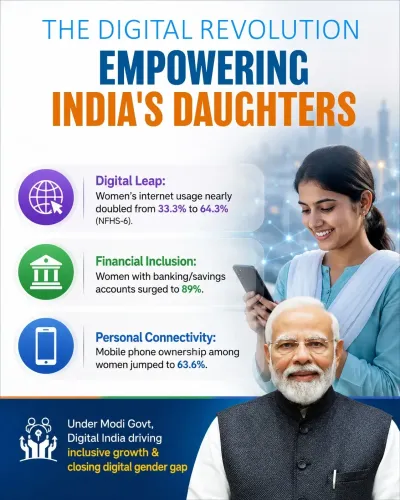
The primary beneficiaries of this architecture have been unbanked households, first-generation borrowers, small traders, and rural women who lacked access to formal financial services before 2014. By linking bank accounts to Aadhaar and mobile numbers, the government created a verifiable identity and transaction trail that commercial lenders could use to assess creditworthiness.
On the international stage, India has increasingly presented this sequenced model — account opening, followed by direct transfers, followed by credit access, underpinned by digital rails — as a scalable template for other developing nations. Sitharaman's Aix-en-Provence address is part of this ongoing diplomatic effort to establish India's development approach as a global reference point.
What's Next
Attention will now turn to the Reserve Bank of India's next Financial Inclusion Index release, which tracks the depth and quality of banking penetration across the country. Any expansion of sovereign-guaranteed credit ceilings in the forthcoming Union Budget will be closely watched as a signal of how far the government intends to push the credit-access agenda. Sitharaman's international advocacy suggests the political and policy momentum behind financial inclusion remains strong heading into the budget cycle.
Point of View
She is reinforcing the BJP's governance record while signalling continuity of the inclusion agenda. The choice of a European forum also serves a diplomatic purpose: positioning India's digital public infrastructure as a development model that global institutions and partner nations can study or adopt. Analysts will note that the framing carefully links political leadership (PM Modi) with technocratic architecture (JAM trinity), a pattern consistent with how the government has communicated on economic policy since 2014.
NationPress
3 Jul 2026
Frequently Asked Questions
What is PM Jan Dhan Yojana and when was it launched?
PM Jan Dhan Yojana is a national financial inclusion mission launched on 28 August 2014 by Prime Minister Narendra Modi to provide every unbanked household in India with a zero-balance bank account, enabling access to savings, remittances, insurance, and direct benefit transfers.
What did Nirmala Sitharaman say at Aix-en-Provence 2026?
Finance Minister Sitharaman said financial inclusion has been 'the foundation of India's social transformation,' crediting PM Jan Dhan Yojana with bringing crores of unbanked citizens into the formal banking system and digital infrastructure with enabling them to become entrepreneurs and build creditworthiness.
What is the Rencontres Économiques d'Aix-en-Provence?
It is an annual international economic forum held in Aix-en-Provence, France , where global policymakers, central bankers, and economists discuss inclusive growth and development models. India's Finance Minister addressed the forum on 3 July 2026 .
What is collateral-free credit with sovereign guarantee in India?
This refers to government-backed loan schemes — most notably Pradhan Mantri Mudra Yojana — that allow micro-entrepreneurs and first-time borrowers to access credit of up to ₹10 lakh without pledging assets, with the government providing a guarantee to lenders against default.
How has India's digital infrastructure supported financial inclusion?
India's digital public infrastructure — including Aadhaar -based identity, UPI payments, and mobile connectivity — built on the Jan Dhan account base to enable real-time transfers, reduce cash dependence, and create a verifiable transaction trail that helps low-income citizens establish creditworthiness.