Sitharaman Highlights Northeast's Global Landmarks at 12-Year Mark
Synopsis
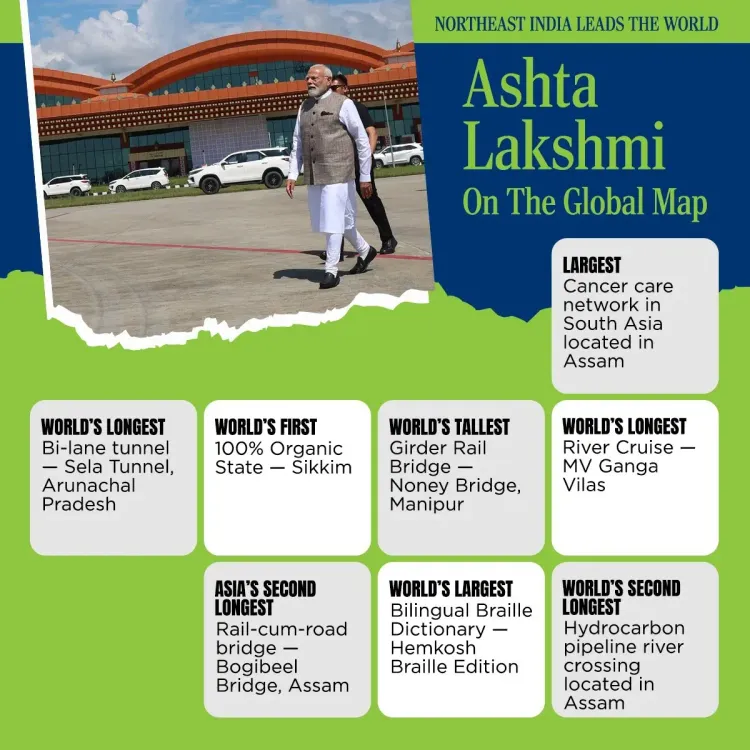
Finance Minister Nirmala Sitharaman marked twelve years of Northeast development on 20 June 2026, citing Sikkim's global organic-state status and two engineering world records — the longest bi-lane tunnel and the tallest girder rail bridge — as proof that the 'Ashta Lakshmi' region has arrived on the global map.
Key Takeaways
Nirmala Sitharaman posted on 20 June 2026 under #12YearsOfRisingNorthEast , marking a dozen years of the government's Northeast development drive.
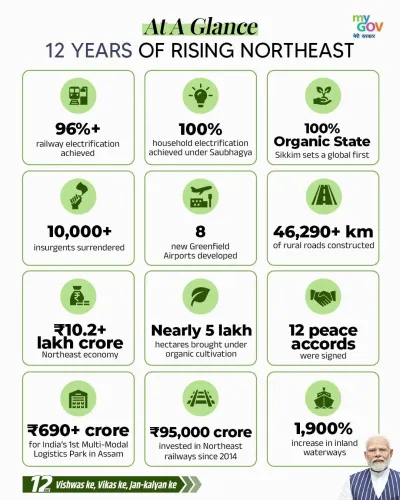
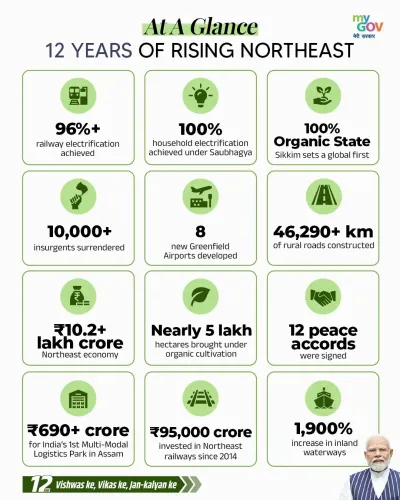
Sikkim became the world's first 100% Organic State in 2016 by eliminating all chemical fertilisers and pesticides from its farmland.
The Northeast now hosts claims to the world's longest bi-lane tunnel and the tallest girder rail bridge, reflecting large-scale engineering investment in difficult terrain.
The 'Ashta Lakshmi' framing covers all eight northeastern states: Arunachal Pradesh, Assam, Manipur, Meghalaya, Mizoram, Nagaland, Sikkim, and Tripura.
Investment has been channelled through schemes such as NESIDS and Bharatmala since the Act East Policy was launched in 2014 .
Future Union Budget allocations for Northeast rail and tunnel corridors will be a key indicator of sustained political priority for the region.
Union Finance Minister Nirmala Sitharaman on Saturday, 20 June 2026 marked twelve years of the government's Northeast development push by pointing to three engineering and agricultural milestones that have placed the region on the global stage. Posting on X under the hashtag #12YearsOfRisingNorthEast, she described the eight northeastern states — collectively called 'Ashta Lakshmi' — as now home to world-class landmarks.
Context
Sitharaman's post references three specific achievements: the world's first 100% Organic State, the world's longest bi-lane tunnel, and the tallest girder rail bridge. Sikkim earned the organic-state distinction in 2016 after a phased elimination of chemical fertilisers and pesticides across all its farmland, receiving international recognition for the feat. The tunnel and rail-bridge claims underscore the scale of physical infrastructure built in terrain that has historically challenged engineers.
The term 'Ashta Lakshmi' — Sanskrit for 'eight Lakshmis' — is an official development metaphor for the eight northeastern states: Arunachal Pradesh, Assam, Manipur, Meghalaya, Mizoram, Nagaland, Sikkim, and Tripura. The framing positions the region not as a frontier requiring catch-up investment, but as a contributor of global firsts.
Policy Backdrop
The twelve-year milestone traces to 2014, when the government rebranded the Look East Policy as the Act East Policy, explicitly tying Northeast connectivity to economic integration with Southeast Asia. Successive Union Budgets since then have channelled funds through dedicated instruments such as the North East Special Infrastructure Development Scheme (NESIDS) and the national highway programme Bharatmala to address the region's acute terrain and connectivity deficits.
The pattern of highlighting individual engineering achievements — a tunnel record here, a bridge record there — has become a consistent feature of the government's communication on the Northeast, designed to demonstrate that abstract budget allocations have translated into tangible, measurable outcomes on the ground.
Stakeholders and Impact
Residents across the eight states stand to benefit most directly: improved road and rail connectivity reduces travel time, lowers logistics costs for local produce, and opens supply chains that were previously unviable. Sikkim's organic-farming model has additionally created export value and rural income streams independent of infrastructure alone.
Infrastructure developers and contractors operating in high-altitude, seismically active terrain have also built technical capability through these projects — expertise that is increasingly sought in comparable geographies. For ASEAN neighbours, the improved connectivity corridor signals India's readiness to deepen cross-border trade links through the Northeast gateway.
What's Next
The government's annual Northeast infrastructure review is expected to list further project inaugurations in the pipeline, and the next Union Budget will be watched for fresh outlays on rail and tunnel corridors in the region. Sitharaman, as Finance Minister, holds direct influence over those allocations, making her communication on Northeast achievements a signal of continued political and fiscal priority for the region.
Point of View
Globally recognised outcomes, shifting the Northeast narrative from neglect to achievement. By invoking 'Ashta Lakshmi' — a term that carries cultural weight — the government signals that the region is a source of national pride rather than a recipient of charity. The choice to highlight engineering superlatives alongside Sikkim's organic distinction is deliberate: it speaks simultaneously to urban infrastructure audiences and to rural, agri-focused constituencies in the region. As Finance Minister, Sitharaman's voice on this topic also previews the political framing likely to accompany any Northeast-specific budget announcements in the near term.
NationPress
18 Sept 2026
Frequently Asked Questions
What is 'Ashta Lakshmi' in the context of Northeast India?
'Ashta Lakshmi' refers to the eight northeastern states of India — Arunachal Pradesh, Assam, Manipur, Meghalaya, Mizoram, Nagaland, Sikkim, and Tripura — and is used in official government narratives to frame the region as a collective source of national strength and prosperity.
Why is Sikkim called the world's first 100% Organic State?
Sikkim earned this distinction in 2016 after phasing out all chemical fertilisers and pesticides across its entire farmland, making it the first state anywhere in the world to achieve fully organic agriculture at a state-wide scale.
What is the Act East Policy and how does it relate to Northeast India?
The Act East Policy, launched in 2014 as a rebranding of the earlier Look East Policy, prioritises physical connectivity and economic integration of Northeast India with Southeast Asian nations, treating the region as India's strategic eastern gateway.
What schemes fund infrastructure development in Northeast India?
Key central schemes include the North East Special Infrastructure Development Scheme (NESIDS) and the Bharatmala national highway programme, both of which have directed significant funds toward roads, tunnels, and rail connectivity in the Northeast since 2014.
What did Nirmala Sitharaman post about the Northeast on 20 June 2026?
Finance Minister Nirmala Sitharaman posted on X marking twelve years of Northeast development, highlighting that the region is now home to the world's first 100% Organic State, the world's longest bi-lane tunnel, and the tallest girder rail bridge, describing the 'Ashta Lakshmi' states as firmly on the global map.