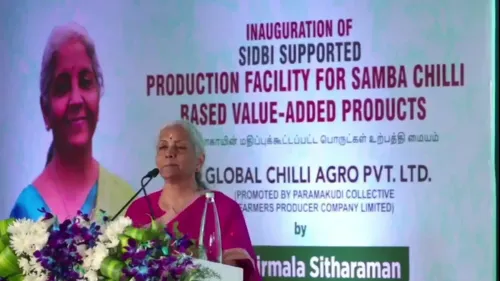
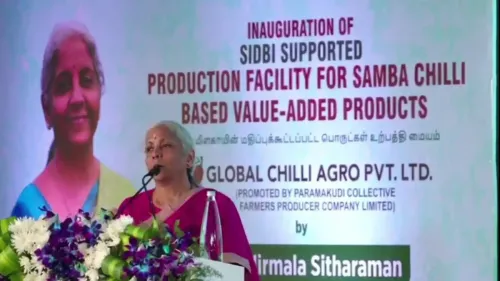
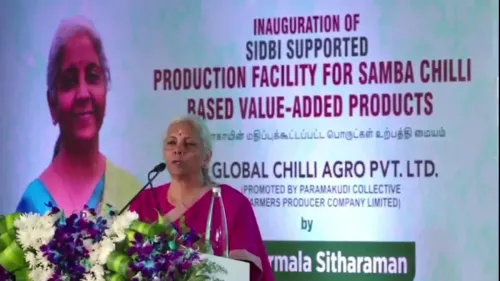
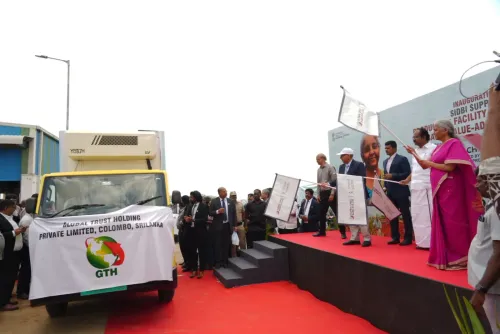
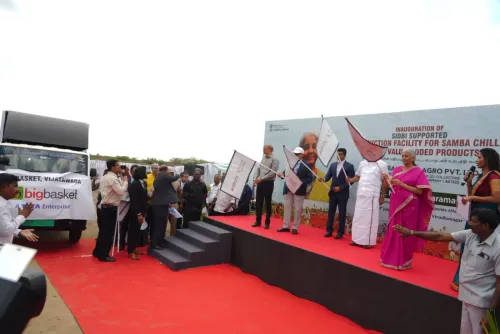
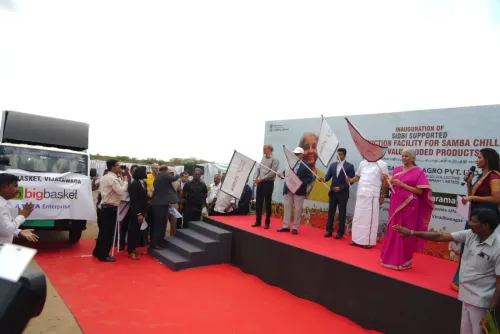
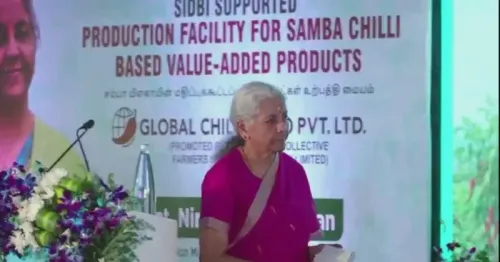
Sitharaman Highlights SIDBI's First Farmer-Linked Chilli Processing Unit
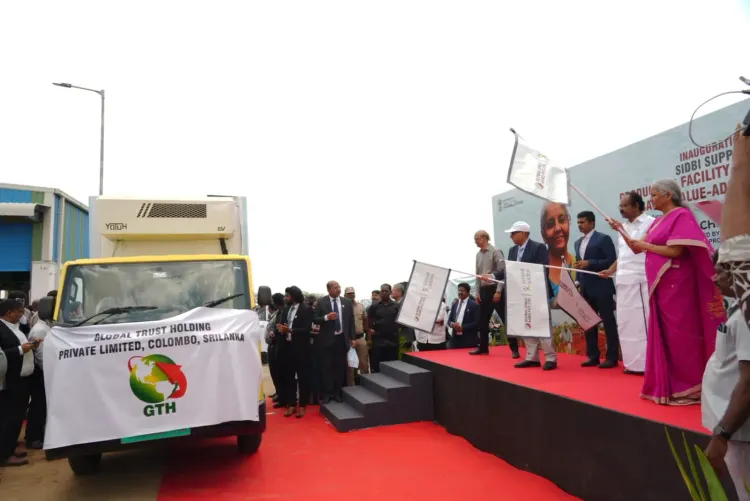
Synopsis
Union Finance Minister Nirmala Sitharaman spotlighted a historic SIDBI intervention: a VALARI-branded chilli processing facility backed by nearly 1,000 farmers — including 472 women — financed through ₹3.83 crore in blended support and ₹50 lakh in working capital, combining grants, returnable assistance, and ISO 22000 and ZED certifications.
Key Takeaways
The VALARI brand facility produces chilli powder, chilli flakes, and cleaned whole chillies, backed by nearly 1,000 farmers including around 472 women members .
SIDBI has provided ₹3.83 crore through blended finance and an additional ₹50 lakh in working-capital support.
The blended finance structure combines grant support, performance-linked returnable assistance, and working capital — a first for SIDBI.
The facility holds ISO 22000 food safety certification and ZED (Zero Defect Zero Effect) certification under the MSME Ministry's quality scheme.
Finance Minister Nirmala Sitharaman described the project as a 'historic first' for SIDBI in farmer-linked integrated interventions.
The model mirrors India's broader policy push to formalise agri-value chains and increase women's participation in organised rural enterprises.
Union Finance Minister Nirmala Sitharaman on Saturday, 18 July 2026 shared details of a first-of-its-kind integrated farmer-linked agro-processing facility backed by the Small Industries Development Bank of India (SIDBI), describing it as a historic milestone in blended finance for rural MSME value chains. The facility, operating under the VALARI brand, produces chilli powder, chilli flakes, and cleaned and packaged whole chillies, and is supported by nearly 1,000 farmers, including around 472 women members.
Context
Sitharaman's post — the second in a thread — described the facility as carrying ISO 22000 food safety certification and ZED (Zero Defect Zero Effect) certification, a quality-and-environment standard promoted by the Ministry of MSME since 2016. The minister noted that the project marks a 'historic first' for SIDBI, combining multiple financing instruments in a single farmer-linked intervention for the first time.
SIDBI has provided ₹3.83 crore through blended finance, alongside ₹50 lakh in working-capital support. The blended structure combines grant support, performance-linked returnable assistance, and working capital — an approach designed to de-risk farmer collectives while enabling them to meet quality standards for domestic and export markets.
Policy Backdrop
SIDBI, established in 1990 as India's apex development financial institution for micro, small and medium enterprises, has increasingly been deployed as a channel for policy-driven interventions in agri-value chains. The Atmanirbhar Bharat package of 2020 included dedicated liquidity and credit support routed through SIDBI, reinforcing its role beyond traditional refinance into direct developmental support.
India's broader policy thrust has been to formalise horticulture and spice value chains by linking primary producers — particularly farmer collectives — with certified processing units. The blended finance model used here, mixing non-returnable grants with performance-linked returnable assistance, is designed to lower the cost of capital for small agro-processors while maintaining accountability for outcomes.
The ZED certification component is significant: it signals that the facility meets graded quality and environmental benchmarks set by the MSME Ministry, potentially opening pathways to institutional buyers and export markets that require traceable, certified supply chains.
Stakeholders and Impact
The approximately 472 women members among the farmer base represent a deliberate policy choice to embed gender participation in organised rural enterprises. Women's inclusion in agri-value-chain MSMEs has been a stated priority across multiple central schemes, and this project operationalises that goal at the producer level.
For the nearly 1,000 farmers linked to the facility, the arrangement provides an assured processing outlet for chilli produce under a branded identity — reducing dependence on unorganised mandis and volatile spot prices. The working-capital component of ₹50 lakh is intended to smooth procurement cycles between harvest and processing.
Agro-processing MSMEs in the spices segment stand to benefit from the replicability signal this project sends: a SIDBI-backed, certification-ready model with a defined financing template could attract similar interventions in other horticulture commodities and geographies.
What's Next
The minister's framing of this as a 'first-of-its-kind' and 'historic first for SIDBI' suggests the institution may look to replicate the blended-finance template in other states and commodity clusters. Observers will watch for references to this model in SIDBI's forthcoming annual report or in the next Union Budget's MSME and agriculture financing proposals.
The VALARI brand's performance in domestic and export markets will serve as the practical test of whether certification-backed, farmer-linked processing units can achieve commercial sustainability without ongoing grant dependence — a key question for scaling the model nationally.
Point of View
Not merely a developmental footnote. The deliberate emphasis on the '472 women members' and the 'historic first' framing suggests the government is building a replicable narrative around gender-inclusive rural MSMEs — one that can be cited in both domestic policy documents and international development forums. The ZED and ISO 22000 dual-certification angle is equally telling: it positions the facility for export-market access, aligning with the broader push to grow India's processed-spices export basket. Whether SIDBI can scale this template without diluting its blended-finance discipline will be the real test of the model's longevity.
NationPress
17 Oct 2026
Frequently Asked Questions
What is the VALARI brand and what does it produce?
VALARI is the brand under which the SIDBI-backed agro-processing facility markets its products — chilli powder, chilli flakes, and cleaned and packaged whole chillies. The facility holds ISO 22000 and ZED certifications and is linked to nearly 1,000 farmers.
How much money has SIDBI provided to this chilli processing project?
SIDBI has provided ₹3.83 crore through blended finance — combining grant support and performance-linked returnable assistance — along with ₹50 lakh in working-capital support.
What is ZED certification and why does it matter for MSMEs?
ZED stands for Zero Defect Zero Effect, an MSME Ministry scheme launched in 2016 that certifies manufacturing units on quality and environmental standards through a graded system. For agro-processing MSMEs, ZED certification can improve access to institutional buyers and export markets.
Why is this project described as a historic first for SIDBI?
According to Finance Minister Nirmala Sitharaman's post, this is the first time SIDBI has combined grant support, performance-linked returnable assistance, and working capital in a single integrated farmer-linked intervention, making it a novel blended-finance model for the institution.
How many women farmers are part of this SIDBI-backed project?
Around 472 women members are among the nearly 1,000 farmers linked to the VALARI chilli processing facility, reflecting a deliberate emphasis on gender inclusion in organised rural agro-processing enterprises.