Sitharaman pitches India's welfare model at French university
Synopsis
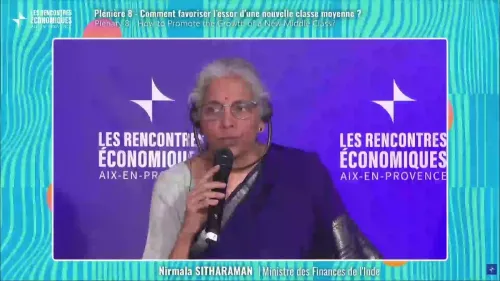
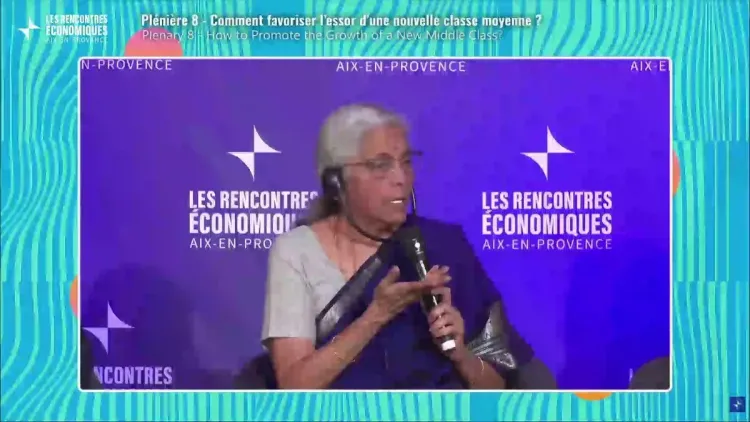
Finance Minister Nirmala Sitharaman, addressing Aix-Marseille University in France, presented India's welfare approach as an integrated system of housing subsidies, skilling, internships and concessional enterprise loans — aimed at sustaining economic security, not just reducing poverty headcounts.
Key Takeaways
Nirmala Sitharaman addressed Aix-Marseille University in France on 3 July 2026 , outlining India's welfare model to an international academic audience.
She described the approach as 'holistic', built on affordable housing with interest subsidies, skilling, internships, and concessional loans for enterprise creation.
The Pradhan Mantri Awas Yojana , launched in June 2015 , provides subsidised housing loans through a Credit Linked Subsidy component.
The Skill India Mission ( July 2015 ) and the MUDRA scheme ( April 2015 ) form the skilling and enterprise-credit legs of the framework.
The minister stressed that India's goal is not merely poverty reduction but ensuring citizens 'thrive and remain economically secured' after exiting poverty.
The address reflects India's broader strategy of presenting domestic welfare programmes as a coherent, scalable model at international forums.
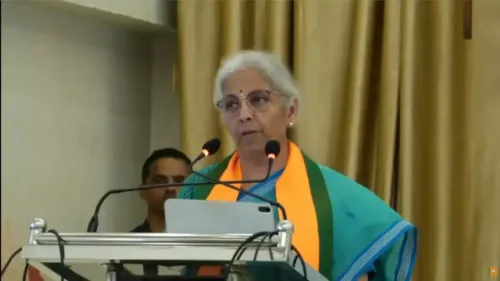
Union Finance Minister Nirmala Sitharaman outlined India's integrated approach to social welfare during an address at Aix-Marseille University in France on 3 July 2026, arguing that the country's development model goes beyond poverty alleviation to build lasting economic security for its citizens.
Context
Speaking at the prestigious French public research institution, Sitharaman described India's welfare framework as 'holistic', centred on four pillars: affordable housing with interest subsidies, skilling, internships, and concessional loans to start enterprises. Her remarks framed these not as isolated programmes but as a connected system designed to ensure that people who rise out of poverty are equipped to stay there.
'Our focus is not just on lifting people out of poverty but on empowering them to thrive and remain economically secured,' the minister said, in remarks shared on social media by her official account.
Policy Backdrop
The four pillars Sitharaman referenced map directly onto flagship Central schemes. The Pradhan Mantri Awas Yojana (PMAY), launched in June 2015, extends subsidised housing loans to urban and rural households through a Credit Linked Subsidy component, addressing chronic housing shortages across income segments.
The Skill India Mission, announced in July 2015, targets vocational training and apprenticeships for India's large youth population, while the MUDRA scheme, introduced in April 2015, channels concessional credit to non-corporate small enterprises and first-generation entrepreneurs. Together, these programmes represent the government's attempt to build a multidimensional anti-poverty architecture rather than relying on direct cash transfers alone.
Since 2014, successive administrations have integrated housing, skill development, and enterprise credit into a single policy narrative. Overseas university and think-tank platforms have become a recurring venue for senior ministers to present this model as scalable and distinct from conventional welfare approaches.
Stakeholders and Impact
The primary beneficiaries of the programmes cited are urban and rural poor households, youth seeking vocational training, and micro-entrepreneurs accessing formal credit for the first time. The government's framing — emphasising post-poverty economic security — reflects a broader shift away from measuring progress purely through headcount poverty ratios.
By presenting this framework at an international academic forum, Sitharaman also signals India's interest in positioning its welfare model as a reference point for other developing economies grappling with similar challenges of scale and resource constraints.
What's Next
Observers will watch for updated multidimensional poverty index data that incorporates housing and skill metrics, which could give statistical weight to the claims made in forums such as this. Any bilateral economic or development-cooperation announcements emerging from the minister's broader France engagements are also expected to attract attention. The address at Aix-Marseille University underscores India's growing use of European academic platforms to build soft-power credibility around its domestic reform record.
Point of View
Skill India, and MUDRA as a unified system rather than standalone schemes, the government is making a structural argument: that India has moved beyond the cash-transfer model that defines welfare in many peer economies. The emphasis on 'remaining economically secured' rather than just escaping poverty is a subtle repositioning of the success metric, one that is harder to measure but politically more aspirational. Whether this framing gains traction in multilateral development discussions may depend on how quickly updated multidimensional poverty data can substantiate the claims.
NationPress
3 Jul 2026
Frequently Asked Questions
What did Nirmala Sitharaman say at Aix-Marseille University?
Finance Minister Nirmala Sitharaman said India's welfare approach is 'holistic', combining affordable housing with interest subsidies, skilling, internships, and concessional loans to start enterprises, with the goal of empowering people to thrive and remain economically secured — not just exit poverty.
What is India's holistic welfare model?
India's holistic welfare model, as described by Sitharaman, integrates housing subsidies under PMAY, vocational training under Skill India, internship programmes, and concessional enterprise credit under the MUDRA scheme into a single, multidimensional anti-poverty framework.
What is the MUDRA scheme and who can benefit?
The MUDRA scheme, launched in April 2015, provides concessional credit to non-corporate small enterprises and first-time entrepreneurs, enabling individuals without access to formal banking to start or expand micro-businesses.
Why is Nirmala Sitharaman speaking about welfare in France?
Sitharaman addressed Aix-Marseille University as part of India's broader practice of presenting its domestic development model at international academic and policy forums, building global recognition for its welfare programmes.
What is the Pradhan Mantri Awas Yojana and how does it work?
Pradhan Mantri Awas Yojana, launched in June 2015, is a Central government scheme that provides affordable housing to urban and rural households through interest subsidies on home loans via a Credit Linked Subsidy component, reducing the effective cost of borrowing for eligible beneficiaries.