Sitharaman Highlights Welfare Reach in Bengaluru Address
Synopsis
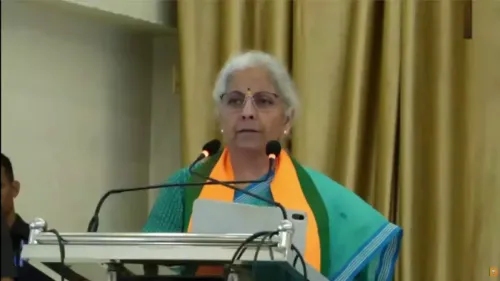
Union Finance Minister Nirmala Sitharaman, addressing an audience in Bengaluru on 14 June 2026, highlighted over 12 crore toilets, 15.85 crore rural tap connections, 10.5 crore Ujjwala LPG links and free food grains for 81 crore citizens as proof of the government's 'saturation governance' model reaching India's last mile.
Key Takeaways
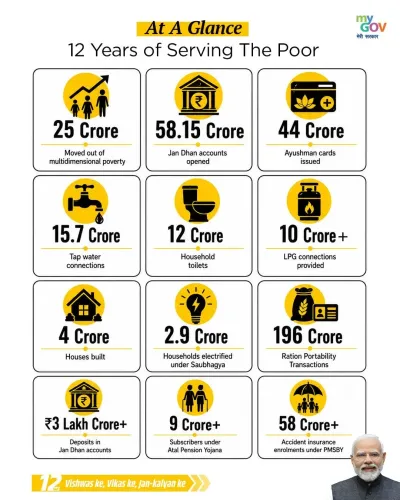
Over 12 crore household toilets have been constructed under the Swachh Bharat Mission , surpassing its original 10 crore target.
Nearly 15.85 crore rural tap-water connections have been provided under the Jal Jeevan Mission since 2019.
10.5 crore Ujjwala LPG connections have been distributed to women in below-poverty-line households, more than double the scheme's initial target.
Free food grains are being provided to over 81 crore citizens under the Pradhan Mantri Garib Kalyan Anna Yojana .
Finance Minister Sitharaman described the approach as 'saturation governance'—ensuring development reaches the last person in the queue .
The remarks were made in Bengaluru on 14 June 2026 and shared on the minister's official social-media handle.
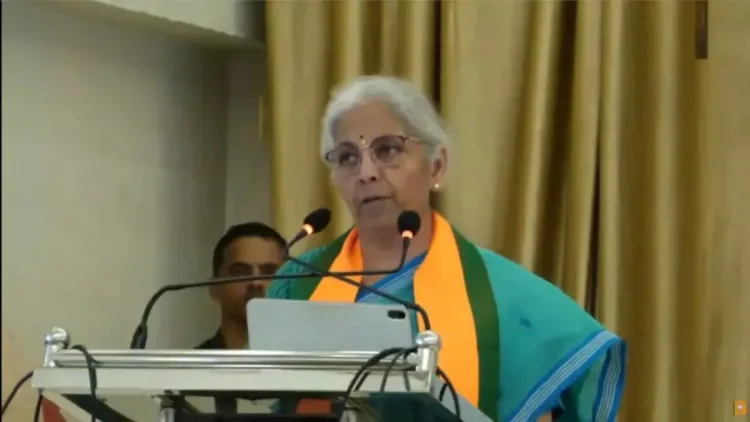
Union Finance Minister Nirmala Sitharaman, speaking in Bengaluru on Sunday, 14 June 2026, cited landmark figures across four flagship welfare schemes to argue that the central government's 'saturation governance' model is delivering measurable change at the household level for crores of Indians.
Context
Sitharaman pointed to over 12 crore household toilets constructed, nearly 15.85 crore rural tap-water connections established, 10.5 crore Ujjwala LPG connections distributed, and free food grains extended to over 81 crore citizens as evidence of the scale of welfare delivery under the current dispensation. 'We're taking the approach of saturation governance, ensuring that development reaches the last person in the queue,' she said, articulating the government's stated philosophy of universal, last-mile coverage rather than selective beneficiary targeting.
The remarks came during a public engagement in Bengaluru and were shared on the Finance Minister's official social-media handle, drawing attention to the convergence of multiple centrally sponsored schemes under a single governance framework.
Policy Backdrop
The four schemes Sitharaman cited each carry a distinct legislative and budgetary lineage. The Swachh Bharat Mission, launched in October 2014, set an initial target of 10 crore toilets by 2019 to end open defecation; the figure she cited—over 12 crore—suggests the programme has surpassed that original benchmark. The Jal Jeevan Mission, announced in August 2019, aimed to provide functional tap-water connections to every rural household by 2024, and the 15.85 crore connections figure reflects the scale of infrastructure rolled out under that scheme.
The Pradhan Mantri Ujjwala Yojana, inaugurated in May 2016 with an initial target of 5 crore LPG connections for women in below-poverty-line households, has more than doubled its reach to 10.5 crore connections. The Pradhan Mantri Garib Kalyan Anna Yojana, introduced in March 2020 during the COVID-19 pandemic, has since been extended to provide 5 kg of free food grains per person per month to eligible households, covering over 81 crore citizens.
Stakeholders and Impact
The primary beneficiaries of these schemes are rural households, women in below-poverty-line families, and food-security recipients across India's states and union territories. The toilet and tap-water programmes directly address public health outcomes, while the Ujjwala scheme targets indoor air pollution by replacing biomass cooking fuel with clean LPG. The free food-grain programme addresses nutritional security for a substantial share of the population.
The Finance Minister's framing of 'saturation governance' signals a policy preference for measurable household-level targets over aggregate economic indicators—a shift that has shaped budget allocations and inter-ministerial coordination since 2014 under Prime Minister Narendra Modi. For state governments, the metrics also serve as benchmarks in periodic saturation dashboards released by the relevant ministries.
What's Next
Analysts and policymakers will watch the next Union Budget for continued or enhanced allocations to these four schemes, particularly as the Jal Jeevan Mission's original 2024 deadline has passed and residual coverage gaps in remote areas remain a policy challenge. Parliamentary sessions are expected to see scrutiny of implementation data, and state-level review exercises are likely to follow high-profile ministerial statements of this kind.
The Bengaluru remarks reinforce that welfare delivery metrics will remain a central pillar of the government's public communication ahead of future electoral cycles, with saturation coverage framed as both a social-justice imperative and a governance achievement.
Point of View
' the Finance Ministry is projecting a unified last-mile delivery doctrine that cuts across sanitation, water, energy and food security. The framing is also a pre-emptive counter to opposition arguments about elite-skewed growth, offering household-level statistics as the government's rebuttal. With budget cycles and potential electoral contests on the horizon, expect these four scheme metrics to become recurring reference points in official communication.
NationPress
14 Sept 2026
Frequently Asked Questions
What is saturation governance as described by Nirmala Sitharaman?
Saturation governance, as described by Finance Minister Nirmala Sitharaman in Bengaluru on 14 June 2026, refers to the central government's approach of ensuring welfare schemes reach every eligible household rather than stopping at partial coverage, with the goal of delivering benefits to 'the last person in the queue.'
How many rural tap water connections have been provided under Jal Jeevan Mission?
Nearly 15.85 crore rural tap-water connections have been provided under the Jal Jeevan Mission , according to figures cited by Finance Minister Nirmala Sitharaman on 14 June 2026.
How many people get free food grains under PM Garib Kalyan Anna Yojana?
Over 81 crore citizens receive free food grains under the Pradhan Mantri Garib Kalyan Anna Yojana , which provides 5 kg of grains per person per month to eligible households.
What is Pradhan Mantri Ujjwala Yojana and how many connections have been given?
Pradhan Mantri Ujjwala Yojana is a 2016 scheme that distributes free LPG connections to women in below-poverty-line households to promote clean cooking fuel. As of figures cited in June 2026, 10.5 crore connections have been distributed, more than double the original target of 5 crore.
What did Nirmala Sitharaman say in Bengaluru about welfare schemes?
In Bengaluru on 14 June 2026 , Finance Minister Nirmala Sitharaman cited over 12 crore toilets, 15.85 crore rural tap connections, 10.5 crore Ujjwala LPG links and free food grains for 81 crore citizens as proof that welfare delivery is 'changing lives of crores of Indians on the ground' through a 'saturation governance' approach.