Smriti Irani hails record 5,000+ adoptions in 2025-26
Synopsis
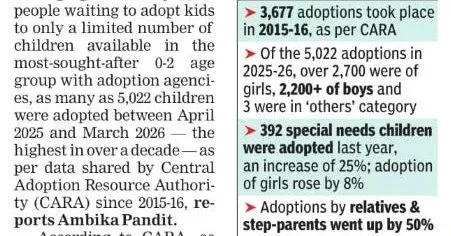
BJP leader Smriti Irani has highlighted that more than 5,000 children found adoptive families in 2025-26 — India's highest annual adoption figure in over a decade — crediting sustained administrative reforms and field-level officers rather than any single policy moment.
Key Takeaways
More than 5,000 children were adopted in India in 2025–26 , the highest annual figure in over a decade.
BJP leader Smriti Irani attributed the milestone to decade-long systemic reforms, not a single intervention.
The Juvenile Justice Act, 2015 and Adoption Regulations, 2017 form the legal backbone of India's current adoption framework.
CARA's CARINGS portal , strengthened between 2018 and 2022, digitised child-family matching and reduced procedural delays.
Irani specifically credited district-level officers and field functionaries for sustaining implementation after policy headlines faded.
The next CARA annual report and potential amendments to the JJ Act in parliament are the key developments to watch.
BJP leader and former Union Minister for Women and Child Development Smriti Irani on Monday, 27 July 2026 credited a decade of quiet administrative reforms for pushing India's annual adoption figure above 5,000 children in 2025–26 — the highest tally in over ten years — while calling out the unsung role of field-level officers in turning policy into reality.
Context
Writing on social media and directing followers to a longer piece on LinkedIn, Irani said the milestone 'rarely belongs to one individual or one moment' and is instead 'the outcome of reforms that quietly strengthen systems, improve processes and then, over time, begin to change lives.' She specifically acknowledged 'countless officers, administrators and field functionaries who persevere long after the headlines have faded.'
Irani served as Union Minister for Women and Child Development between 2019 and 2024, a period during which her ministry oversaw procedural changes to India's adoption architecture. Her post reflects on reforms initiated during that tenure and why the 2025–26 figure carries personal significance for her.
Policy Backdrop
India's adoption framework rests on the Juvenile Justice (Care and Protection of Children) Act, 2015, which replaced the earlier 2000 legislation and introduced mandatory timelines, a clear priority for domestic placements, and strengthened institutional mechanisms. The Adoption Regulations of 2017, notified by the Ministry, further streamlined eligibility criteria and reduced procedural hurdles for prospective parents.
The Central Adoption Resource Authority (CARA) — the statutory body under the Ministry of Women and Child Development that regulates both domestic and inter-country adoptions — also saw its CARINGS online portal significantly strengthened between 2018 and 2022, digitising the tracking and matching of children with adoptive families. These layered reforms, spread across multiple years and administrations, form the scaffolding behind the latest numbers.
Stakeholders and Impact
The most direct beneficiaries of the milestone are the more than 5,000 children who found permanent families in a single year — a cohort that would otherwise have remained in institutional care. For prospective adoptive parents, faster digital processes and clearer guidelines have reduced the uncertainty and wait times that historically discouraged families from pursuing legal adoption.
Child welfare officers and district-level administrators, whom Irani singled out for praise, bear the operational burden of implementing central directives across 28 states and 8 Union Territories. Their consistent execution across years — not a single policy announcement — is what Irani argues produced this result. The broader pattern in Indian social-sector delivery confirms this: outcomes in child welfare depend heavily on sustained bureaucratic follow-through at the block and district level.
What's Next
Attention will now turn to the next annual CARA adoption report, which is expected to provide a granular breakdown of domestic versus inter-country adoptions, state-wise performance, and average wait times. Any proposed amendments to the Adoption Regulations or the Juvenile Justice Act in the forthcoming parliamentary session could further shape the trajectory of these numbers.
If the 2025–26 figure is formally confirmed in the CARA report, it would mark a significant inflection point and likely renew legislative interest in reducing remaining procedural bottlenecks — including court ratification timelines — that child welfare advocates have long flagged as barriers to higher adoption rates in India.
Point of View
While framing it as a systemic rather than personal achievement to deflect any perception of self-promotion. The explicit acknowledgement of bureaucratic implementers is politically astute: it broadens the credit coalition while reinforcing the narrative that durable reform requires administrative depth, not just political will. Within the BJP's wider governance communication, this fits a pattern of highlighting 'silent delivery' in social welfare as a counter-narrative to opposition critiques of the party's record on child protection. The milestone, if confirmed by CARA's formal report, could also be leveraged ahead of any legislative push to amend the JJ Act.
NationPress
27 Jul 2026
Frequently Asked Questions
How many children were adopted in India in 2025-26?
According to a post by former Union Minister Smriti Irani, more than 5,000 children found families through adoption in 2025-26, which she described as the highest annual figure in over a decade. The figure is expected to be formally confirmed in CARA's next annual report.
What is CARA and what role does it play in adoptions in India?
The Central Adoption Resource Authority (CARA) is a statutory body under the Ministry of Women and Child Development that regulates both domestic and inter-country adoptions in India. It maintains the CARINGS online portal, which digitises the process of matching children in institutional care with prospective adoptive parents.
What reforms changed India's adoption process?
Key reforms include the Juvenile Justice (Care and Protection of Children) Act of 2015, which set mandatory timelines and prioritised domestic adoption, and the Adoption Regulations of 2017, which streamlined eligibility and reduced procedural steps. The CARINGS portal was also strengthened between 2018 and 2022 to digitise tracking and matching.
What was Smriti Irani's role in adoption reforms?
Smriti Irani served as Union Minister for Women and Child Development from 2019 to 2024, during which her ministry oversaw procedural changes to India's adoption system under the JJ Act and CARA framework. She has written about these reforms in a LinkedIn piece linked from her social media post.
Why does India's adoption rate matter?
A higher adoption rate means more children leave institutional care and join permanent family environments, which research consistently links to better developmental outcomes. Reducing procedural delays and digitising the process are seen as critical levers for sustaining and improving these numbers year on year.