Sonowal backs CMPS as India's maritime manufacturing leap
Synopsis
Union Minister Sarbananda Sonowal championed the Container Manufacturing Policy Scheme (CMPS) on October 28, 2026, positioning it as a cornerstone of India's Aatmanirbhar Bharat push and its bid to become a trusted global player in container manufacturing and maritime logistics.
Key Takeaways
Sarbananda Sonowal , Union Minister of Ports, Shipping and Waterways, publicly endorsed the CMPS on October 28, 2026 .
He described the scheme as reflecting the Modi government's commitment to Aatmanirbharta , manufacturing excellence and a stronger maritime India.
The CMPS aims to foster innovation, attract investment and build domestic container manufacturing value chains.
The scheme is rooted in the Aatmanirbhar Bharat initiative (2020) and Maritime India Vision 2030 (2021).
India's domestic container industry has historically depended heavily on imports, particularly from China ; CMPS is designed to close that gap.
Implementation details, investment commitments and parliamentary follow-through remain the next critical milestones.
India's push to become a self-reliant force in global maritime logistics moved a step forward on Wednesday, October 28, 2026, when Union Minister of Ports, Shipping and Waterways Sarbananda Sonowal threw his weight behind the Container Manufacturing Policy Scheme (CMPS), calling it a direct expression of Prime Minister Narendra Modi's commitment to manufacturing excellence and a stronger maritime India.
What Sonowal said — and why it signals momentum
Sonowal framed the CMPS as far more than a procurement incentive. 'CMPS reflects the PM Modi ji-led government's unwavering commitment to Aatmanirbharta [self-reliance], manufacturing excellence and a stronger maritime India,' he wrote. 'It will foster innovation, attract investment, build domestic value chains and contribute to India's emergence as a trusted global player in container manufacturing and maritime logistics.'
The language is deliberate. 'Trusted global player' signals that New Delhi is not just chasing self-sufficiency — it is bidding for a seat at the table of international supply chains long dominated by East Asian manufacturers. That is an ambition with real geopolitical weight.
The policy lineage behind CMPS
The scheme sits inside a well-mapped architecture. Aatmanirbhar Bharat, announced in 2020, set the philosophical frame: reduce import dependence, build domestic capacity. Maritime India Vision 2030, launched in 2021, translated that frame into sector-specific targets — port capacity, shipping growth, and critically, domestic manufacturing of maritime equipment and containers.
For years, India's container fleet has relied overwhelmingly on imports, with China supplying the bulk of the world's steel shipping containers. Every box India builds at home is one less box it buys abroad — and one more step toward insulating domestic logistics from global supply-chain shocks. The Sagarmala programme has run parallel, linking port infrastructure investment to hinterland connectivity.
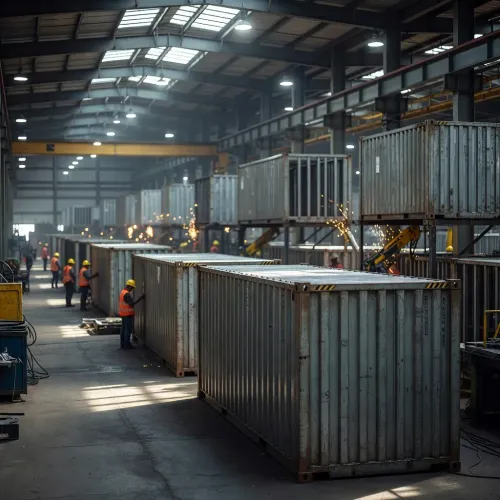
CMPS is designed to close the manufacturing gap directly, using policy incentives to seed a domestic container production industry that can eventually compete on the world stage.
What to watch as CMPS moves forward
The minister's public endorsement raises the political visibility of the scheme, but implementation details will determine whether it delivers. Investors — domestic and foreign — will be watching for concrete production targets, incentive structures, and how the Ministry of Ports, Shipping and Waterways coordinates with industry. Parliamentary and budgetary follow-through in the coming sessions will be the real test.
India has stated this ambition before. The difference now is the convergence of policy infrastructure, a minister willing to champion it loudly, and a global supply-chain realignment that is actively looking for alternatives to single-source dependencies. The window is open. CMPS is India's bid to step through it.
Frequently Asked Questions
What is CMPS in India's maritime sector?
CMPS stands for Container Manufacturing Policy Scheme, a central government initiative designed to develop domestic container manufacturing capacity in India, reduce import dependence and integrate Indian firms into global maritime supply chains.
What did Sarbananda Sonowal say about CMPS?
On October 28, 2026, Sonowal stated that CMPS reflects the Modi government's commitment to Aatmanirbharta and manufacturing excellence, and that it will foster innovation, attract investment and help India emerge as a trusted global player in container manufacturing and maritime logistics.
How does CMPS relate to Aatmanirbhar Bharat?
CMPS is positioned as a sector-specific implementation of the Aatmanirbhar Bharat initiative announced in 2020, which aims to reduce India's dependence on imports — particularly for containers historically sourced from China — and build self-reliant domestic manufacturing ecosystems.
What is Maritime India Vision 2030?
Maritime India Vision 2030, launched in 2021, is the central government's roadmap for expanding port capacity, growing the shipping sector and promoting domestic manufacturing of maritime equipment, within which schemes like CMPS operate.
What will determine if CMPS succeeds?
The scheme's success will hinge on the details of its implementation guidelines, the scale of domestic and foreign investment commitments it attracts, and parliamentary and budgetary support in upcoming sessions.