Southwest monsoon yet to exit Northeast; region logs 26% rainfall deficit
Synopsis
The Southwest Monsoon has yet to exit Northeast India — and the numbers left behind are stark. Meghalaya received barely 40% of its expected rainfall, East and Northeast India combined logged their lowest seasonal total since 1901, and all-India monsoon rainfall ranks as the fourth worst since 2001. The Kharif harvest across the region — already strained in conflict-hit Manipur — is now squarely in focus.
Key Takeaways
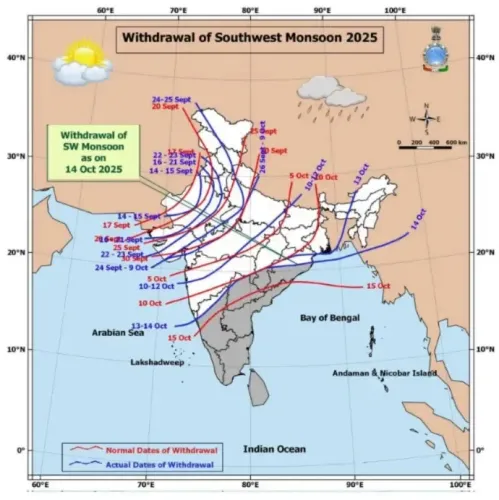
The IMD has not yet confirmed the withdrawal of the Southwest Monsoon from Northeast India as of 2 October 2026 ; last year's withdrawal date was 14 October 2025 .
The eight-state Northeastern region recorded a combined 26 per cent rainfall deficit during the June–September 2026 monsoon season.
Meghalaya logged the worst shortfall at 60 per cent , receiving only 1,077.1 mm against a normal of 2,695.3 mm .
All-India monsoon rainfall of 759.4 mm was 87 per cent of LPA — the fourth lowest since 2001 and 13th lowest since 1901 .
Rainfall over East and Northeast India combined was 1,017.1 mm , the lowest since 1901 .
Manipur's 46 per cent deficit, worsened by ethnic conflict and poor irrigation, has severely hit the Kharif cropping season.
The Southwest Monsoon has not yet withdrawn from the Northeastern region of India as of 2 October 2026, even as its retreat has already begun in parts of western India, including Rajasthan and sections of Madhya Pradesh. The eight-state region recorded a combined 26 per cent deficit in average rainfall during the four-month monsoon season from June to September 2026, according to officials of the India Meteorological Department (IMD).
Withdrawal Status and Timeline
A senior IMD official confirmed that the department is yet to formally declare the monsoon's withdrawal from the Northeast. For reference, in 2025, the Southwest Monsoon withdrew from the Northeastern region on 14 October. The IMD's operational criteria for declaring withdrawal require cessation of rainfall activity for five consecutive days, establishment of an anticyclone in the lower troposphere, and a considerable reduction in moisture content.
The monsoon had advanced into substantial parts of the Northeastern region on 7 June — two days behind its normal onset date — and covered the entire region by 10 June.
State-by-State Rainfall Picture
Meghalaya recorded the steepest shortfall among the eight Northeastern states, logging a 60 per cent deficit — receiving only 1,077.1 mm of actual rainfall against its normal of 2,695.3 mm for the June-to-September period. Manipur followed with a 46 per cent deficit, Arunachal Pradesh with 44 per cent, and Assam with 28 per cent.
Four states fared better. Sikkim and Nagaland recorded 9 per cent and 6 per cent excess rainfall, respectively, placing them in the normal category. Mizoram and Tripura recorded 19 per cent and 16 per cent deficient rainfall — technically within the normal band under IMD norms, which classify rainfall ranging from 19 per cent deficient to 19 per cent excess as normal.
National Monsoon Performance Among Worst on Record
The underperformance was not confined to the Northeast. All-India Southwest Monsoon rainfall for the 2026 season stood at 759.4 mm — 87 per cent of its Long Period Average (LPA) — making it the fourth lowest since 2001 and the 13th lowest since 1901.
Rainfall over East and Northeast India combined was 1,017.1 mm, the lowest since 1901. South Peninsular India recorded 542.0 mm, the fourth lowest since 1901 and the second lowest since 2001. Northwest India received 94.1 per cent of its LPA, and Central India — at 97 per cent — was the only major zone to record normal seasonal rainfall.
Impact on Agriculture and the Kharif Season
Agricultural scientists and IMD officials note that July rainfall is especially critical for the Kharif season, when sowing gathers momentum across the country, including in the mountainous Northeast. A senior official from the Manipur Agriculture Department said the 46 per cent monsoon deficit, compounded by the state's prolonged ethnic conflict and inadequate irrigation infrastructure, had severely affected farming. The official added that the state government had taken supportive measures to facilitate agricultural activities in both the Imphal Valley and the hill districts during the Kharif cropping season.
Notably, the IMD had earlier flagged concerns about persisting El Niño conditions while revising its seasonal forecast. Despite those conditions, meteorologists had remained cautiously optimistic that the Northeast would receive adequate rainfall before the monsoon's withdrawal — an expectation that, for several states, did not materialise.
What Comes Next
With the monsoon yet to formally exit the Northeast and the last withdrawal date on record being 14 October 2025, the region could see residual rain activity in the coming weeks. However, the cumulative deficit — particularly Meghalaya's historic 60 per cent shortfall — is unlikely to be recovered. Kharif crop assessments and any government relief or compensation measures for affected farmers in Manipur, Arunachal Pradesh, and Assam will be closely watched in the weeks ahead.
Point of View
Yet state-level contingency planning, particularly in Manipur where ethnic conflict has already crippled normal administration, appears to have lagged. The IMD's data also reveals an uncomfortable regional split: Central India escaped relatively unscathed while the Northeast bore a disproportionate share of the national shortfall. That asymmetry rarely receives the policy attention it deserves.
NationPress
2 Oct 2026
Frequently Asked Questions
Has the Southwest Monsoon withdrawn from Northeast India in 2026?
No, as of 2 October 2026, the IMD has not confirmed the withdrawal of the Southwest Monsoon from the Northeastern region. The withdrawal process has begun in parts of western India such as Rajasthan and Madhya Pradesh, but the Northeast typically sees the monsoon retreat later — in 2025, the withdrawal date was 14 October.
Which Northeastern state recorded the worst rainfall deficit in the 2026 monsoon season?
Meghalaya recorded the largest deficit — 60 per cent below normal — receiving only 1,077.1 mm of rainfall against an expected 2,695.3 mm for the June-to-September period. Manipur (46%), Arunachal Pradesh (44%), and Assam (28%) also recorded significant deficits.
How does the 2026 all-India monsoon performance compare historically?
All-India Southwest Monsoon rainfall in 2026 was 759.4 mm, or 87 per cent of the Long Period Average — the fourth lowest since 2001 and the 13th lowest since 1901. Rainfall over East and Northeast India was the lowest on record since 1901.
How has the rainfall deficit affected farming in the Northeast?
The deficit has severely impacted the Kharif season, particularly in Manipur, where a 46 per cent monsoon shortfall compounded by the ongoing ethnic conflict and inadequate irrigation has damaged agricultural output. The Manipur Agriculture Department says supportive measures have been taken, but the structural challenges remain significant.
What are El Niño conditions, and did they cause the 2026 monsoon deficit?
El Niño refers to the periodic warming of surface waters in the central and eastern Pacific Ocean, which typically suppresses monsoon rainfall over South Asia. The IMD flagged persistent El Niño conditions while revising its 2026 seasonal forecast. Meteorologists had hoped the Northeast would still receive adequate rainfall despite these conditions, but several states fell well short of normal totals.